
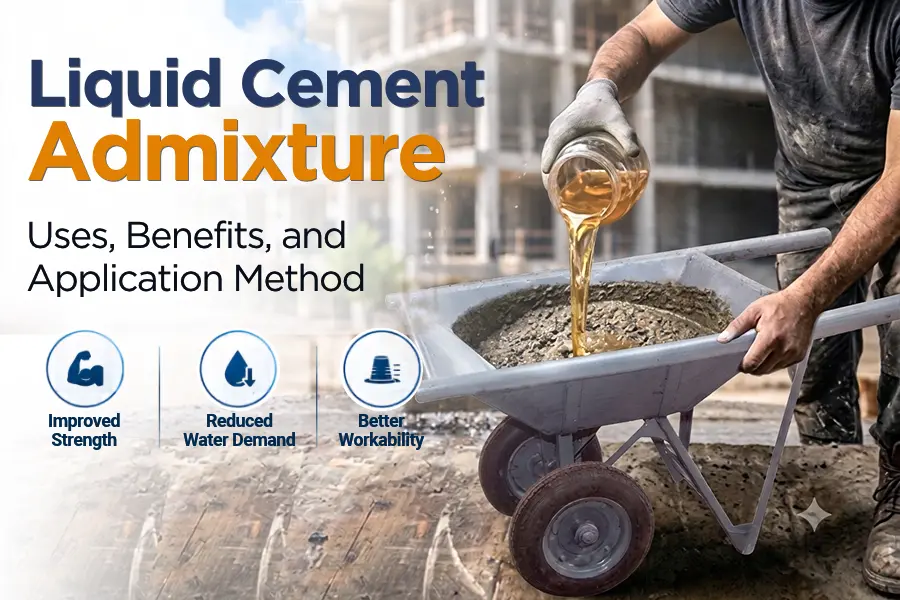
High-quality concrete is vital in the process of building strong and long-lasting structures. But the presence of cement, sand, aggregates, and water alone cannot guarantee that the outcome will be exactly as desired. Such factors as workability of the concrete, water requirement, development of strength, and exposure of the material to different environments affect the quality of concrete.
Table of Contents
The Liquid Cement Admixture steps in at this point. The admixture can change the properties of the cement mixture so that it is able to conform to certain construction requirements. From making workability easier to providing strength and durability, the proper admixture can improve construction processes.
The article discusses types, uses, and benefits of liquid cement admixtures as well as some of the solutions provided by Sakshi Chem Sciences.
What Is a Liquid Cement Admixture?
The term liquid cement admixture refers to a substance or compound added when mixing concrete or mortar in order to enhance particular properties of both the fresh and cured product.
The type of liquid admixture can affect the level of workability and the amount of water consumed, influence the curing period, and improve the durability of the material.
In general, liquid admixtures make the task of dosing and introducing them into the concrete mixture easier.
Some types of liquid admixtures are:
Water-reducing admixtures: Facilitate enough workability with less water used.
Air-entraining admixtures: Add several air bubbles.
Retarding admixtures: Control the curing period (especially in hot conditions).
Accelerating admixtures: Speed up the curing.
Superplasticizers: Reduce the amount of water and increase the fluidity of the mixture.
Key Benefits of Liquid Cement Admixture
The use of a proper liquid admixture can positively influence construction quality.
1. Enhanced Workability
The use of rigid concrete presents difficulties in terms of pumping, placing, and finishing since it can be hard to handle. The addition of some admixtures can increase workability and help with smooth handling of concrete.
2. Lower Water Consumption
Water is a crucial component in concrete, but excess water may result in an increase in porosity and reduced strength. In this case, water-reducing admixtures can be deficient in controlling the amount of water while achieving the desired consistency.
3. Improved Strength Gain
Due to their capability to control water consumption and ensure consistency with mixes, proper admixtures can help in increasing compressive and flexural strength. The real performance is dependent on mix design proportions, quality of materials, how concrete is placed, and curing time.
4. Better Durability
Some mixtures reduce the permeability of concrete and increase its durability against environmental factors (such as water). Examples of situations when such admixtures can be helpful are structures operating in wet conditions.
5. Easier Construction Operations
Improved workability and controlled setting characteristics can simplify concrete placement and finishing. This can help site teams manage construction schedules and reduce application difficulties.
Applications of Liquid Cement Admixtures
Liquid admixtures find use in residential, industrial, and infrastructure projects, depending on the formulation of each product. Liquid admixtures are mostly applicable in:
1. Reinforced cement concrete (RCC) works: Foundations, columns, beams, slabs.
2. Masonry works: Brickwork and autoclave aerated concrete (AAC).
3. Plastering: Plastering for external and internal walls.
4. Precast concrete: Concrete blocks and precast components.
5. Pavement works: Footpaths, driveways, and flooring for industrial usage.
6. Water-related structures: Sumps, vacuuming systems, or any other concrete applications.
Liquid Cement Admixture Solutions from Sakshi Chem Sciences
Sakshi Chem Sciences provides an array of concrete and cement admixture products that cater to the varying needs of construction projects.
Some of the products offered include:
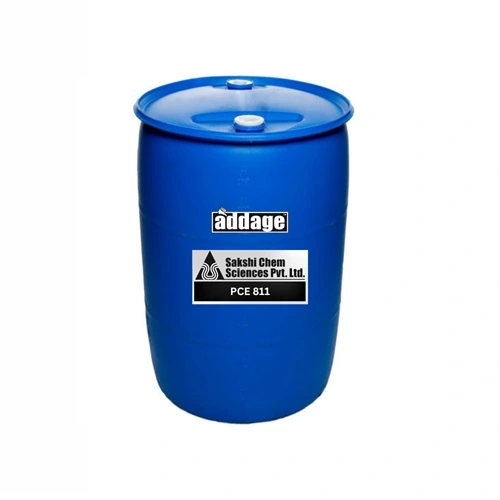
PLAST PCE 811
PLAST PCE 811 is a type of admixture from Sakshi’s admixture range. Polycarboxylate ether (PCE) technology is often utilized in high-range water-reducing admixtures to achieve better dispersion of cement particles and more workability of concrete.

PLAST PCE 816
PLAST PCE 816 is another product in Sakshi’s family of PCE-based products. Formulations based on PCE can be selected for concrete applications where controlled water reduction and workability are required.

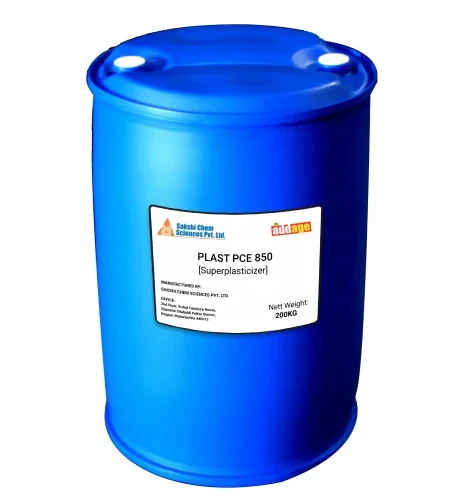
PLAST PCE 850
PLAST PCE 850 is also a product developed under Sakshi. One needs to select the proper grade based on slump, retention, compatibility, and project.
Addage Air Entraining Agent
The Addage Air Entraining Agent is a special agent specifically meant for applications where the air entrainment is controlled. Air-entraining admixtures create tiny, well-distributed air bubbles in concrete that can help resist freeze-thaw cycles in proper exposure conditions.
The necessary dosage and suitability of each product can be verified using its technical data sheet and through trials.
How to Apply a Liquid Cement Admixture?
Correct use of liquid cement admixture is very important to achieve the expected results in concrete. It helps with the workability of concrete and provides necessary properties when the right amount of admixture is used, the right mixing sequence is followed, and uniform distribution is ensured.
Stage 1: Find out the necessary amount
It is necessary to determine the right amount of liquid cement admixture. It usually depends on the amount of cement, the design of mixture, product formulation and project requirements. If necessary, refer to the manufacturer’s technical data sheet to look up the dosage information. Do not change the amount of admixture without getting clear instructions on doing it; otherwise, you can influence the workability and performance characteristics of concrete.
Stage 2: Measure the components analyzed
Measure cement and water in accordance to the approved mix design. The key to consistent and good concrete is accurate measurement. In addition, do not forget about the water contained in aggregates when calculating the amount of mixing water needed.
Stage 3: Introducing the liquid admixture
The stage of introduction of the liquid admixture should be as indicated in the instructions of the product. As per the formulation, either the admixture may need to be mixed with some mixing water or may need to be added during mixing separately. The sequence should be followed properly so that one can be assured of the efficacy of the admixture. Do not assume that the methods of addition of all types of liquid admixtures would be the same.
Stage 4: Mix thoroughly
After that, continue mixing the cement, aggregates, water, and admixture until they are mixed uniformly during the batch process. Adequate mixing will eliminate the presence of unwanted spaces in the mix, causing variations in the properties of the concrete. Follow the specified time of mixing in addition to the equipment needed according to the requirements of the project.
Stage 5: Check the fresh concrete’s workability
Before placing the concrete, assess its consistency, uniformity, and slump, where applicable. Check whether the mix meets the requirements of the intended application, such as pumping, pouring, or placement in formwork. If the concrete does not meet the specified requirements, consult the mix design and technical guidance rather than adding extra water or admixture without approval.
Stage 6: Place, compact, and cure the concrete
Once the mix is ready, place it using the appropriate method for the application. Ensure proper compaction to minimise air voids and achieve a uniform concrete structure. After placement, follow the recommended curing procedure to maintain suitable moisture and temperature conditions during the early stages of hardening. Proper curing supports strength development and helps reduce the risk of surface cracking.
A few important precautions: Always follow the manufacturer’s instructions for dosage, dilution, compatibility, and mixing sequence. Store the admixture under the recommended conditions and check its shelf life before use. If combining multiple admixtures, confirm their compatibility through technical guidance or preliminary trials.
The key is to follow the requirements of the specific product rather than assuming that every liquid cement admixture needs the same application method.
Why Choose Sakshi Chem Sciences?
Sakshi Chem Sciences Pvt. Ltd. is a well-known name with around two decades of experience in developing and providing construction chemical solutions.
The company’s extensive product line includes over 50 construction chemical solutions, including cement and concrete additives, waterproofing solutions, grouts, mold release compounds, and product repairs that can be utilized in construction projects.
With state-of-the-art R&D and a high-tech manufacturing plant, Sakshi aims to provide economical solutions for construction projects.
Along with the manufacturing of construction chemicals, its supply network has been expanded to several parts of the world, such as Africa and Europe.
Conclusion
A good Liquid Cement Admixture can increase workability of concrete, help control the amount of water used, and contribute to the strength and durability of concrete. However, this only works if it is the right use of the admixture since it requires the right formulation, proper dosage, and correct preparation.
Among all products offered by Sakshi Chem Sciences are PLAST PCE 811, PLAST PCE 816, PLAST PCE 850, and Addage completely different admixtures.
Using the right admixture in the right way can allow contractors to achieve the desired speed and consistency in concrete operations.
Frequently Asked Questions
1. What is the primary role of a liquid cement admixture?
It enhances certain properties of concrete/mortar, including workability, water requirement, setting time, and sturdiness.
2. How does PCE differ from an air-entraining admixture?
PCE admixtures work mainly by dispersing cement particles to improve workability and decrease the water requirement, while air-entraining ones add controlled air bubbles to concrete.
3. Are liquid cement additives permitted for use in RCC work?
Yes. Appropriate additives are used in RCC projects, like slabs, beams, columns, and foundations, according to the approved design mix.
4. What should I bear in mind to choose the right liquid cement additive?
You should keep in mind the concrete strength, required workability, water requirement, needed slump retention, construction conditions at the site, and compatibility with other materials.

Sagar Telrandhe is a Construction Engineer with a B.Tech in Construction Engineering & Management. Passionate about infrastructure development, project planning, and sustainable construction, he specializes in modern construction techniques, project execution, and quality management, contributing to efficient and innovative building.