
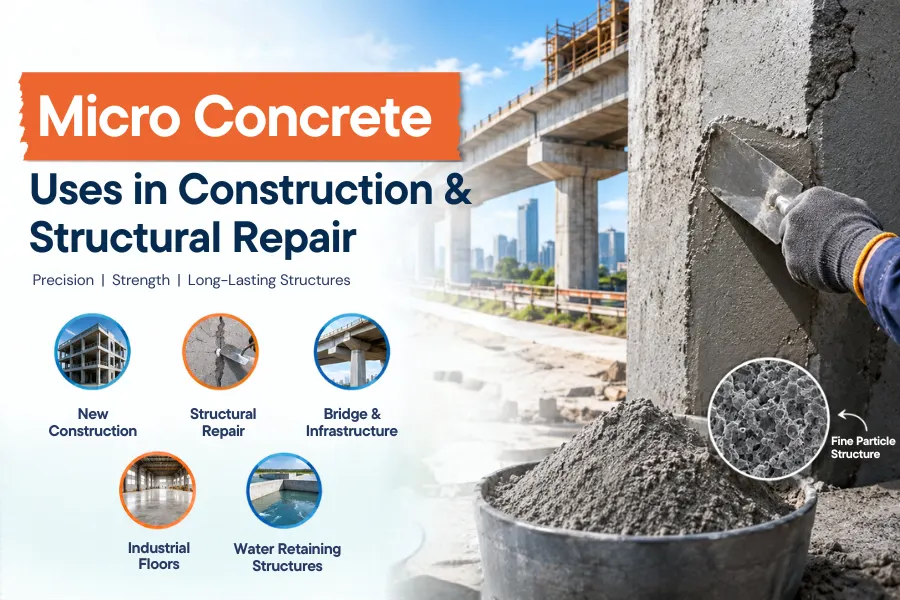
Micro concrete is an excellent alternative for repairing and improving concrete projects where conventional concrete cannot be utilized. With the use of micro concrete, even narrow spaces, highly overlapped spots, and limited-reach areas can be reached.
Table of Contents
From column jacking and beam repair to filling the voids and retaining structures, Micro concrete in construction and structural repair is a comprehensive method of restoring deteriorated concrete and enhancing the structure’s performance.
In this article, we will discuss micro concrete, its applications, benefits made use of, and the way it is applied in accomplishing repair projects.
What Is Micro Concrete?
Micro concrete is a composite mix of highly refined concrete made from cement, aggregates, and specially formulated additives. The product is particularly useful in repair situations and is designed for ease of flow, strength, and durability.
Micro concrete differs from conventional concrete as it offers several advantages in situations where normal concrete cannot be processed or compacted; it can be pumped into forms or into specific areas that need repair depending upon the formulation.
Micro concrete is routinely used in:
- Repair of RCC beams and columns.
- Filling of honeycombed surfaces.
- Repair of concrete structures and buildings.
- Repair of precast unit.
Top Uses of Micro Concrete in Construction
1. Repair and Jacketing of Columns
When RCC columns are damaged, they often need to be reinforced to ensure their structural integrity. Micro-concrete is poured in the cavity around the column during the jacketing process.
Micro-concrete is characterized by good flowability and is capable of filling all gaps around the reinforcement, which makes it a superior repair material.
2. Repair of Beams
Damaged beams may have cracks, honeycombing, and losses of material. Repair systems made of micro-concrete can be implemented to fill the damaged areas and restore the concrete profile.
Micro-concrete can flow into the areas where conventional concrete cannot be pumped.
3. Repair and Strengthening of Slabs
Concrete slabs may be cracked or have other damage due to age, exposure to moisture, or other site conditions. By using micro-concrete, it is possible to repair damaged parts of slabs in residential, commercial, industrial, and parking structures.
4. Bridge and Infrastructure Rehabilitation
Bridges, elevated roads, and dams are all built to withstand rigorous service conditions. Any restoration material to be used in these structures must ensure sufficient strength and durability.
Micro concrete can help in various restoration projects, as its flowability and operational qualities are suited for the job.
5. Industrial Floor Restoration
Industrial floors are exposed to a lot of load, wear, and tear. Any affected areas can lead to unsafe conditions and hinder daily operations.
Micro concrete is an appropriate material for repairing floors.
6. Filling in Areas of Honeycombing
Honeycombing can happen when concrete is poorly compacted, creating pockets in the structure. Untreated, such defects can damage the durability of concrete and allow moisture to get to the reinforcing bars.
Micro concrete can fill the accessible spaces and cavities and restore the affected area.
7. The repair of areas that are hard to access
One of the key benefits of micro-concrete is that it can be used to repair areas of hard access.
Micro-concrete is ideal for the following locations:
- High reinforcement.
- Limited wall forms.
- Deep repair sections.
- Limited access points in the structure.
Thanks to its fluid nature, micro-concrete easily reaches areas that are difficult to compact manually.
8. Repair of old structures and structural strengthening
Old structures may need to be repaired or reinforced due to deterioration, loading changes, and other factors.
Micro-concrete can be used in effective strengthening systems for reinforcing columns or undertaking repairs for structural elements, thus supplying the required section and operation.
9. Repairing precast elements
Precast elements are often prone to damage in the form of edges, joints, voids, etc., which can occur during the manufacturing process, when handling the units, or during installation.
Micro-concrete can be employed in specific precast repairs that need fluid cement-based materials.
10. Water-Exposed Structures
Water tanks, sewage structures, and other water-exposed concrete elements can experience cracking, deterioration, and reinforcement-related issues.
Where appropriate, micro concrete can be incorporated into repair systems for restoring damaged concrete. However, waterproofing requirements should be evaluated separately rather than assuming micro concrete alone provides complete waterproofing.
Why Is Micro Concrete Preferred for Structural Repair?
Superior Strengths
Being an appropriate type for tough repair purposes, micro concrete is a high-strength material if prepared, applied, and cured properly.
Flow abilities
Due to its fluid structure, micro concrete is able to reach even the hard–to–reach areas with no difficulty or problems.
Non-shrinkage properties
The right formulation of non-contraction materials ensures that crack occurrence is diminished in micro concrete repair applications.
Convenience
Micro concrete can either be poured or pumped into a prepared field, thus granting its applicability for various repair scenarios.
Resistance to damage
Provided that the right composition and method of repair preparation are used, micro concrete can definitely provide a reliable repair solution.
How Is Micro Concrete Applied?
A normal repair process consists of the following steps:
Surface preparation: Cleaning and removing any weak or damaged concrete.
Preparation of reinforcement: Treatment and exposing of reinforcement as required by the repair specifications.
Formwork: Providing secure and proper support to the formwork used for repair.
Mixing: Preparing the micro cement as per the manufacturer’s specifications and mixing technique.
Pouring: Using a pour or pump technique to fill the required area with the mixture.
Curing: Following the curing procedures as required for complete strength development.
It is essential to follow the necessary thickness guidelines, application technique, and curing process according to the technical information of the product used and requirements of the project.
Why Choose Sakshi Chem Sciences?
With 20 years of industry expertise, Sakshi Chem Sciences Pvt. Ltd. is a prominent manufacturer, supplier, and exporter of construction chemicals.
The company’s portfolio consists of more than 50 construction chemical solutions, including cement and concrete additives, waterproofing solutions, grouts, release agents, and products for repair and rehabilitation.
Thanks to advanced research and development facilities, state-of-the-art production technologies, and strict quality control, Sakshi Chem Sciences aims to create reliable and affordable construction chemicals for various construction needs. Furthermore, the company’s technical specialists help customers choose the most appropriate products according to their requirements.
Conclusion
Modern applications of micro concrete have gained a lot of popularity in terms of the niche applications of the material. For instance, it can be used for column jacketing and beam repairs, filling of honeycombs, making of slabs, and rehabilitation of infrastructure in construction.
The success of micro concrete in construction and structural repair is determined by the right preparation of the surface, suitable product selection, correct mixing and placement of the concrete, and effective curing. If these processes are organized properly, micro concrete can be used to rehabilitate damaged concrete.
FAQs
1. What is the purpose of micro concrete?
Micro concrete is widely utilized in structural repairs, reinforcement of columns using jacketing applications, repairs of beams and slabs, fixing of honeycombs, and strengthening purposes.
2. Is micro concrete good for column jacketing?
Micro concrete is safely used in column jacketing since its flowable nature enables it to fill the confined spaces surrounding steel reinforcement.
3. Is micro concrete used for honeycomb treatment?
Using the right formulation of micro concrete enables its use in honeycomb treatment and void filling once the damaged concrete is prepared in an appropriate manner.
4. Can micro concrete be a replacement for traditional concrete?
Micro concrete should be used only in specific situations; hence, it should not be treated as a replacement for traditional concrete. The right selection of the material should be made following the specifics of construction and application.
5. Is micro concrete a waterproof product?
Micro concrete may provide the desired results when applied correctly; however, it should not be considered a waterproofing solution.

Sagar Telrandhe is a Construction Engineer with a B.Tech in Construction Engineering & Management. Passionate about infrastructure development, project planning, and sustainable construction, he specializes in modern construction techniques, project execution, and quality management, contributing to efficient and innovative building.