
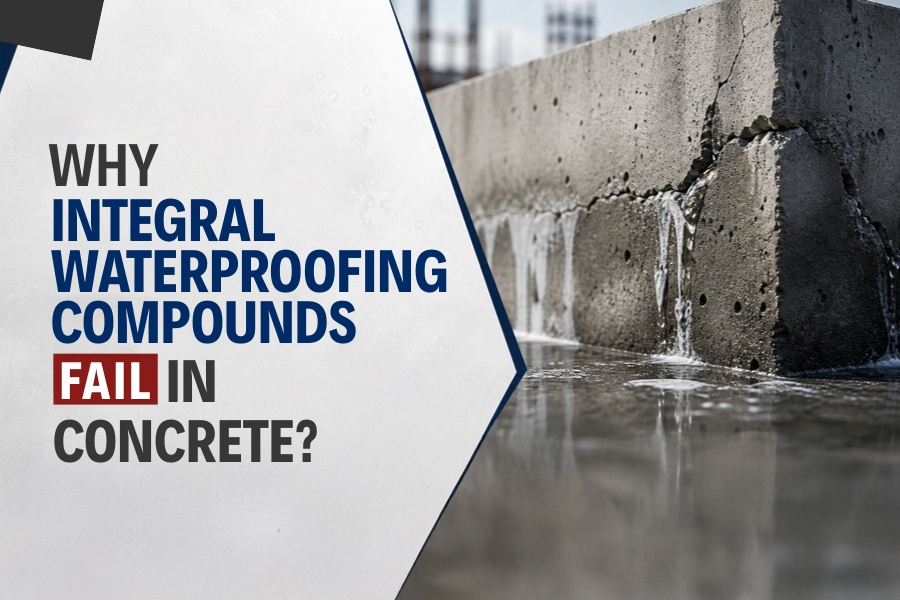
Introduction
One of the most embarrassing and expensive problems faced by builders today is the loss of concrete. Many things can be leaking, from damp basements to a faulty water tank or podium slab, and even jobsite waterproofing will not help prevent these failures from happening at times.
Table of Contents
This brings us to an important question: Why is it that integral waterproofing compounds fail in real-life situations?
On paper, these materials should reduce the permeability of concrete and prevent the entry of moisture; however, the industry is still seeing many failures of these materials, although they do not necessarily represent failure of the actual waterproofing product, they may reflect a design flaw in the mixing or poor construction practices.
At Sakshi Chem Sciences Pvt. Ltd., we are committed to providing quality construction chemical products; however, we also recognize that the ultimate performance is determined by the way in which those construction chemicals are used. Let’s take a look at the reasons for the failure of these products and methods for avoiding them.
What Integral Waterproofing Compounds Are Manufactured To Do?
Integral waterproofing compounds are concrete or mortar materials that are added directly to the material being mixed. An integral waterproofing compound will work to enhance the internal structure of the concrete by:
(1) Reducing capillaries in the concrete.
(2) Reducing the ability of water to penetrate into the concrete.
(3) Increasing the density of the concrete.
(4) Increasing the ability of the concrete to resist penetration by water.
When applied properly, the usage of these products will form a stronger and more durable concrete matrix than would be achieved without the addition of the integral waterproofing compound, but they will not remedy poor-quality concrete as a result of being utilized as part of a poorly designed system.
Why Integral Waterproofing Compounds Fail in Concrete
Understanding what goes wrong with Integral Waterproofing Compounds necessitates an examination of real-world issues that occur on-site.
1. Water to Cement Ratio
The most common cause of failure is excessive water in the mix.
What happens?
- Larger pore sizes and capillaries form.
- Concrete becomes more porous.
- Strength is reduced.
Even the best waterproofing cannot prevent the formation of the large pore networks which will be created as a result of excessive amounts of water.
Solution: Control water-to-cement ratios; use water-reducing admixtures if necessary.
2. Incorrect Amount of Waterproofing Compound
Another important consideration for performance is the amount of waterproofing compound used.
Underdosing will lead to:
- Insufficient pore blocking.
- Uneven waterproofing.
Overdosing will cause:
- A disturbance to the process of cement hydration.
- A reduction in strength.
- Surface Deficiencies.
Most failures occur due to site teams estimating dosages of waterproofing compound rather than measuring accurately.
Solution: Measure and always follow the dosage recommendations from the manufacturer.
3. Poor Concrete Mix Design
A good concrete mix design will be the basis of any waterproof concrete.
Common mistakes in mix design include:
- Poorly graded aggregates.
- Lack of fine aggregate.
- Low cement content.
These conditions will produce internal voids that no waterproofing compound can seal.
Solution: Use a well-designed concrete mix with properly graded aggregates and an adequate amount of cement paste.
4. Inadequate Compaction
- Inadequate Compaction.
- Even a good mix can fail when the compaction is poor.
What happens:
- The air voids remain trapped
- Honeycombing
- Weak areas
These defects are direct channels for water.
Important to note: nothing, not even a waterproofing compound, can make up for poor compaction of concrete.
The solution to this problem is to properly vibrate and compact the concrete at the time of placement.
5. Improper Curing Practices
The curing process is paramount for the hydration of concrete and refining the porosity.
Poor curing results in:
- Micro-cracking.
- Incomplete hydration.
- Concrete that is weak and permeable.
- Waterproofing compounds cannot function properly without sufficient curing.
- The solution is to keep the curing constant, especially when it is hot and dry.
The Role of Supporting Systems
In some cases, additional systems such as crystalline waterproofing admixtures are used.
These systems:
- Create crystals in the pores.
- Seal micro-cracks over time.
- Deliver long-term protection.
However, even with an advanced system, the functioning is directly dependent upon:
- Proper mix design.
- Controlled water content.
- Good compaction.
- Sufficient curing.
When these items are not provided, the performance will be compromised.
Common Site Mistakes That Lead to Failure
Many failures occur because of normal site practices:
- Adding water to improve workability.
- Changing cement suppliers without testing for compatibility.
- Re-tempering with water after the initial set.
- Failing to vibrate in congested areas of reinforcement.
How to Prevent Waterproofing Failures?
To avoid issues and ensure long-term performance, follow these key practices:
- Maintain a controlled water-cement ratio.
- Use water-reducing admixtures where required.
- Measure the waterproofing compound dosage accurately.
- Ensure proper aggregate grading.
- Perform thorough compaction.
- Follow proper curing procedures.
A disciplined approach ensures that waterproofing compounds perform as intended.
Practical Checklist for Site Engineers
When working with concrete, use the following checklist to help ensure better onsite control:
- Confirm Mix Design before Batching.
- Take Accurate Measurements of Dosages.
- Do Not Add Water to the Concrete at the Jobsite.
- Ensure Continuous Vibration when Placing Concrete.
- Examine the Concrete for Quality Following Removal of Formwork.
- Observe Curing Times.
Most of the time, failing to properly supervise and/or pay attention will lead to failure of concrete structures due to incorrect placement of the concrete.
Why Choose Sakshi Chem Sciences Pvt Ltd
Sakshi Chem Sciences Pvt Ltd. has a variety of high-quality construction chemicals available to ensure that you have the consistency in performance that you can rely on.
Some of the strengths of Sakshi Chem Sciences Pvt Ltd are:
- Over 20 Years of Experience in the Industry.
- Highly Advanced Research and Development of NEW Products.
- Severe and Rigorous Quality Control of Our Products.
- Constructed a Large Amount of Admixtures and Waterproofing Products.
- Strong International Footprint.
We do not just sell products to you; we provide you with the knowledge to make sure you have success using our products.
Conclusion
So what is the cause of Failure when using Integral Waterproofing Compounds?
The cause is NOT in the product you are using, but rather how the concrete you made was designed, mixed, placed, and cured.
The main factors affecting the success of Integral Waterproofing Compounds are:
- Excessive Water in the Mix.
- Incorrect Mix Design.
- Poor Compaction.
- Incorrect Amount of Admixture added to the Concrete.
- Insufficient Curing Time.
If proper procedures are followed when using Integral Waterproofing Compounds, dense, durable, and leak-proof concrete will be achieved.
With reliable solutions from Sakshi Chem Sciences Pvt. Ltd., combined with disciplined site practices, you can achieve long-lasting waterproof performance.
Because in construction, true waterproofing starts with getting the basics right.
FAQs
1. Can integral waterproofing compounds stop leaks in honeycombed concrete?
No. Honeycombing creates direct voids that waterproofing compounds cannot seal. Proper compaction is essential.
2. Does adding more waterproofing compound improve performance?
No. Overdosing can disturb cement hydration and reduce concrete quality.
3. Why is curing important for integral waterproofing?
Curing ensures proper hydration and pore refinement, allowing the compound to work effectively.
4. Can crystalline waterproofing replace integral waterproofing compounds?
They serve similar purposes but work differently. Both require proper mix design and site practices.
5. What is the biggest cause of waterproofing failure?
Adding excess water at the site is the most common reason for failure.

Sagar Telrandhe is a Construction Engineer with a B.Tech in Construction Engineering & Management. Passionate about infrastructure development, project planning, and sustainable construction, he specializes in modern construction techniques, project execution, and quality management, contributing to efficient and innovative building.