
Introduction
Concrete is a popular material used in construction due to its strength and durability. However, one limitation that is less obvious is that concrete is a porous material, and therefore, water can seep in through small cracks and pores over time.
Even the strongest concrete can allow this process to happen through small cracks and capillaries, which lead to extensive damage over a long period of time.
Table of Contents
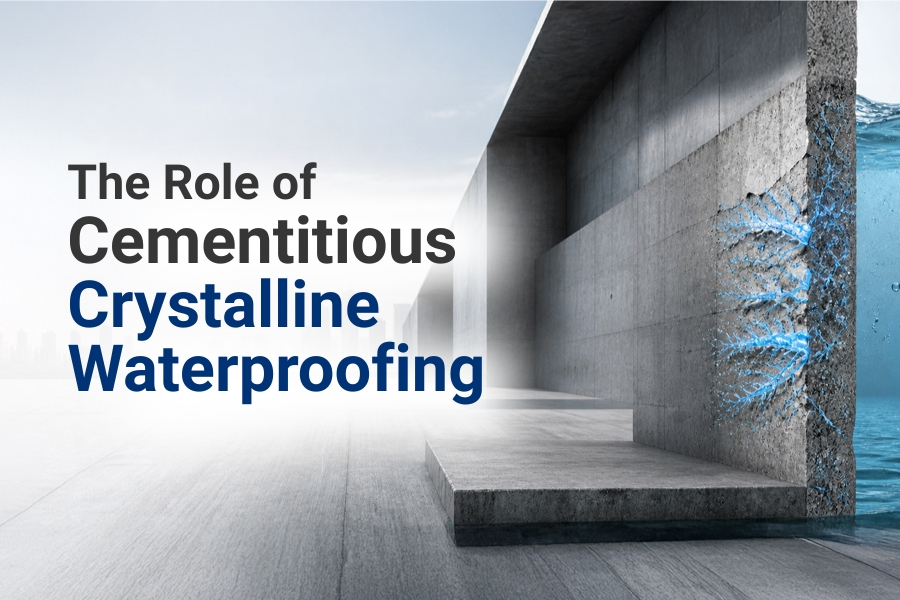
Cementitious Crystalline Waterproofing is a unique product that works internally within the concrete structure to create long-lasting resistance to water and chemical intrusion throughout the entire structure, rather than just being a surface application.
At Sakshi Chem Sciences Pvt Ltd., we focus on advanced waterproofing solutions designed to improve the durability, maintenance, and life of structures. In this blog, we will be discussing the role of Cementitious Crystalline Waterproofing in modern construction, how it works, and its benefits.
The Problem – Why does Concrete Need Waterproofing?
Concrete has microscopic pores and capillaries created during the hydration process, allowing for:
- Water infiltration.
- Chemical intrusion.
- Corrosion of the steel reinforcement.
- Cracking of the finished surface.
Over time, this creates a deterioration of the structural integrity of the concrete and increases the ongoing maintenance of it.
Traditional waterproofing systems are typically surface coatings that can wear away or tear, or they can become damaged. Cementitious Crystalline Waterproofing is the type of product that creates an internal waterproof barrier.
What is Cementitious Crystalline Waterproofing?
Cementitious Crystalline Waterproofing technology utilizes specially designed chemical compounds that react with both water and unhydrated cement particles in concrete.
The resulting chemical reaction produces insoluble crystalline compounds to:
- Assist in penetrating into the concrete matrix.
- Seal all of the pores and capillaries present within the concrete.
- Block water movement.
This is not simply a surface coating, so it will become a permanent addition to the concrete materials.
How It Works?
Cementitious Crystalline Waterproofing is applied easily through a very simple and efficient water-blocking process.
1. The product can either be applied on top of the concrete or it can be blended into the mix of dry cement and aggregates, depending on your specific needs.
2. When the product contacts water, it will also begin chemically reacting with the cement particles within the concrete.
3. The chemical reaction will create needle-shaped crystals that grow in size and fill in all of the pores and capillaries located within the concrete.
4. The created needle-like crystalline structure will block all of the pathways for water, thus making the concrete impermeable to water.
5. One of the most beneficial features of Cementitious Crystalline Waterproofing is its ability to “self-heal” any newly formed micro-cracks caused by water. The presence of water will reactivate the chemical reaction, automatically sealing any newly created micro-cracks.
Key Applications
Cementitious Crystalline waterproofing is considered one of the most effective solutions for a variety of commercial and industrial applications, including:
1) Foundations and Basements
Constructed below ground, all foundations and basements have a high likelihood of experiencing wetting from groundwater as a result of hydrostatic pressure. Applying cementitious crystalline waterproofer on these types of structures will provide long-term protection against hydrostatic pressures.
2) Fish Tanks and Water Reservoirs
The chemical composition of cementitious crystalline materials allows them to be bonded to all cement-based materials, which will offer continued physical barriers between the wall and floor surfaces to prevent leakage from the walls or floors of water storage facilities, and to eliminate the risk of water contaminating food products.
3) Tunnels & Underground Structures
Both tunnels and underground structures are constantly subjected to the moisture generated from water springs as a function of weather conditions. Applying cementitious crystalline waterproofing will protect the structural integrity and operational performance of the structures, even with a constant supply of excess moisture present.
4) Parking Garages & Industrial Floors
Parking garages and industrial floor areas are constantly exposed to water, chemicals, and physical abuse. Cementitious crystalline waterproofing creates an additional layer of protection around the floor and parking garage systems that will help to extend the life of both systems.
Benefits of Cementitious Crystalline Waterproofing
1. Internal Protection
In contrast to surface coverings, it protects the concrete from within by providing long-lasting protection.
2. Self-Sealing Capabilities
By allowing the product to reactivate itself and seal any micro-cracks, this contributes to longevity and lower maintenance costs.
3. Resistance to Hydrostatic Pressure
Withstands water pressure from both above and below ground level; therefore, it is suitable for use in all types of below-ground construction.
4. Extended Life Span
It becomes a part of the concrete and, as such, will not peel, wear out or degrade as quickly. 5. Reduced Maintenance Cost.
Fewer repairs and a longer life span will provide significant savings over time.
Cementitious vs Traditional Waterproofing
| Feature | Traditional Waterproofing | Cementitious Crystalline Waterproofing |
| Protection Type | Surface-based | Internal + surface |
| Durability | Can wear off | Permanent |
| Crack Handling | Limited | Self-healing |
| Maintenance | High | Low |
| Resistance | Moderate | High |
The comparison above demonstrates what an increasing number of individuals in the building community are recognizing: that Cementitious Crystalline waterproofing is fast becoming the most popular method for waterproofing structures.
Factors That Affect Performance
To ensure that your waterproofing product performs at its best, the following factors must be considered:
Quality of the Concrete: Properly formulated concrete mixtures reduce permeability.
Application Method: Applying the product properly and uniformly will help ensure correct operation.
Curing Method: Using an appropriate curing method will enhance the performance of your product.
Environmental Conditions: The product must be activated by moisture before it will function effectively.
The overall configuration of your waterproofing system will provide you with the best possible results.
Why Choose Sakshi Chem Sciences Pvt. Ltd?
Sakshi Chem Sciences Pvt. Ltd. has combined innovation, quality, and reliability to provide cutting-edge construction chemical solutions.
What Makes Us Unique?
Over 20 years of experience in the construction chemicals industry.
Advanced Research and Development capability to develop new products.
Stringent Quality Control procedures
Comprehensive product offerings that accommodate all different types of construction chemical applications.
Global Presence
Our Cementitious Crystalline waterproofing products create long-term protection, are easily applied, and can be used consistently in all climates.
Technical assistance is available to help you select and apply the proper type of product for your project.

Conclusion
Waterproofing is more than the simple protection of concrete; it is an expression of preservation for the strength, durability, and useful life of an entire structure.
Cementitious Crystalline waterproofing products represent an innovative and superior method for waterproofing. They hydrate the internal structure of concrete by sealing pores in the cement paste, thus providing long-term resistance to both water and chemicals.
As construction demands continue to evolve, choosing the right waterproofing solution becomes essential. With trusted products from Sakshi Chem Sciences Pvt. Ltd., you can ensure stronger, more durable, and more reliable structures.
Because in construction, true strength comes from protection that lasts from the inside out.

Sagar Telrandhe is a Construction Engineer with a B.Tech in Construction Engineering & Management. Passionate about infrastructure development, project planning, and sustainable construction, he specializes in modern construction techniques, project execution, and quality management, contributing to efficient and innovative building.