
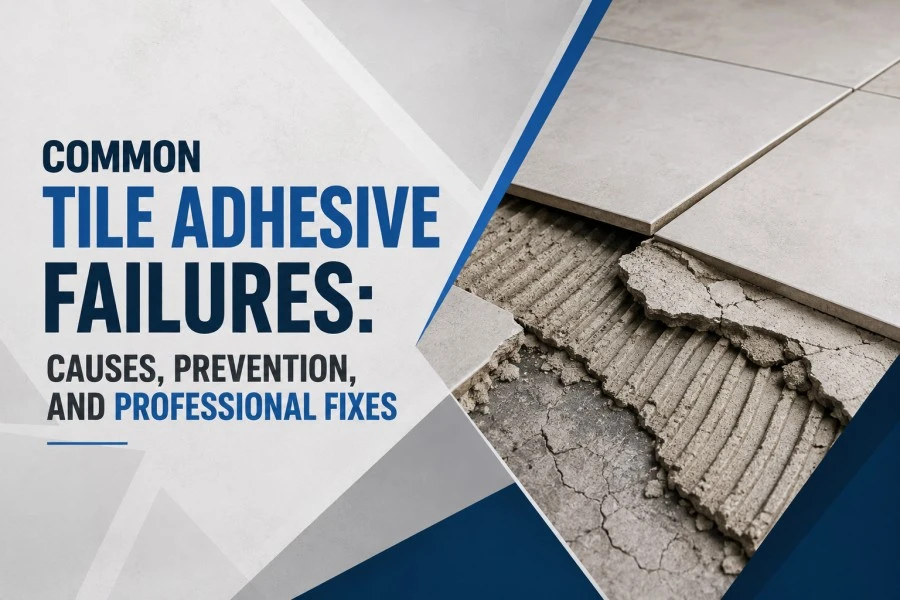
It’s possible for a tiled floor to appear immaculate and to have some problems afterward. If a tile sounds hollow after installation, it may mean that the tile itself is not responsible for this malfunction. Instead, the issue might be somewhere beneath the tile.
Table of Contents
The feasibility of understanding the problems with tile adhesive in order to avoid them is something every contractor, tiler, manufacturer, architect, and other project stakeholders should be aware of because they can do something to prevent the majority of problems.
Tile adhesives are more than just a mixture of sand and cement. They can contain cellulose additives, polymers, fillers, and other components, including those that enhance performance qualities. The use of RD Powder for Tile Adhesive can be beneficial when the right grade is chosen and correctly produced.
What Causes Tile Adhesive Fail?
The malfunction of tile adhesive doesn’t occur for one reason only. Commonly, there are several reasons that contribute to this problem.
Some typical reasons are:
- Unsuitable and defective substrate.
- Choosing the wrong adhesive.
- Selecting incorrect water-to-powder ratio.
- Not using enough adhesive.
- Too much adhesive thickness.
- Using adhesive for a longer period of time than prescribed.
- Not mixing adhesive properly.
- Applying the tile or moving too early.
- Too much humidity present in the air.
- Changes in temperature.
- Movement of substrate or structure.
- The system is unsuitable for the substrate or adhesive.
Even the best adhesive cannot compensate for poor quality of the installation work. Correspondingly, even good works are not going to give the desired results if the adhesive does not match the purpose.
What Are the Most Common Tile Adhesive Fail?
There are many ways through which tile adhesive failures manifest themselves. Some may readily be apparent while others may take time to develop.
1. Tile Debonding
Debonding happens whenever there is no bond between the tile and the substrate or the adhesive bed itself. Extreme cases may involve the detachment of tiles.
The reasons for this may include improper preparation of the surface, inadequate adhesive application, inadequate choice of the adhesive, too much movement of the substrate, and moisture issues.
2. Hollow or Drummy Tiles
When there is a hollow sound during the tapping of the tile, then this means that there is a gap in its bottom. The presence of tiny localized voids does not mean an immediate failure, but too many areas of poor contact will have an effect on the installation.
It is very crucial when it comes to large format tiles because they need to be covered with enough adhesive to transmit loads.
3. Cracked tiles or grout
The mere fact that the tile is cracked does not mean that the adhesive in itself is faulty. It simply indicates that the substrate is moving, the movement joints are not enough, thermal expansion is occurring, or structural movement practices.
4. Edge Lifting
Tiles that begin lifting at corners or edges may be experiencing movement, inadequate adhesive coverage, moisture-related problems, or stresses caused by thermal expansion.
5. Loss of Bond Strength
An adhesive may initially hold a tile in place but gradually lose performance when exposed to unsuitable moisture, temperature, chemicals, or mechanical stresses.
6. Uneven or Poorly Supported Tiles
Inconsistent adhesive application can leave some areas well bonded while other sections remain unsupported. Over time, these weak zones can become failure points.
Why Tile Failures Usually Start Below the Surface?
In the event of a damaged or dislodged tile, it is easy to simply blame the tile. However, the obvious fault might be the last manifestation of the deep-rooted problem.
Think of your floor as a sandwich:
First layer: substrate; the second layer is adhesive applied on top of the substrate. Tile comes after adhesive; the last layer is grout.
If the substrate is dirty, adhesive cannot create a proper bond. If the adhesive is improperly prepared or mixed, its properties are affected. If there are significant voids under the tile, the loads are not distributed evenly. If the layer below the tile is moving too much, adhesive needs to compensate for that movement.
Thus, it is extremely important to determine the state of the substratum when failing a diagnosis. Your damaged tile can be replaced, but if the basic problem is not solved, the same failure is going to repeat itself.
What Is Tile Adhesive and Why Is It Important?
Tile adhesive is an advanced type of adhesive considered essential in mounting different types of tiles on the right surfaces.
Within the framework of modern tile adhesive’s design, it is possible to build in almost any performance parameter needed for a certain type of tile.
Among the parameters that can be engineered into modern tile adhesives are the following ones:
- Good adhesion
- Higher workability
- Nonsaturation
- Flexibility
- Deformability
- Better coverage
- Higher movement resistance
- Uniform behavior during application
Modern highly developed adhesive should be taken into account in cases when tile changes in size and installation method.
If considering the cases of employing large-size tiles, low-absorption tiles, outdoor installation, wet and high-traffic surfaces, special adhesives with special characteristics should be employed.
Another principle of formulation of dry-mix adhesives involves using polymers.
The Role of RD Powder for Tile Adhesive
RD Powder for Tile Adhesive, also known as Redispersible Polymer Powder or RDP, is the polymer additive that is used in various dry-mix formulations based on cement.
When blended with water, the suitable RDP grades re-disperse and contribute to the polymer phase inside the hardening of cementitious materials. Depending on the polymers’ formulation and chemistry, the RDP can help enhance properties such as flexibility, adhesion, tensile properties, workability, among others.
For tile adhesive manufacturers, it is essential to choose the right grade of RDP due to the fact that different applications require varying performance characteristics.
ADDAGE AKULPOL 3032
Sakshi Chem Sciences has developed a redispersible polymer powder called ADDAGE AKULPOL 3032, which is meant for construction dry-mix formulations that include tile adhesives as applications.
It is important to understand that ADDAGE AKULPOL 3032 is not intended to replace cement and other important components.
The properties of the final product depend on various factors, such as the composition of the formulation, type of cement, fillers, cellulose ether, additives, polymer dosage, water content, and mixing methods.
That is why the selection of redispersible polymer powder should be based on an analysis of the formulation rather than the fact that it has a more or less general description.


Common Tile Adhesive Failure Causes
1. Inadequate Preparation of the Surface
One of the greatest problems arises before mixing the adhesive.
Dust, grease, paint, loose particles, curing compounds, laitance, and other contaminants might inhibit proper adhesion between the substrate and adhesive.
The substrate needs to be:
- Clean
- Sound
- Level
- Prepared properly
- Within moisture limits defined for the adhesive
Cracks or structural problems in the substrate should also be dealt with before tiling.
Solution Provided by Professionals
Check and prepare the substrate before installation. Get rid of contaminants and loose materials, repair unsuitable areas, and apply the proper primer or preparation system when requested.
2. Wrong Adhesive Selection
Not all tile adhesives can be used in each case.
A small ceramic wall tile that will be installed indoors is different from a big porcelain tile that will be put on the floor or the outside.
The type of adhesive depends on:
- Type of tile
- Size of tile
- Weight of tile
- Substrate
- Indoor or outdoor use
- Wet or dry conditions
- Expected traffic
- Thermal movement
- Required flexibility
- Solution Given by Specialists
Choose your adhesive according to actual conditions of installation rather than purely looking for the cheapest variants or general product descriptions.
3. Inadequate Adhesive Layer
Insufficient adhesive coverage creates voids beneath the tile. These voids may cause hollow sounds and increase the risk of damage to the tile or loosening it from its base when the surface is subject to weight.
Large tiles require special attention since inadequate coverage can create big voids.
Professional Solution
Use proper trowel size and install properly. Depending on the situation and tile’s requirements, back-buttering may also be appropriate to reach better adhesion.
It is necessary to check the coverage while installing.
4. Wrong Mixing
Tile glue is a compound product. The volume of water, mixing time, and procedure are all part of the formula.
Too much water can change the glue’s physical and operational characteristics. Too little, on the contrary, will make it difficult to spread and prevent the glue not hydrate or dispersing properly.
Professional solution.
Measure water precisely and follow manufacturer’s recommendations regarding mixing.
5. Exceeding the Open Time
After adhesive has been applied to the substrate, it can be used for a predetermined period of time. That means that if tiles are installed after the adhesive has formed a skin on its surface, adhesion will not be achieved as it should.
Situations like this can often occur when installers use more adhesive than recommended.
Solution:
In order to prevent this from happening, contractors should install tiles when the open time indicated by the manufacturer has not expired. Factors affecting working time include high temperature, significant air movement, low humidity, etc.
6. Too Much Adhesive
Using a lot of adhesive does not guarantee the quality of the installation.
A very thick adhesive layer may lead to deterioration of adhesion, curing, shrinkage, and dimensional stability. It also makes it more difficult to get a uniform adhesive layer.
Solution:
Make sure to use an appropriate adhesive and trowel thickness. In case of numerous substrate irregularities, level the surface using the right material instead of just relying on the adhesive for correction.
7. Moisture-Related Issues
Moisture is highly influential in causing failures in the adhesive for tiles.
Most commonly affected areas include bathrooms, balconies, kitchens, pool areas, basements and outer walls.
Moisture can enter because of poorly-waterproofed surfaces, leaking plumbing, cracks, or drain malfunction.
Professional Solution.
The source of the moisture should be identified prior to fixing the tiles. Waterproofing and drainage issues should be dealt with right away.
8. Movement of the Surface
Concrete as well as other construction surfaces expand, shrink, settle, and change because of weather conditions and construction processes.
Should the tiles be incapable of accommodating the impact of the moving surfaces, it may lead to appearing stress that will further cause cracks and debonding in the glued tiles.
Professional Solution.
Appropriate movement joints should be used, and an adhesive system must be chosen to accommodate future movements.
9. Early Movement on the Surface
The newly installed tiles require waiting time to develop an adequate connection.
Walking, moving furniture, or using ladders on the surface may disturb the tiles earlier than the adhesive has time to set.
Professional Solution
Access to newly tiled areas must be restricted until the specified waiting period is over.
Tile Adhesive Failure Causes vs Professional Solutions
| Failure Cause | Likely Problem | Professional Solution |
| Dirty substrate | Weak bond | Proper cleaning and preparation |
| Wrong adhesive | Poor compatibility | Select application-specific adhesive |
| Low coverage | Hollow areas/debonding | Correct trowelling and coverage |
| Incorrect water ratio | Poor adhesive performance | Follow specified mixing ratio |
| Excessive adhesive thickness | Uneven drying/curing | Maintain recommended thickness |
| Exceeded open time | Reduced contact | Work in smaller sections |
| Excess moisture | Bond deterioration | Resolve moisture/waterproofing issues |
| Substrate movement | Cracking/debonding | Use movement joints and suitable systems |
| Early traffic | Tile movement | Restrict access during setting |
| Poor RDP selection | Inadequate polymer modification | Select suitable RD Powder for Tile Adhesive |
Understanding Tile Adhesive Quality Standards and Performance
Assessing the quality of a product should not solely rely on its appearance.
A tile adhesive manufacturer must have controlled raw materials, be uniform in manufacturing and testing, and maintain clarity in technical documentation.
Tile adhesives can be assessed based on standards such as EN 12004-1 and relevant but national standards.
Basic characteristics of tile adhesive are:
- Initial tensile strength
- Adhesive under water conditions
- Adhesive under heat conditions
- Open time
- Slippage
- Deformability
- Setting time
- Process ability
The testing requirements depend on the product type and applicable standard.
Common Warning Signs of Tile Adhesive Failure
Detecting matters in their early stages may avert small issues from developing into huge repair work.
The following signs could help you identify if there are issues on the tile’s surface.
Sounds
When one hears multiple hollow sounds across a larger radius, one should learn that there could be insufficient contact under tiles.
Movement
It is essential to check a tile “give way” when standing on it.
Cracks
Cracks appear due to movement and inadequate installation of grout, as well as due to stress.
Lifting of Edges
If edges or corners of tiles begin raising, it means that movement has occurred, as well as poor bonding, excess moisture, or installation problems.
Cracks in Tiles
Cracks may be caused by lack of support under the tile, movement of a construction structure, shock, or pressure.
Debonding
If there have been problems with the same tiles replaced several times at the same location, it means that the main issue has not been covered.
Professional Fixes for Failed Tile Adhesive
Diagnosis comes first in making repairs.
Merely laying new adhesive on the already defective adhesive surface is not a solution that could be classified as anything approaching the correct one.
Step 1: Remove the damaged tile/s
Be cautious when removing loose and/or damaged tiles and check the tile’s back and substrate for damage.
Step 2: Check the glue
Examine different parts of the glue. Did it come off from the tile? Did it come off from the substrate? Is it still connected to one of the surfaces?
This information will help to understand how exactly the failure occurred.
Step 3: Examine the base
Look for cracks, moisture, pollution, weak areas, and movement.
Step 4: Get rid of any cause of the problem
Clean the substrate, fix cracks, arrange waterproofing, improve surface preparation, and change installation methods if needed.
Step 5: Use the right glue
Select the glue based on the type of tile, substrate, environment, and working conditions.
Step 6: Install the tile
Follow the manufacturer’s mixing, application, coverage, open-time, and curing recommendations.
Why Prevention Is Better Than Repair?
It is easier to prevent tiles from failing than to fix them once they have. Tile failures may require:
- Taking off damaged tiles
- Taking out old adhesive
- Fixing substrate again
- Buying replacement tiles
- Putting tiles back
- Regrouting
- Cleaning area
Possibly closing the place during the repair work.
The total cost is not just about the materials. The price that comes from labor, closing work, and inconvenience might be more than the price of installation.
Conclusion
Failures of common tile adhesive occur for reasons that can be articulated. This is usually related to several identifiable factors that include inadequate preparation of substrate, faulty adhesive selection, insufficient coverage, improper mixing, early traffic, moisture, movements of substrate, and improper curing, among others.
However, the good news is that most of these problems can be eliminated.
For tile adhesive companies, the formulation quality is as significant as the selection of raw materials. The right raw material choice, such as RD Powder, can ensure the production of polymer-modified systems which have been known to perform well. A well-known product in this category is ADDAGE AKULPOL 3032 manufactured by Sakshi Chem Sciences.
But for installers, even the best adhesive will behave properly only if it has been mixed, applied, and cured properly.
It is best to follow the rule of thumb: prepare the substrate, select the proper adhesive, follow the directions given by the producer, obtain the desired level of coverage, and wait until the installation is sufficiently strong.
Frequently Asked Questions
1. What are the most frequent failures in tile adhesive?
The failures are tile debonding, hollowness, cracked grout, tile shifting, edge risings, poor adherence, and premature failure.
2. Why do tiles get loose after being laid?
Loose tiles can be attributed to insufficient substrate preparation, improper adhesive coverage, wrong adhesive choice, wrong mixing, humidity, substrate shifting, or premature loading.
3. Can bad mixing imply the failure of adhesive?
Yes. If too much or too little water is added during the mixing process, this can affect the properties of the adhesive.
4. Why can tiles sound hollow after laying?
Hollowness of tiles can be due to insufficient coverage by adhesive or the existence of air pockets that are formed under the tile. It can depend on the number of air voids and their location.
5. What is Redispersible Powder in Tile Adhesive?
Redispersible Powder is a polymer additive for dry-mix cement formulations that can help achieve better adhesion, flexibility, and ease of application.

Sagar Telrandhe is a Construction Engineer with a B.Tech in Construction Engineering & Management. Passionate about infrastructure development, project planning, and sustainable construction, he specializes in modern construction techniques, project execution, and quality management, contributing to efficient and innovative building.