
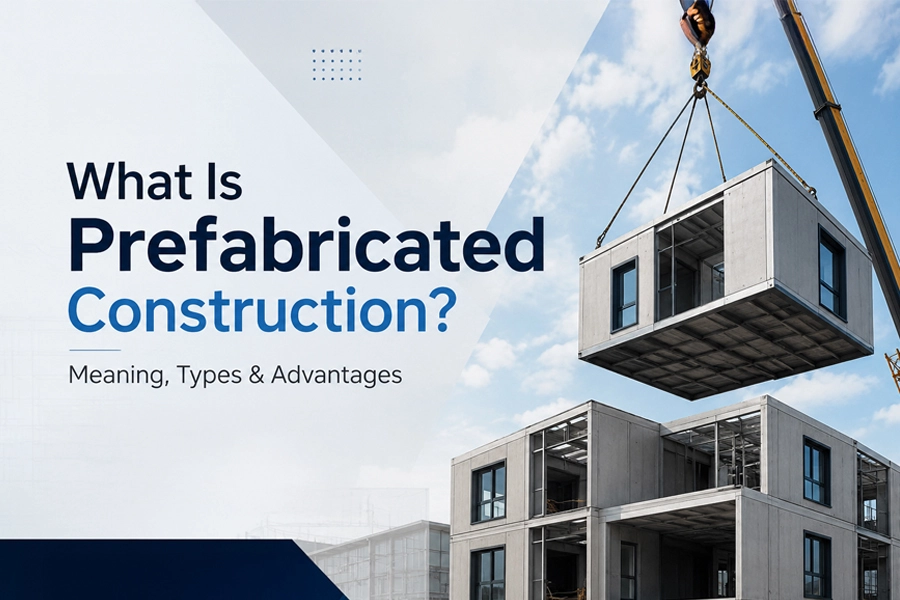
The way we build structures has changed dramatically over the years, with improvements in technology and tools. Builders have developed new strategies to help complete their projects more quickly without sacrificing the quality of the final product. One such option for builders to enhance their productivity is through the use of Prefabricated Construction.
Table of Contents
Prefabrication has revolutionized how facilities, from homes, workplaces, and hospitals to factories, are created. Moving a significant part of the construction process from the construction site to a factory allows for a more efficient and consistently produced project to be completed. This allows for both economic and timely completion of the building.
What is Prefabricated Construction?
Prefabricated Construction refers to a manufacturing process for a building where the structural elements of the building are constructed at a factory off the construction site. Structural elements of the building such as walls, slabs, beams, and columns are constructed in a controlled environment, and then, when they are completed, are transported to the construction site for assembly.
This method and manufacturing process enhance the overall quality of the finished product, decrease the time to construct the building, and minimize the amount of material wasted during the construction process.
Many people think that prefabricated buildings are temporary structures; however, they are built to the same quality, strength, durability, and safety standards as conventional buildings.
Why Is Prefabricated Construction Growing in Popularity?
The construction industry has many challenges, including labor shortages, weather-related delays, material waste, and inconsistent quality in workmanship. Prefabricated Construction helps overcome many of these issues.
Manufacturing and site preparation often simultaneously reduce the amount of time required to complete a project because less time is needed to build each component in a factory before bringing it to the job site for use in the final assembly or installation.
Additionally, producing prefabricated components in a factory setting allows for greater accuracy and consistency through rigorous quality control. As a result, fewer mistakes are made during construction, resulting in reduced rework.
As global urbanization is increasing and project schedules are becoming tighter, prefabrication is a practical alternative to meet the construction needs of today.
How does Prefabricated Construction Work?
For the most part, prefabricated construction follows a step-by-step process:
1) Design and planning are completed.
2) Pre-manufacturing of structural systems occurs in a factory.
3) Site preparation of foundations occurs.
4) Transport prefabricated items from the factory to the site.
5) Lift and assemble prefabricated items using a crane and specialized equipment.
6) Finish all joints and connections.
7) Complete final finishing work.
Prefabricated construction systems offer the fastest method of project completion compared to traditional construction methods because of an accelerated workflow.
Examples of Prefabricated Construction Systems
1. Prefabricated Concrete Construction
Prefabricated concrete construction is the most common form of prefabricated construction used in India. Various precast members (beams, columns, slabs, staircases, wall panels) are produced prior to the beginning of the construction project and then assembled at the job site.
This method has multiple applications, including, but not limited to, commercial buildings, residential offerings, parking structures, and infrastructure developments.
2. Steel Framing Systems
Steel components are fabricated in a factory, shipped to the project site and ready to install. All of the steel framing systems are manufactured to an extremely high level of accuracy, strength and speed of construction compared to traditional framing methods.
Steel prefabrication is widely used in industrial buildings, warehouses, and commercial projects.
3. Panelized Construction
In this system, wall panels, roof panels, and floor sections are produced off-site and assembled at the project location.
Panelized systems are often used in residential projects due to their simplicity and efficiency.
4. Modular Construction
Modular construction involves manufacturing complete building modules in a factory. Entire rooms, bathrooms, or living units are transported and assembled at the site.
Hotels, hospitals, student housing, and temporary facilities commonly use this approach.
5. Sandwich Panel Systems
These panels consist of two outer layers with insulation material in between. They provide excellent thermal performance and are frequently used in industrial and commercial structures.
Advantages of Prefabricated Construction
Completing Projects Faster
Speed is one of the top benefits of Prefabricated Construction. Working on-site and assembling components at the facility will reduce the time required for overall construction.
Quality Control
Using factory-controlled manufacturing allows for consistent quality assurance throughout the process. Between the use of advanced machinery and quality control guidelines throughout production, each component can be manufactured to a higher degree of accuracy than traditional construction methods provide.
Less Waste
Traditional construction can often result in large quantities of material being disposed of as waste. Prefabrication allows for materials to be used in a way that minimizes the amount of waste generated during the construction process.
Fewer Workers
Most of the prefabrication work occurs in factories, which means that there are fewer individuals at the job site to complete the construction work. This reduces the excess time it takes to finish a project due to a shortage of laborers and also makes prefabricated construction more efficient.
Greater Safety
Factory environments are usually safer than active construction sites where there are multiple types of work being performed simultaneously and at different times of the day. Since the amount of work has been reduced at a job site because of prefabrication, there will be fewer accidents and injuries to construction workers.
Sustainable
Using prefabrication practices will reduce the amount of waste generated from construction jobs, allowing for reduced material consumption and lower overall environmental impact from these projects.
Applications of Prefabricated Construction
Prefabricated construction is being utilized in many different industries today. A few examples of some of the sectors currently employing prefabrication include:
- Residential housing projects.
- Multi-family housing buildings.
- Hospitals and medical facilities.
- Schools and universities.
- Manufacturing companies and warehouses.
- Metro stations and transit-related infrastructure.
- Shopping malls, business centres, etc.
However, these examples represent only a small slice of the total types of developments that can benefit from the flexibility and efficiency provided by prefabrication.
Conclusion
Prefabricated Construction is transforming the construction industry by offering a faster, more efficient, and higher-quality alternative to traditional building methods. By manufacturing structural components in controlled factory environments and assembling them on-site, builders can reduce project timelines, minimize waste, and improve overall quality.
As cities continue to expand and infrastructure demands increase, prefabrication is expected to play an even greater role in modern construction. With the right materials, planning, and construction chemicals from trusted partners like Sakshi Chem Sciences Pvt Ltd, prefabricated structures can deliver long-lasting performance and exceptional value.
FAQs
1. What is prefabricated construction in simple terms?
It is a construction method where building components are manufactured off-site and assembled at the project location.
2. Is prefabricated construction durable?
Yes. When designed and installed correctly, prefabricated structures offer durability comparable to traditional construction.
3. What materials are used in prefabricated construction?
Common materials include concrete, steel, timber, sandwich panels, and composite materials.
4. Is prefabricated construction faster than traditional construction?
Yes. Manufacturing and site preparation occur simultaneously, significantly reducing project timelines.
5. Where is prefabricated construction commonly used?
It is widely used in residential projects, hospitals, industrial buildings, educational facilities, and infrastructure developments.

Sagar Telrandhe is a Construction Engineer with a B.Tech in Construction Engineering & Management. Passionate about infrastructure development, project planning, and sustainable construction, he specializes in modern construction techniques, project execution, and quality management, contributing to efficient and innovative building.