
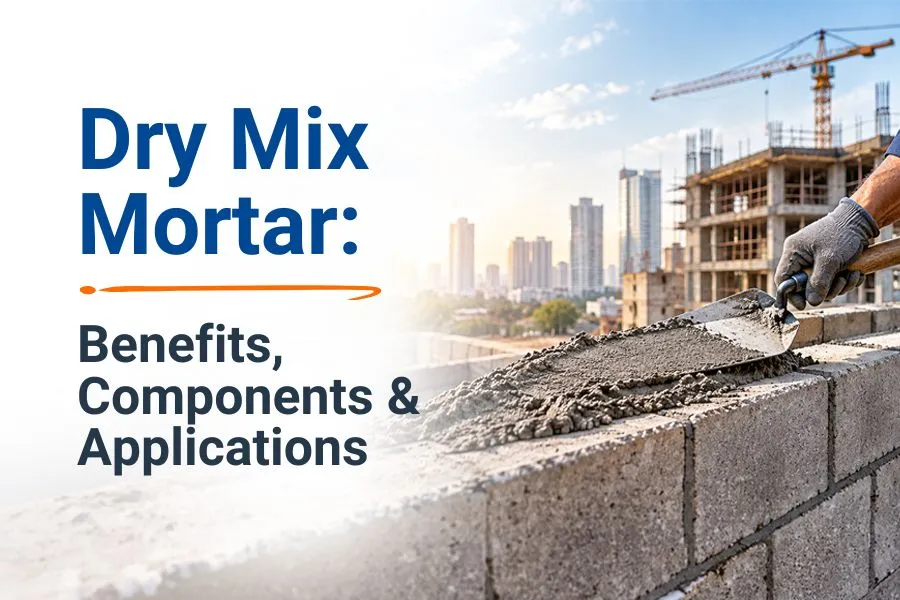
Modern construction relies on constantly pushing the efficiency boundaries of construction materials, and Dry Mix Mortar fits the bill. Unlike the traditional mortar mixed at a construction site, dry mix mortar is made under controlled conditions using specified proportions of various ingredients. It only calls for adding water to achieve the required consistency and application.
Table of Contents
For manufacturers and contractors, this makes for easier material handling and greater efficiency of the work processes, as well as predictable results.
What Is Dry Mix Mortar?
Dry mix mortar is a prepared mix of cementitious agents, graded aggregate minerals, fillers, and additives. All components are blended in the right proportions in a factory and delivered in dry condition.
Formulations may be tailored depending on applications. Different formulations can have different physical properties, including adhesion, water retention, plasticity, workability, and strength.
As such, dry mix mortar can be functional in a multitude of construction activities, including tile fixing, plastering, repair works, flooring, etc.
Key Components of Dry Mix Mortar
1. Binders
Cement is a widely used binding agent in the preparation of dry mix mortar. The substance interacts with water and begins to harden; consequently, its mechanical qualities increase as the dry mortar gets wet. Also, depending on the purpose, other binding agents can be utilized, for instance, gypsum or lime.
2. Aggregates
Fine aggregates, particularly properly graded sand, make up the bulk of the mortar. The aggregates provide mass and affect the texture as well as the working and mechanical properties of mortar. Aggregate grading and cleanliness are crucial in producing consistent results.
3. Fillers
Fine mineral fillers enhance particle packing and the characteristics of the final mix. Limestone, along with other appropriate mineral materials, can be used according to product specifications.
4. Functional Additives
Small quantities of chemical additives can significantly improve mortar performance. Common examples include:
- HPMC: Helps with water retention, workability, consistency, and sag control.
- RDP: Improves adhesion, flexibility, cohesion, and crack resistance.
- PCE: Supports cement dispersion and can help reduce water demand while maintaining workability.
- Starch ethers: May improve anti-sag properties and application characteristics.
- Defoamers: Help control unwanted air entrainment during mixing.
The right additives and dosage depend on the specific mortar formulation and application.
Benefits of Dry Mix Mortar
The use of factory-produced mortar provides many useful benefits:
- Uniform Quality: By means of controlled production and precise proportions, consistency from one batch to another is ensured.
- Increased Workability: Different kinds of additives improve the working process of mortar.
- Lower Waste Production: Precise batch and mixing proportions lead to fewer mistakes and lower material wastage at the site.
- Time and Labor Saving: Workers don’t have to measure each component separately, and this makes the work easier.
- Versatility of Application: There is a wide variety of formulations designed to meet different construction needs, such as adhesive mortar, plaster, repair mortars, and flooring systems.
Applications of Dry Mix Mortar
1. Tile Adhesives and Stone Fixing
The use of dry mix mortar developed for fixing tiles, porcelain, and stone is now widely accepted. Improving the properties of the mortar with the help of additives like RDP and HPMC is possible.
2. Plastering and Rendering
When it is necessary to execute plastering works both internally and externally, dry mix mortar is one of the most relevant solutions. The proper choice of aggregate grading and additives will help to apply a smooth layer and achieve good adhesion.
3. Repair Mortars
It is possible to create repair mixtures to restore concrete and masonry structures. Additives can be added to improve the properties of the mortar.
4. Self-Leveling Flooring
Dry mix mortar production is used for providing level surfaces before floor coverings are laid. It is important to control the flow of the mixture, setting, as well as water consumption.
5. Masonry and Block Joining
The dry mortar can also be applied to connect masonry items as well as blocks. Having a uniform composition helps facilitate the process of applying the mixture and obtain even joints.
Why Choose Sakshi Chem Sciences for Dry Mix Mortar Additives?
Sakshi Chem Sciences Pvt. Ltd. is a prominent manufacturer, supplier, and exporter of additives and chemicals used in construction. The company has the experience of over two decades and offers a range of over 50 products to meet various construction needs.
With the help of a state-of-the-art research and development division and advanced manufacturing system, the company produces chemicals that are effective and reliable. Each and every product goes through strict quality checks.
Sakshi Chem Sciences Pvt. Ltd has been supplying its construction chemicals to customers from Africa, the Middle East, Europe, and Southeast Asia.
Conclusion
Dry mix mortar is now essential to modern construction because it efficiently accommodates the manufacturing process alongside its simple use on the job site. In applications ranging from tile adhesives to plaster, repair applications, and flooring, one can use the appropriate recipe to achieve better consistency, usability, as well as efficiency during the application process.
With an extensive product range, research and development, quality-oriented production, and an international distribution chain of products, Sakshi Chem Sciences guarantees dependable construction chemical solutions for manufacturers who want to produce advanced dry mix mortar products.
Frequently Asked Questions
1. What is dry mix mortar used for?
It is used for applications such as tile fixing, plastering, masonry, concrete repair, and flooring.
2. What are the main ingredients of dry mix mortar?
The main components are binders, aggregates, fillers, and performance-enhancing chemical additives.
3. Why is HPMC used in dry mix mortar?
HPMC can improve water retention, workability, consistency, and resistance to sagging.
4. What does RDP do in mortar?
RDP can improve adhesion, flexibility, cohesion, and resistance to cracking in suitable formulations.
5. Can dry mix mortar be customized?
Yes. Formulations can be adjusted according to the application, substrate, required performance, and processing conditions.

Sagar Telrandhe is a Construction Engineer with a B.Tech in Construction Engineering & Management. Passionate about infrastructure development, project planning, and sustainable construction, he specializes in modern construction techniques, project execution, and quality management, contributing to efficient and innovative building.