
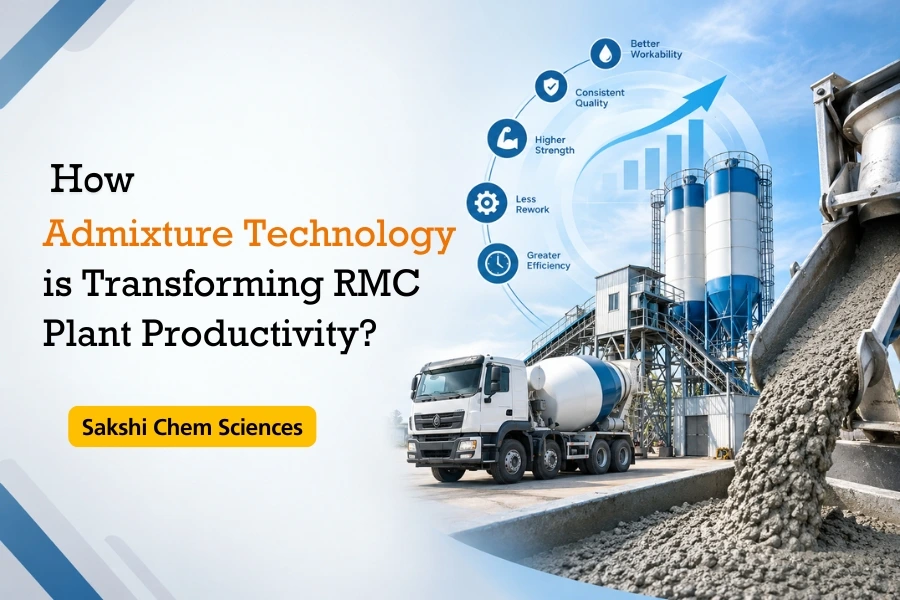
In an environment where speed, quality, and cost are important factors, ready-mix concrete plants process material from batching to the timely delivery of the finished product, and any delay may impact the entire production cycle.
Table of Contents
The difference made by Admixture Technology comes into play here. Advanced concrete admixtures give RMC producers an opportunity to manage the concrete workability, set time, demand for water, and strength at substantially higher levels. When properly selected and dosed, they enable the plants to produce much more stable concrete and improve operational performance subsequently.
Why Is Productivity a Challenge in RMC Plants?
There are multiple aspects involved in RMC production that warrant attention. The materials required for RMC production must be accurately calculated, mixed, supplied, and provided in good time. The most common challenges include:
- Lack of workability uniformity among the various mixed batches.
- Excessive water or cement used for the production process.
- Delays due to variation in setting time.
- Material wastage.
- Maintaining the quality of the material uniformly.
- Weather conditions and site limitations.
- Problems with pumping and transporting materials.
These problems lead to an increase in expenses and complications with the scheduling of RMC production.
What Is Admixture Technology?
Concrete admixtures are specially designed chemical products that are added to concrete during the mixing process to alter certain properties. Admixture technology involves using these products to obtain the desired performance from concrete while creating a better mix overall.
Depending on the formulation, admixtures can be used to:
- Reduce water consumption.
- Increase workability.
- Manage setting time.
- Create a certain strength level.
- Create durability.
- Improve concrete pumpability.
Examples of such admixtures are water reducers, superplasticizers, accelerators, retarders, and others.

The specific product to be used is chosen based on the class type of concrete, the raw materials used in manufacturing it, environmental conditions, length of transportation, and customer requirements.
How Admixture Technology Improves RMC Plant Productivity?
1. Production Process Accelerated and Enhanced
By using the right admixtures, RMC companies can create concrete mixes with desired workability using a minimum quantity of water. This means easier management of the mixing.
Setting-control admixtures can assist the concrete in preserving workability during transit or in retardation of the initial setting process, for instance, when required when using concrete for certain purposes.
2. Workability and Pumping Characteristics Improved
Workability plays a crucial role for RMC producers. In fact, concrete always travels from the mixing plant to the construction site before pouring.
The effective use of admixtures allows improving fluidity and pumpability of the concrete without excessive usage of water.
3. Improved Uniformity of Concrete
One of the greatest merits of the use of admixtures is uniformity of the product.
Separately from other admixtures, some of them serve a purpose to counteract the undesirable influence of environmental conditions, various materials, or any other elements that influence the quality of the concrete provided.
4. Optimized Usage of Water and Cement
The use of water-saving as well as high-range water-reducing agents may enable obtaining the desired workability while reducing the need for water. This could create a possibility to optimize cement-based mixtures in correlation to the necessary level of strength and durability depending on the design of the mixture and its requirements. Reductions in cement content should be established based on the knowledge of specific mixtures, rather than assuming some value for any mixture in its formulation.
5. More Efficient Working Operations of the Plant
Concrete that has better-controlled mixing processes allows for more efficient batching, mixing, delivery, and placing processes. The possibility for operating plans will improve as the predictability of concrete behavior will help the production become more efficient and protect from possible problems caused by the variability of workability of concrete.
Sustainability Benefits of Admixture Technology
The benefits of productivity and sustainability often work side by side.
Admixtures that reduce the use of excess water or improve the efficiency of cement usage contribute to the increase in the efficiency of concrete making. Cement reduction, where it is possible, also minimizes the negative impact on the environment caused by the cement production process.
High-performance concrete makes it possible to build structures of greater durability, which means that repairs or replacements will be required less frequently.
It is worth mentioning that the sustainability advantages are influenced by the entire recipe of concrete, materials used, delivery procedure, and environmental requirements.
What Can RMC Plants Achieve with the Right Admixture?
An effectively prepared admixture system provides benefits, not just for the concrete.
RMC production facilities can achieve the following outcomes:
- Constant batch performance.
- Better control over workability.
- Optimized use of water and cement.
- Less material waste.
- Smoother production and delivery process.
- Improved pumping and placement.
- Control over cure time.
- Predictability in the performance of concrete.
Such improvements allow the factories to produce materials of high quality in large volumes.
How to Choose the Right Admixture for an RMC Plant?
Choosing an admixture simply because of its name is not the best idea; rather, it should be used along with the whole composition of the concrete.
Essential criteria include:
Concrete Class and Performance
Prior to making an admixture choice, it must be known what properties like strength, durability, workability, setting, etc. are expected.
Raw Materials
The type of cement, supplementary cementitious materials, characteristics of aggregates, and quality of water used may also play an important role in the quality of the admixture.
Weather Conditions
Temperature and humidity will greatly affect the setting and workability of the concrete. The use of admixtures needs to be adjusted depending on hot or cold weather.
Transport Time
Long-distance transportation would normally require using admixtures that do not affect the quality or performance of the concrete but keep it workable for the required time.
Compatibility
The admixture has to be compatible with cement and all other components used in the concrete mix.
Technical Support
A good supplier is an essential source of formulation ideas, dosage recommendations, and related help or advice regarding the use of admixtures.
Why Choose Sakshi Chem Sciences?
Sakshi Chem Sciences Pvt. Ltd. is a leading manufacturer, distributor, and exporter of construction chemicals and additives, with 20 years of experience.
The company offers over 50 construction chemical solutions, including concrete and cement admixtures, waterproofing products, grouts, mould release agents, and repair and restoration solutions.
Sakshi combines high-capacity R&D with state-of-the-art production capabilities and strict quality controls.
Thanks to these characteristics, Sakshi’s products are known for their reliability, efficiency, and effectiveness.
The company operates a growing supply chain in many parts of the world, including the Middle East, Africa, Europe, and Southeast Asia.
Sakshi provides concrete suppliers with consulting services that help them deliver the right mixture as per specific requirements given the type of concrete.
Conclusion
The use of Admixture Technology is revolutionizing the perspective of modern RMC manufacturing companies. The application of this revolutionary technology enables the RMC producers to use different chemical admixtures to achieve desired features in their concrete.
As a result, the application of the right combination of admixtures contributes to making the concrete more workable, pumpable, and suitable in terms of water consumption and hardening rate.
Nonetheless, the proper utilization of the admixture does not boil down to merely introducing more chemicals in the production process. The successful application of admixtures requires choosing the correct product, precise dosing, compatibility tests, and mix optimization.
Sakshi Chem Sciences is a provider of a comprehensive range of construction chemicals that will surely satisfy the needs of RMC plants that want to improve the quality of their concrete mixes.
Frequently Asked Questions
1. What is admixture technology in concrete?
Admixture technology involves using specially formulated chemical additives to modify concrete properties such as workability, water demand, setting time, strength development, and durability.
2. How do admixtures improve RMC plant productivity?
They can help improve workability, optimize water demand, control setting time, reduce production variations, and support more consistent concrete performance.
3. Can admixtures reduce cement consumption?
In some mix designs, suitable water-reducing admixtures can create opportunities to optimize cement content while maintaining required performance. This should always be confirmed through proper mix design and testing.
4. Why is admixture compatibility important?
Different cementitious materials and concrete components can respond differently to admixtures. Compatibility testing helps ensure the desired workability, setting, and strength development.
5. Does one admixture work for every RMC mix?
No. Admixture selection depends on the concrete formulation, raw materials, environmental conditions, transportation time, and required performance.

Sagar Telrandhe is a Construction Engineer with a B.Tech in Construction Engineering & Management. Passionate about infrastructure development, project planning, and sustainable construction, he specializes in modern construction techniques, project execution, and quality management, contributing to efficient and innovative building.