
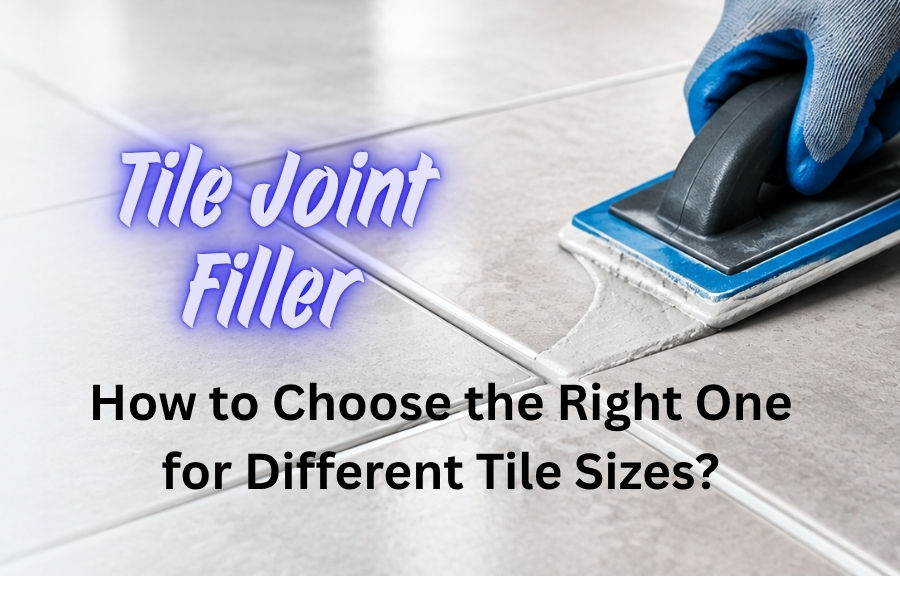
Selecting the right kind of tiles for your project is merely one part of the task of laying a finished floor. The filling material used for the joints is equally important in taking the installation to the final stage. A good tile joint filling material will help to guard the tile joints from water, soil, stains, and daily wear and tear.
Table of Contents
Nevertheless, there is no one type of filling material that can perform equally well in all situations. There are many factors that determine the nature of the filling material to be used in each case.
Why Does Tile Joint Filler Matter?
Tile joints are the spaces in between tiles but serve more purposes than that. They allow for some small differences in the size or movement while preventing dirt and moisture from building up in those spaces.
With the right filler, you can get:
- Greater joint strength.
- More moisture resistance.
- A visually more attractive and uniform appearance.
- Easier cleaning.
- Better performance and frequently better lifetime of tiled surfaces.
Choosing the correct filler will help you cope with various issues such as cracking, staining, powdering, and deteriorating joints in cases of residential, commercial, and industrial applications.
Understanding Tile Size and Joint Width
While tile size is undoubtedly an important factor for consideration regarding material selection, it is not the sole determinant. She must take into consideration factors such as the joint width requested, tile type (material), underfloor, and installation.
Small Tiles
Small tiles such as mosaics or tiles that are smaller in size are often fixed in place only using relatively thin joints.
Here, the use of an ultra-fine cementitious grout or appropriate polymerized grout can provide a neat surface.
In some aesthetic applications, where the importance of aesthetics and stain resistance is high, the use of an epoxy grout can be considered.
Medium-sized Tiles
Tiles such as 300 x 300 mm, 450 x 450 mm, or 600 x 600 mm are the most frequently used tiles in residential houses or offices.
For medium-sized tiles, it is possible to choose between different types of grouts, such as cementitious, polymerized, or epoxy, depending on the environment.
For example, the dry indoor space would not have the same grout system as the bathroom, kitchen, or any commercial restroom that is constantly exposed to moisture.
Large Format Tile
Large-format tiles, especially tiles measuring above 600 by 600 mm, are becoming more favored since they give a neater finish with fewer joints visible.
Nonetheless, the larger tile does not equal the need for a tougher grout since other aspects like the width of the joint, stability of the substrate, conditions of installation, and moisture exposure matter.
Flexible grouting systems may have to be recommended for scenarios that require better resistance to movement of the tiles. It is always prudent to confirm product recommendations against those of the manufacturers of the tile and joint.
Types of Tile Joint Fillers
Cement Grout
Cement or traditional grout is quite popular among conventional tile installations as it has certain benefits such as:
- Affordable price.
- Simple to mix and apply.
- Compatible with many residential jobs.
- Variety of shades.
- Works for various tile sizes.
However, it is important to note that traditional grout has a higher chance of absorbing water and staining than specialty grout. Thus, if an area is prone to high moisture or requires rigorous cleaning, a different solution may have to be considered.
Grout Modified with Polymer
Modification using polymers helps to attain better performance indicators in areas like adhesion, flexibility of use, workability, and resistance to cracking compared to typical cement-based formulations.
Such grouts can be used in cases where high performance is required without necessarily switching to epoxy.
Epoxy Grout
Epoxy grout is typically used in areas that require protection against moisture, stains, chemicals, and intensive usage.
It can be used in such applications as commercial kitchens, bathrooms, laboratories, swimming pools, and other high-demand environments if the product is suitable for each specific purpose.
The main advantages of epoxy grout include:
- High resistance to staining.
- Low moisture uptake.
- Good corrosion resistance.
- High durability.
- Easier cleaning in difficult environment.
However, epoxy grout usually has to be applied more carefully than ordinary cement-based grout.
How to Choose the Right Tile Joint Filler?
When choosing the proper tile joint filler, do not focus only on the size of the tiles. Pay attention to the following aspects:
1. Consider the Width of the Joint
The width of the joint determines whether you will need a type of grout suitable for narrow joints or wider ones. Always use a product that has a recommended width corresponding to the actual width of the joint.
2. Think About Moisture Exposure
Wet areas such as kitchens and bathrooms have to be treated differently due to the requirement for better water resistance.
In cases like this, using polymer-modified or epoxy grout rather than cement-based grout can be beneficial.
3. Evaluate the level of Traffic and Use
Although joint fillers for bedrooms, hotels, factories, or shopping might look the same, they will be used in different conditions.
Grout for areas with a larger flow of people will have to be more durable and easier to maintain.
4. Pay Attention to the Type of Tile
Natural stone, ceramic, porcelain, glass, etc. may have different specifications and compatibility with grout.
5. Think About Maintenance
If easy cleaning is a priority, especially in commercial or wet environments, a low-absorption grout can be advantageous.
6. Match the Colour and Finish
Grout contributes significantly to the appearance of a tiled surface. A contrasting colour can emphasize individual tiles, while a matching shade creates a more seamless appearance.
Does Tile Size Alone Determine the Grout?
Not definitely.
Many people think that large tiles require just one type of grout, but tile size is only one factor in choosing a grout. Many things such as width of joints, condition of substrate, level of moisture and temperature variations, traffic, type of tile, and requirements of the particular project will play a role in grout selection.
For instance, the same 600 × 600 a few tilings may require different grout types depending on whether one is a dry living room or a commercial restroom.
This is why the choice of grout should be based on the overall application and not just on the tile size.
Common Mistakes When Choosing Tile Joint Filler
Certain small mistakes can change the look and function of grouting lines:
- Buying something just because it is cheap.
- Disregarding recommended grout width.
- Using common grout for highly humid or aggressive environments.
- Choosing grout without checking compatibility with tiles.
- Mixing grout without the proper amount of water.
- Not following the instructions provided by the manufacturer.
- Choosing color without considering marks and ease of care.
Taking some time during the selection of materials can help avoid the need for repairs.
Why Choose Sakshi Chem Sciences?
Sakshi Chem Sciences Pvt. Ltd. is a top maker, seller, and exporter of construction chemicals and additives. It has been in the business for 20 years.
The company gives an array of more than 50 construction chemical solutions like tile adhesives, concrete and cement admixtures, waterproofing solutions, grouts, mold release agents, and repair and restoration solutions.
Sakshi is one of the few companies that practices quality controlled manufacturing backed by advanced R&D and state-of-the-art testing facilities. The company’s products give effective and reasonable solutions for various construction needs.
While it continues to grow its supply network, Sakshi has gained thousands of domestic and international clients in regions such as Middle East, Africa, Europe, and Southeast Asia. The company provides technical assistance to its customers on the selection of construction chemical solutions based upon their needs.
Conclusion
Understanding how to select the suitable grout is essential to maximizing the efficiency, look, and upkeep of your tile surface. It is indeed necessary to choose the right tile joint filler depending on parameters such as tile size and joint width. However, one ought to take into account factors such as moisture content, foot traffic, material of the tile, conditions of the substrate, and maintenance since they are just as important.
The type of grout that one can use in construction includes cement-based, polymer-modified, and epoxy grout. Thanks to modern technology, some of the grouts might be more appropriate than others.
Sakshi Chem Sciences is an expert in tile installation and provides cost-effective solutions thanks to its advanced technology and experience in the industrial sector.
Frequently Asked Questions
What is the best filler for small tiles?
A fine-grade cement-based or polymer-modified grout can be suitable for many small-tile applications. Epoxy grout may also be considered where higher stain and moisture resistance is required.
Is epoxy grout suitable for large-format tiles?
It can be, provided the epoxy grout is compatible with the tile and joint width. Tile size alone should not determine grout selection.
Which grout is better for bathrooms?
A grout with low water absorption and good resistance to moisture is generally more suitable for bathrooms. Epoxy or suitable polymer-modified systems may be considered depending on the application.
Does grout colour matter?
Yes. Grout colour affects the overall appearance of the tiled surface and can also influence how noticeable dirt and staining are during use.
How can I make tile joints last longer?
Use a grout suitable for the tile, joint width, and environment; prepare and fill the joints correctly; follow the recommended mixing procedure; and maintain the surface according to the product manufacturer’s instructions.

Sagar Telrandhe is a Construction Engineer with a B.Tech in Construction Engineering & Management. Passionate about infrastructure development, project planning, and sustainable construction, he specializes in modern construction techniques, project execution, and quality management, contributing to efficient and innovative building.