
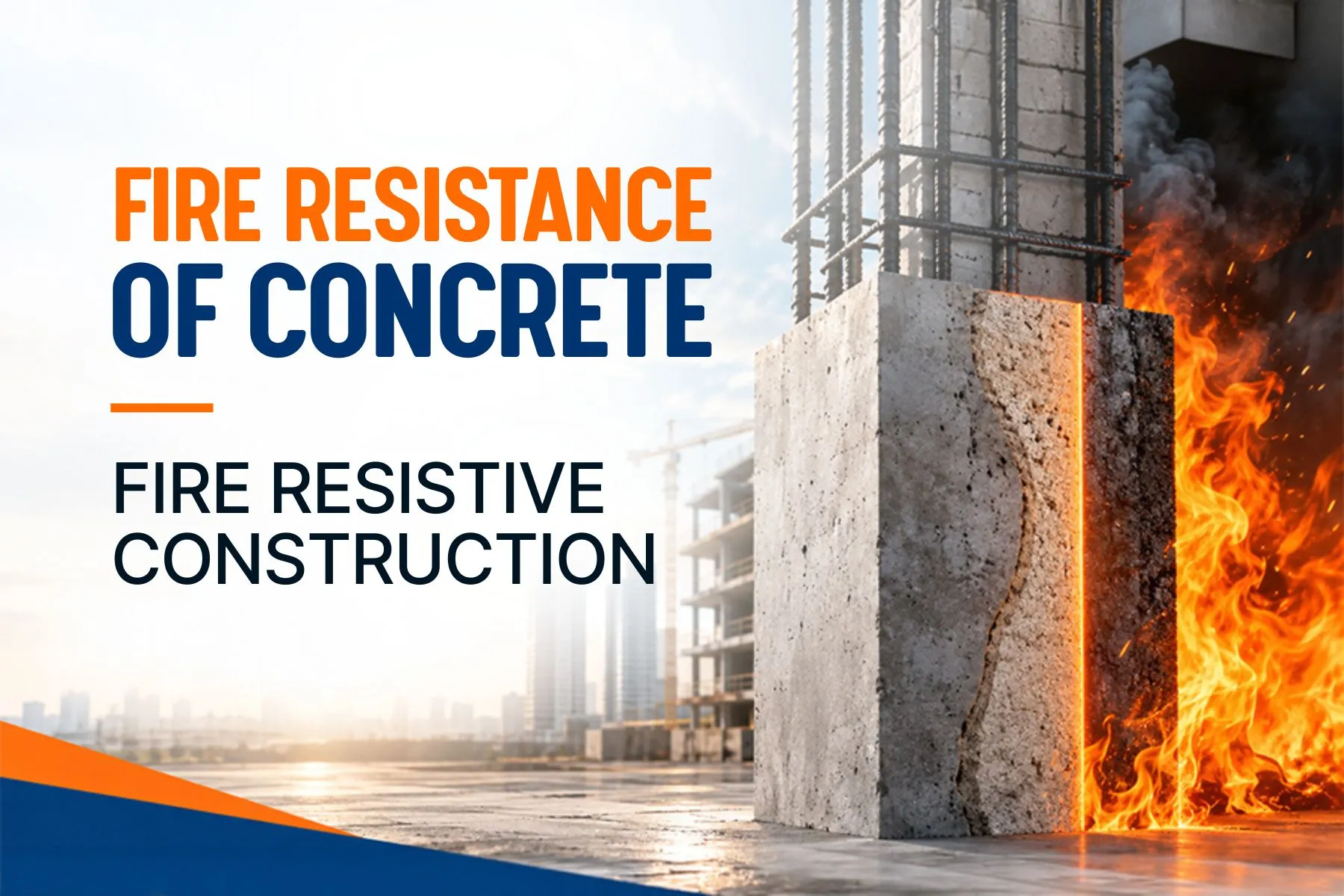
When designing any building, industrial plant, tunnel, or any other infrastructure project, fire safety must be taken into account. The behavior of materials when exposed to heat and fire has a direct effect on a construction’s safety.
Table of Contents
Concrete is one of the most commonly used materials that stands for fire-resistant construction. It is non-combustible and possesses a considerably lower thermal conductivity in comparison with a number of other construction materials. However, calling the material “fireproof” would not be quite correct. Its performance during a fire depends on a range of factors such as its composition, moisture content, type of aggregate, dimensions of the element, reinforcement of the construction, and intensity of the fire.
It is important to be aware of these factors in the process of constructing fire-resistant concrete structures.
What Is Fire Resistance of Concrete?
The term Fire Resistance of Concrete refers to the ability of the concrete component or structure in question to perform as needed in case of fire.
Structural fire design mainly takes into account the following factors:
Load-bearing: The extent to which the structural unit can still carry the required load.
Integrity: The extent to which the element can prevent flames and hot gases from penetrating it.
Insulation: The extent to which heat transfer through the element occurs within limits set by the requirements.
The fire resistance level largely depends on the building type, component, use, design needs, and applicable fire safety regulations.
Why Does Concrete Perform Well in a Fire?
Concrete possesses certain properties that make it ideal for use in fireproof construction projects.
1. Non-Combustible in Nature
When a fire occurs, concrete does not become combustible like timber or different types of plastic. It does not catch fire and therefore does not provide fuel to the fire.
This feature allows the concrete to play a vital role in structural members where it is necessary to control the contribution of the fire load.
2. Low Heat Transfer
Compared to other materials, concrete is a low conductor of heat. Thus, while exposed to fire, the surface temperature of the concrete structure may go very high; however, the temperature inside the concrete increases slowly.
This property plays a great role in safeguarding the inner parts of a concrete structural member, as well as its reinforcement.
3. Presence of High Thermal Mass
Concrete material is known for its high heat-retaining property. When there is a fire, a larger portion of the heat is retained in the concrete rather than being transmitted quickly through the structure.
In this regard, the amount of concrete and its composition are crucial for determining the speed of heat reaching the reinforcement or the rear face.
4. Protection of Reinforcement through Structure
In reinforced concrete construction, the role of concrete covering around the steel reinforcement should be noted. Good-quality concrete covering provides the necessary time for reinforcement temperature to rise.
Factors Affecting Fire Resistance of Concrete
The behavior of concrete in fires may be different depending on the mix used or the structure involved. It can depend on many variables.
Composition of Concrete
The kind of cementitious elements used (the amount of cement, aggregates, water, etc.) has an effect on the behavior of the concrete during the process of heating.
The most important factor involved is the type of aggregates. This is due to the fact that different kinds of aggregates react in different ways to heat when it is applied.
Amount of humidity
The concrete itself has a certain amount of moisture in its pore spaces. The moisture is converted into vapour after heating.
When the vapour pressure is too high, it results in explosive spalling, especially in high-strength concrete given certain conditions.
Cross Section
Thick concrete sections create a larger barrier to heat penetration, as it takes longer for heat to get through.
Thus, columns, beams, walls, and slabs will have to be treated differently, depending on their size and the conditions they will face.
Reinforcement Cover
The distance between the surface of concrete and reinforcement is crucial for fire resistance design. Enough cover helps to prolong the heating of reinforcing bars, thus obtaining the necessary fire resistance of reinforced concrete structures.
Fire Temperature and Duration
The fire exposure implies the answer to the question of not only the maximum temperature but also the duration of the fire. A concrete element experiencing the impact of high temperature for a short time is different from one affected by relatively high temperature values for a much longer duration.
Therefore, the fire scenarios as well as relevant fire tests should be kept in mind when designing.
What Happens to Concrete During Fire?
Concrete is exposed to both chemical and physical transformations with an increase in temperature. As temperature increases, moisture is released from the concrete. Continued heating also influences the cement paste and its bond with aggregates.
The next phase in the heating process is from the point where the concrete begins to lose its strength and rigidity. As this happens, the process of thermal expansion and uneven thermal expansion creates internal stresses.
In extreme situations, cracking or spalling can happen, which depends on the concrete’s composition, moisture content, the speed at which it has been heated, temperature conditions, and time of exposure to heat.
For these reasons, the appearance of a concrete surface after a fire cannot be considered a reliable indicator of whether a structure is ruined or not.
Effect of Fire on Steel Reinforcement
While concrete is considered a fire-resistant material, the efficacy of the fire-resistant concrete structure depends on the behavior and response of the steel reinforcement.
As the steel is heated, it gradually loses both its strength and stiffness. The concrete layer acts as an insulator and limits the speed of heating reaching the reinforcement.
That is why fire-resistance structural design takes into consideration several factors including:
- Thickness of concrete cover
- Size of the cross-section
- Arrangement of the reinforcement bars
- Amount of load
- Type of the structural member
- Time necessary for material resistance to fire
Conditions of fire exposure
The right choices should be made by a structural professional based on existing design and fire protection standards.
Explosive Spalling: An Important Concern
A challenge linked to concrete subjected to high temperatures is explosive spalling, whereby concrete pieces detach from the surface of concrete, which can occur at high temperatures.
In certain cases, pressure in gas form could be a reason for such behaviour of concrete.
Thermal stresses and disparity of expansion of components of the concrete mix could also be the cause.
The risk depends on concrete density, its capacity to transport moisture, water content, moisture heating conditions, and concrete strength.
High-strength and low-permeability concrete require special attention in case of using these types of materials in fire conditions because the moisture and the vapour cannot go through their structure freely.
According to some research, the application of polypropylene fibres in concrete could decrease the chances of explosive spalling when appropriate concrete composition and the use of the fibres are justified by carrying out necessary tests and following recommendations.
Concrete in Fire-Resistive Construction
When used correctly, concrete can help build fire-resistant structures.
Structures
Concrete columns, beams, slabs, walls, and stairways can be used in construction to create fire-resistant elements.
Safety measures should be taken to ensure that floor and wall systems provide barriers to separate parts of a structure and minimize fire spread by meeting the recommended fire resistance requirements.
Tunnels
Concrete is widely used for tunnel construction. In case of a fire in a tunnel, the most important thing is to make sure that critical elements of the structure remain intact.
Depending on the project specifics, special fire-resistant concrete technology may be required for tunnels where fire situations are more dangerous than normal.
Industry facilities
There are many types of fire loads in different industries; therefore, fire safety measures should be considered in accordance with the nature of the materials and goods involved in the production process.
When it comes to infrastructure projects?
Bridges, parking lots, utility construction, and other types of infrastructure are subject to fire safety regulations, too.
How Can Concrete Be Designed for Better Fire Performance?
Including fire resistance in the initial phases of the design process is very important rather than postponing its implementation.
The following key points should be highlighted:
Use of proper concrete materials: The choice of aggregates and composition of concrete should correspond with the anticipated exposure.
Use of appropriate reinforcement cover: Covering requirements must be in accordance with engineering and fire design norms.
Implementation of moisture and permeability control measures: The quality and curing of concrete significantly influence the pore structure and moisture movement.
Considering spalling risks: High-strength or heavy concrete may require additional evaluations for fire performance.
Using proper additives if needed: Although some additives and mixtures will improve some performance characteristics, it is important to ensure that these systems will work for this particular case.
Following applicable rules for fire design standards: Fire resistance must be assessed according to applicable regulations, taking into account all calculations, tests, or other well-known engineering methods.
Role of Construction Chemicals in Fire-Resistant Concrete
Chemicals used in construction have the ability to modify concrete and cement-based products so that they achieve performance specifications. The effect of the additives lies in the possibility for the producers to create concrete that possesses required workability while being controlled in terms of water content because of using suitable water-reducing agents.
Fibres and other special materials may also be present in relevant formulations if fire properties are considered.
Nonetheless, construction materials should not be represented as fireproof products. The effectiveness of the materials depends not only on the additives functioning, but on the whole mixture, manufacturing, application, and design.
Why Choose Sakshi Chem Sciences?
Sakshi Chem Sciences Pvt. Ltd. has been in the field of constructing chemicals and additives for two decades and is a prominent manufacturer, supplier, and exporter of construction-related chemicals and additives.
The company has developed a broad range of products, which constitutes more than 50 different types of chemically manufactured substances, including concrete admixtures, construction chemical-based waterproofing products, grouts, mold-releasing agents etc.
Sakshi has established R&D and manufacturing facilities to produce construction chemical products that deliver consistent and effective results. Each product is subjected to thorough quality control.
Sakshi has developed an international network of suppliers in the Middle East, Africa, Europe, and Southeast Asia and is willing to provide clients with high-quality construction chemical solutions.
Our highly skilled staff is ready to provide recommendations in the product selection process.
Conclusion
The Fire Resistance of Concrete is one of those reasons why concrete remains a vital material in fire-resistive construction. Possessing the properties of being non-combustible, possessing thermal mass, being low in thermal conductivity, and having the capability of protecting embedded reinforcement can significantly enhance the performance of concrete when it comes to being fire-resistant.
At the same time, it must be noted that fire does not leave concrete unaffected. High temperatures may cause moisture movement, cracks, reduction in strength, heating of the reinforcement, as well as spalling. The actual performance of concrete is dependent on its composition and size, reinforcement type and amount, as well as on the moisture condition, fire intensity, and duration of exposure.
Given all these considerations, fire resistance must be ensured through material selection, structural design and detailing, a sufficient number of laboratory tests, as well as compliance with fire safety standards.
Frequently Asked Questions
1. Is concrete fire-resistant?
Yes. Concrete is non-combustible and can provide significant fire resistance when appropriately designed and constructed. However, prolonged exposure to high temperatures can reduce its strength and cause damage.
2. What affects the fire resistance of concrete?
Concrete composition, aggregate type, moisture content, member dimensions, reinforcement cover, applied load, fire temperature, and duration of exposure can all influence performance.
3. Can concrete crack during a fire?
Yes. High temperatures can create thermal stresses, moisture-related pressure, and changes within the cement paste and aggregates, potentially resulting in cracking or spalling.
4. Why is concrete cover important in fire-resistant construction?
Concrete cover helps delay the heating of embedded steel reinforcement. Adequate cover is therefore an important part of reinforced concrete fire design.
5. Can additives improve concrete’s fire performance?
Certain fibres and admixtures may support specific fire-performance requirements, depending on the formulation and application. Their use should be based on appropriate testing, technical guidance, and structural design requirements.
6. Is fire resistance the same as being completely fireproof?
No. Fire resistance describes how long a structural element can maintain specified performance under defined fire conditions. Concrete can provide substantial fire resistance, but its behaviour depends on the material, structure, and exposure conditions.

Sagar Telrandhe is a Construction Engineer with a B.Tech in Construction Engineering & Management. Passionate about infrastructure development, project planning, and sustainable construction, he specializes in modern construction techniques, project execution, and quality management, contributing to efficient and innovative building.