
Concrete is one of the most popular construction materials because of its strength, durability, and versatility. Concrete is the foundation of many types of structures, from residential buildings and bridges to industrial floors and major civil engineering projects.
Table of Contents
However, concrete is not fully resistant to damage, and factors such as moisture, chemicals, temperature changes, heavy loads, fire, and improper construction techniques can cause it to lose strength and appearance. Some damage develops over a long period, whereas other types of damage can occur unexpectedly due to a drastic event.
Knowing the causes of damage to concrete is important because if the damage is detected early, it may not cause severe damage requiring costly repairs.
The following are the six most common causes of concrete damage.
1. Carbonation
Carbonation is a natural chemical process whereby carbon dioxide from the air penetrates the concrete through its pores and micro-cracks. In turn, it reacts with the constituents of the cement paste, in particular, calcium hydroxide and thus reduces the alkalinity of the concrete over time.
Typically, it is the highly alkaline conditions within the concrete that protect reinforcement steel embedded within it from corrosion. Thus, as carbonation moves toward the areas with reinforcement steel, this alkaline protection decreases. In turn, if moisture and oxygen are present, the reinforcement steel is eventually exposed to corrosion.
There are different factors that can affect the carbonation rate, such as the permeability of the concrete, the ratio of water to cement, the quality of curing, the amount of cement, the exterior conditions, and the thickness of the concrete cover over the steel reinforcement.
The use of properly designed and well-cured concrete that has low permeability, along with the adequate coating of the steel reinforcement, can decrease the rate of carbonation.
2. Reinforcement Corrosion
The corrosive action on steel reinforcements is an important problem. There are cases when the steel has become exposed to corrosive conditions (carbonation or chloride penetration) and starts corroding.
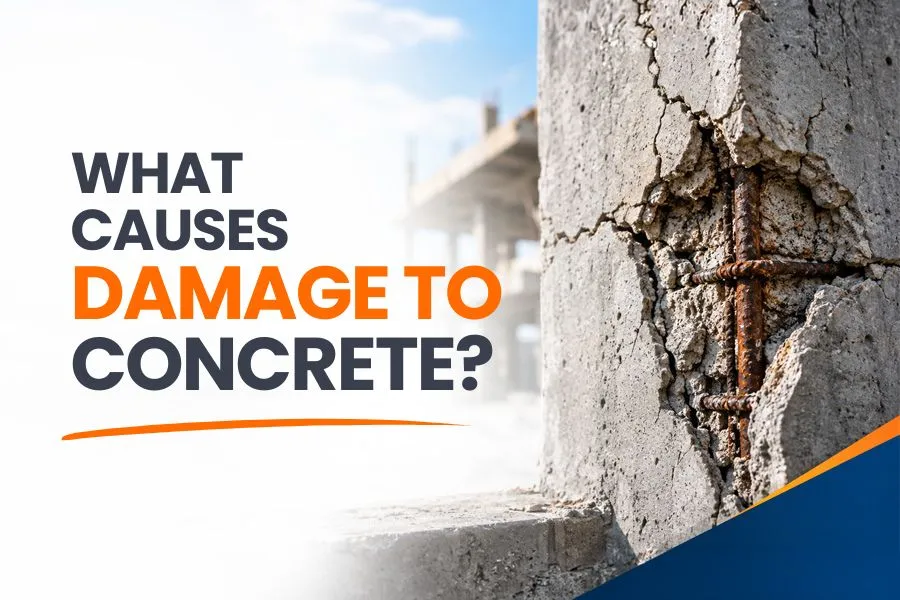
At the onset of corrosion, the steel reinforcement becomes oxidized. Rust occupies a greater volume than the original steel and produces tensile stresses in the surrounding concrete. With time, these stresses can lead to cracking, delamination, and spalling.
Poor concrete quality, inadequate cover, cracked concrete, and the effect of water and chloride increase the risk of this failure mode.
The main point is to prevent any possibility of corrosion developing.
3. Chemical Attack
Concrete can suffer from corrosion when exposed to harmful chemicals like sulfates, which occur naturally in some soils and groundwater. This causes reactions with cement, resulting in expansion and cracks in the concrete.
Caustic materials can do the greatest damage, as they dissolve and corrode the various components of cement, making it weaker and easier to damage with different construction materials as well.
Chemical attacks are most urgent in facilities designed to be in contact with industrial chemicals, wastewater, aggressive groundwater, and sea environments.
Concrete with low permeability generally displays a much higher degree of resistance to the penetration of aggressive substances. Additionally, it is also important to consider cement and admixtures suitable for the exposure conditions.
4. Overloading and Impact
Concrete buildings are built to support a specified load. If those loads are exceeded, there will be excessive stress in the building that can lead to cracking or other types of damage.
Overloading can happen because of changes in the way the building is used, the storage of heavy equipment or goods, construction works, or unforeseen events like earthquakes or accidents.
Secondly, impact is also this type of concern. It is especially crucial for industrial flooring, parking lots, loading spaces, bridge parts, and concrete surfaces used for laying roadways with heavy traffic. Repeated impacts can lead to micro-cracking, which will increase with time.
A solution to the problem is to make sure the structures are designed correctly and the load is controlled adequately. The existing buildings must also be re-evaluated before introducing heavier equipment or changing their purpose.
5. Fire and High-Temperature Exposure
Concrete is widely regarded as being fire-resistant, although when exposed to high temperatures for long periods of time, its properties may be affected. The moisture in concrete transforms into vapour as the concrete is heated. If this vapour cannot escape from the concrete easily, the pressure build-up will lead to the explosive spalling of concrete or surface spalling. High temperatures may also affect the cement paste and the bond between the cement paste and the aggregates.
The degree of damage done by the fire to concrete depends on several parameters, including the temperature of the fire, the time of exposure to the fire, concrete composition, moisture condition, size of concrete member, and configuration of reinforcement.
After a fire has taken place, visible damage on the surface is not sufficient to establish the fire safety of concrete members, but a professional engineer should evaluate the damaged concrete slabs before repairing or using them.
6. Excess Water and Poor Moisture Control
Water plays a key role in fabricating concrete, but excess water in the mix may lead to complications. An excessively high water/cement ratio usually causes increased porosity after curing, which can diminish strength and durability.
Too much water can also promote bleeding, laitance, weakness on the surface, cracking due to shrinkage, and heightened permeability. Once the concrete becomes more permeable, water as well as external harmful substances can easily infiltrate it.
Moisture degradation may also occur when concrete is subjected to wet/dry cycles, as it may lead to cracking.
How Can Concrete Damage Be Prevented?
While some deterioration cannot be prevented, its likelihood can be significantly reduced through careful design and construction methods.
Amongst the key measures that can help are the following:
- Using the most appropriate concrete mix for the prevailing exposure conditions.
- Maintaining a properly controlled water/cement ratio.
- Relying on certain concrete additives if required.
- Ensuring proper placing, compacting, and curing of concrete.
- Providing necessary concrete cover for the reinforcement.
- Controlling cracking of the concrete and minimizing the risks via proper structural and construction methods.
- Protecting concrete against aggressive chemicals and excess moisture.
- Avoiding the overloading of the structures beyond their limits of safety.
- Conducting regular inspections of the concrete to catch deteriorating signs in time.
Construction chemicals provide significant assistance in improving concrete performance. Depending on the features of the projects, concrete admixtures, waterproofing systems, repair products, etc. can be used to solve certain predictive and performance matters.

Conclusion
There is no single universal reason as to why concrete might sustain damage. This can be due to a variety of factors such as the properties of the material, construction practices, environmental conditions, load, and lack of maintenance.
Some of the most common causes of concrete damage are carbonation, corrosion of reinforcing bars, chemical attack, invasiveness, and fire. Identifying these threats early and applying appropriate design, materials, construction techniques, and maintenance methods will enhance the durability of concrete structures.
In projects with a focus on durability, that means you should approach the selection of a suitable construction chemical not based on the price, but rather on the concrete mixture, exposure conditions, requirements for application, and technical specifications.
FAQs
What are the most common causes of concrete damage?
Some of the major causes include carbonation, reinforcement corrosion, chemical attack, overloading, impact, fire, excessive water, and repeated environmental exposure such as wetting and drying.
How does carbonation damage concrete?
Carbonation occurs when carbon dioxide enters concrete and reacts with cement hydration products, reducing its alkalinity. As carbonation reaches reinforcement, the steel can become more vulnerable to corrosion when moisture and oxygen are present.
Can excessive water damage concrete?
Yes. Excess water can increase the water-cement ratio and porosity of hardened concrete. It may also contribute to bleeding, laitance, shrinkage cracking, lower strength, and increased permeability.
How can concrete damage be prevented?
Durable concrete starts with suitable mix design, controlled water content, quality materials, proper placing and compaction, adequate curing, sufficient reinforcement cover, and protection against aggressive exposure. Appropriate construction chemicals can also be used where project conditions require them.

Sagar Telrandhe is a Construction Engineer with a B.Tech in Construction Engineering & Management. Passionate about infrastructure development, project planning, and sustainable construction, he specializes in modern construction techniques, project execution, and quality management, contributing to efficient and innovative building.