
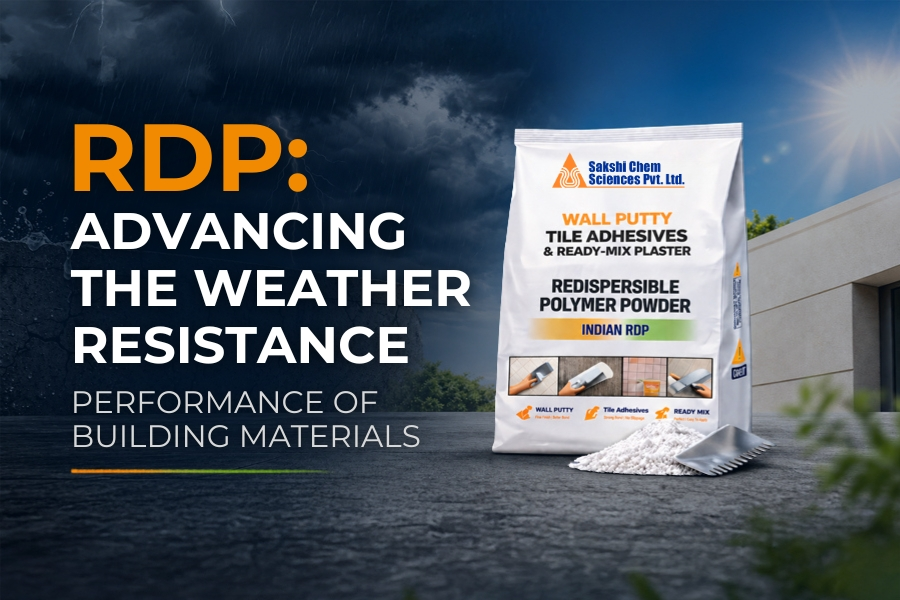
Introduction
With today’s advances in construction technology and techniques, there is no doubt about the importance of having durable structures.
Structures must now be able to meet the rigours of the environment around them, including rain, heat, UV light, and freezes/thaws, among others. However, one challenge remains: maintaining weather resistance performance over time with building products.
Table of Contents
Relying on advanced, newly developed technologies for additive systems, products such as RD Powder (Redispersible Polymer Powder) are changing the way the construction industry is working.
RD Powder provides better bonding, flexibility, water-resistance, and many other benefits to improve the overall durability of an architectural product.
At Sakshi Chem Sciences Pvt., Ltd, we specialise in developing high-performance chemical solutions for the construction industry to ensure that today’s structures are able to withstand the effects of nature.
In this blog post, we will discuss the way RD Powder works, what problems it solves and how it assists in creating enhanced weather resistance.
What RD Powder is and How it Works
RD Powder is a free-flowing polymer powder made from vinyl-acetate-based polymers. When mixed with water, the powder redistributes and forms a flexible polymer film inside cement-based systems.
The film does the following:
- Enhances bonding between materials.
- Reduces internal stresses.
- Enhances flexibility.
- Provides a water-resistant, but breathable, barrier between differing materials.
The benefit of RD powder over conventional additives for architecture is that it is not merely a surface treatment to building products, but rather aids in the modification of the internal integrity of the building product.
This makes it highly effective in improving the weather resistance performance of building materials, especially in environments exposed to moisture, temperature changes, and mechanical stress.
Molecular Mechanism: How RDP Improves Moisture Resistance
At the microscopic level, RD Powder based on PVA works to create a continuous polymeric network within cementitious materials.
What does this create?
- It creates a barrier to capillary pores that allow for water penetration.
- It creates a hydrophobic barrier that inhibits moisture.
- It allows the release of water vapour to prevent internal damage.
The balance between water resistance and breathability is critical to allowing moisture to escape. Without a balance between the two properties, trapped moisture can lead to:
- Mould growth.
- Degradation of the material.
- Weakened structure of the material.
RD Powder improves the moisture-resisting performance of Cementitious Materials by increasing their permeability while also enhancing the ability of cementitious materials to release moisture from within them.
This protection from moisture and high humidity or rain for extended periods is provided by an increase in the long-term durability of materials subjected to constant or repeated moisture exposure.
Effect of Freeze-Thaw Durability
One area that poses a significant threat to building materials is through the cycling of moisture in and out of structures (from freezing to thawing).
What is the freeze-thaw problem facing concrete and masonry?
- Water gets into the pores of concrete and masonry.
- The water freezes and expands.
- This creates an internal pressure.
- Internal pressure causes cracks and surface damage.
- There are many buildings that suffer from significant structural deterioration due to freeze-thaw damage.
How does RD Powder help?
- Provides the material with an increased degree of flexibility.
- Reduces water absorption.
- Provides the material with improved resistance to cracking due to freezing and thawing.
- Helps maintain the structural integrity of the material when subjected to temperature-related stresses.
- Cementitious materials modified with RD Powder are highly durable when subjected to freeze-thaw conditions, making them ideal for use in climates where temperature fluctuations occur frequently.
Key Weather Resistance Challenges in Construction
To understand the value of RDP, it’s important to look at the real challenges faced by construction materials.
1. Water Infiltration and Material Degradation
There is no other element in construction that causes more building damage than water.
The following are the most common points of water entry:
- Roof leaks.
- Inefficient drainage.
- Unsealed joints.
- Surface cracking.
When water enters a building, it can weaken building materials, decrease their strength, and require extra time and money to maintain them.
RDP can help create water-repellent materials by:
- Reducing permeability.
- Improving the bonding strength of materials.
- Preventing water infiltration into the building.
RDP will increase the Weather Resistance Performance (WRP) of materials, thereby reducing the long-term effects of water.
2. UV Radiation and Thermal Cycling
Constant exposure to sunlight and temperature changes through cycles will result in:
- Degradation of surfaces.
- Loss of strength due to UV radiation and temperature exposure.
- Cracking of materials caused by expansion and contraction (thermal cycling).
RDP provides multiple benefits when used in construction:
- Improvement of flexibility.
- Increase in UV resistance.
- Reduction of thermal stress.
These benefits create the ability for construction materials to adjust to changing environmental conditions without failing.
3. Structural Damage Caused by Freeze-Thaw Cycles
When concrete or masonry materials are subjected to a freeze-thaw cycle, the freeze-thaw cycle will cause:
- Cracking.
- Spalling.
- Peeling of surfaces.
RDP can help eliminate structural damage caused by freeze-thaw cycles by:
- Reducing water absorption into the material.
- Increasing elasticity or the ability of a material to stretch without breaking.
- Enhancing the durability of a material.
Preventing structural damage and extending the life of the building.
RDP-Enhanced Material Solutions
RDP is extensively used in various construction materials and products for performance enhancement.
High-Performance Weather-Resistant Concrete
Concrete that is modified with RDP will provide:
- Decreased permeability.
- Better workability.
- Improved durability.
RDP becomes a filler for micro-cracking in the concrete, allowing the internal structure of the concrete to become stronger and able to perform in extreme environments.
Polymer-Modified Mortars and Renders
RDP significantly improves the adhesive ability as well as the flexibility of mortar/renders. This helps prevent cracking. These products have multiple uses, including exterior wall finish, tile adhesive, and repair mortar. RDPs play a critical role in protecting the Weather Resistance Performance of Building Materials when exposed.
Fibre Cement Applications
RDP can improve the performance of fibre cement products by providing flexibility, moisture resistance and reduced cracking. As a result, fibre cement products are ideal for use in exterior wall/roofing applications.
Application Methods For Optimum Performance
Using RDP powder properly is just as important as selecting the correct RDP Powder.
Integrating RDP Within Building Envelope Systems
The purpose of a building envelope is to provide protection to a structure from the outside elements.
Best Practice examples of Building Envelope System Devices are: make sure surface preparation is complete; use compatible materials; use sufficient product to achieve acceptable uniform performance.
Utilising correct integration will improve the overall quality and durability of Building Envelope Systems.
Fluid Applied Weather Barriers
RDP is a key material used in Fluid Applied Weather Barrier Systems.
Examples of Application Techniques for Fluid Applied Weather Barrier Systems: uniformly applied in a thin coat, complete cure before completion of the application and ensure the surface is completely covered.
Fluid Applied Weather Barrier Systems provide excellent waterproofing and flexibility properties.
Installation In Severely Harsh Weather Conditions
Situations where the installation of RDP within Building Envelope Systems occurs shall require the installer to be diligent about how to handle and install RDP.
Will be determined by:
Store products correctly, test adherence of RDP prior to installation, and adjust application methods according to climatic conditions.
By doing so, the installer can ensure optimal performance and long-lasting durability throughout the entire Building Envelope System.
Why Choose Sakshi Chem Sciences Pvt. Ltd?
Sakshi Chem Sciences Pvt. Ltd. combines the latest innovations, expertise, and quality to create dependably constructed chemical products that fulfil the expectations of today’s construction industry. Not only do we sell building products, we also provide complete solutions for durability and performance that will take into account both long-term and short-term results.
Strengths of Our Company:
- 20 years of Industry experience.
- New Research and Development capabilities.
- High-tech manufacturing facilities.
- Large assortment of products.
- Thoroughly established throughout the world.
A major differentiator for us is that we continually improve our product by maintaining consistency. Each of our products is subject to many different quality control procedures before being distributed or produced, so that we can make sure they are uniform across all applications and environments and offer a quality solution for the customer.
Furthermore, our technical staff actively seeks to partner with our clients on product selection, dose calculation, application, and maintenance, facilitating optimal results and ultimately optimal durability and maximum weather resistance based on the materials chosen (in terms of building materials) for use in challenging conditions.


Conclusion
Durability and weather resistance are critical to the long-term performance of buildings in the construction marketplace today. Every day, buildings are subjected to physical stresses from external factors.
Using materials that can withstand these external pressures will ensure that the physical strength and visual appearance of a building will remain intact over time after construction.
Quality materials (including RD Powder) can help improve the performance of many advantages; namely, the reduction of moisture penetration, increased flexibility, improved adhesive qualities, and enhanced freeze-thaw resistance.
By improving the internal structure of construction materials, it significantly boosts the Weather Resistance Performance of Building Materials, ensuring longer service life and reduced maintenance.
When combined with proper application techniques and high-quality products from Sakshi Chem Sciences Pvt. Ltd., RDP ensures stronger, more durable, and more reliable structures.
Investing in the right materials today not only improves immediate performance but also minimises future repair costs, because in construction, it’s not just about building, it’s about building to last.

Sagar Telrandhe is a Construction Engineer with a B.Tech in Construction Engineering & Management. Passionate about infrastructure development, project planning, and sustainable construction, he specializes in modern construction techniques, project execution, and quality management, contributing to efficient and innovative building.