
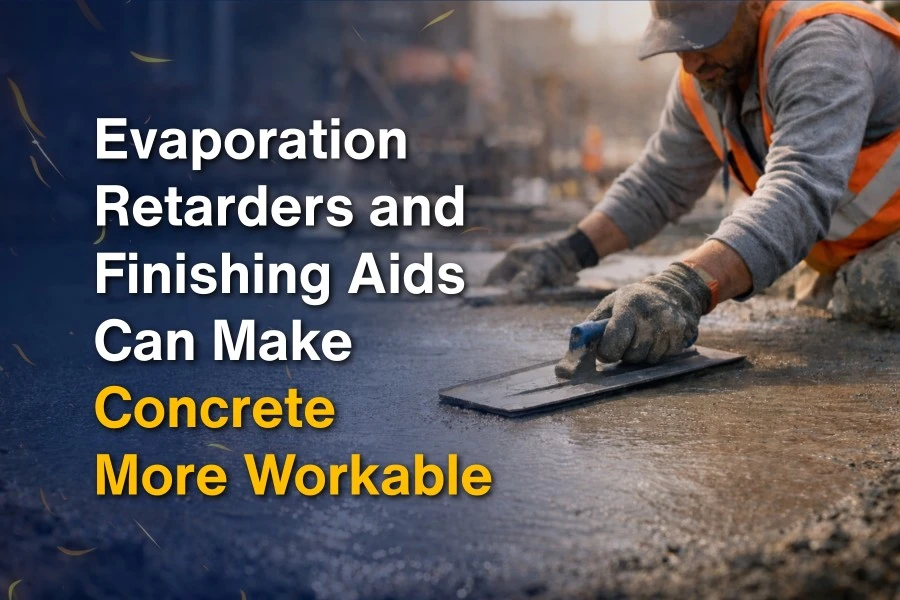
As summer is fast approaching with increasing temperatures, one common issue that is starting to show up on construction job sites is concrete that dries too quickly.
This can lead to the following: Cracking of the concrete, Dusting of the concrete, Discoloration of the concrete, Weakness of the concrete surface, and, in some cases, total surface failure.
Table of Contents
At Sakshi Chem Sciences Pvt Ltd, we have assisted contractors and developers for the past 20+ years, and the one issue that continually arises is improper finishing practices, specifically the misuse of water during the finishing stage.
Adding water to the surface of the concrete appears to be a quick fix to make the concrete workable again; however, this causes more harm than good.
The solution is in smarter chemistry; the use of properly-designed Evaporation Retarders and advanced finishing aids.
Let’s take a closer look at how these two products work together and why their use is critical to the long-term performance of concrete surfaces.
The Real Problem: Surface Water Loss
Newly placed concrete has water in it, which is necessary for the proper hydration of the cement. During hot, dry, or windy weather, the water can evaporate quickly from the surface before the finishing is completed.
When moisture leaves the concrete too quickly:
- A crust will form on top of the concrete surface too soon.
- Plastic shrinkage cracks will develop.
- Finishing will become more difficult.
- The topmost layer of the concrete will become weak.
- Scaling and flaking will develop at a later time.
Most finishers try to remedy these problems with the application of water to the surface of the concrete. However, even a small amount of added water changes the water-to-cement (w/c) ratio at the surface. This weakens the top layer permanently.
Instead of adding water, modern construction practices recommend using Evaporation Retarders.
What Are Evaporation Retarders?
Evaporation Retarders are specially formulated chemical solutions designed to slow down the rate of moisture loss from freshly placed concrete.
Their purpose is simple:
They extend the working time of concrete in its plastic state by reducing surface evaporation, without altering the water-cement ratio.
When sprayed as a fine mist over freshly screeded concrete, evaporation retarders form a thin, invisible monomolecular film over the surface. This film:
- Holds bleed water in place
- Prevents rapid moisture escape
- Gives contractors additional finishing time
- Reduces plastic shrinkage cracking
At Sakshi Chem Sciences, our evaporation retarder formulations are developed through advanced R&D processes and strict quality testing to ensure consistent performance under demanding site conditions.
Proper Use of Evaporation Retarders
Evaporation retarders are highly effective, but only when used correctly.
They should be:
- Applied immediately after screeding.
- Sprayed uniformly using low pressure.
- Used as a surface treatment only.
- Not worked into the concrete.
This last point is very important.
Evaporation retarders are not finishing aids. They are not designed to be troweled into the surface. When overworked or mixed into the concrete, the protective film breaks, and the product behaves similarly to added water, negatively affecting surface strength.
Used correctly, however, they are an economical and effective solution, especially in:
- Hot weather concreting.
- Windy conditions.
- Large slab pours.
- Low-humidity environments.
The Role of True Finishing Aids
As construction projects become larger and deadlines tighter, contractors need solutions that allow them to work efficiently without compromising quality.
This led to the development of advanced finishing aids, particularly those based on colloidal silica technology.
Unlike evaporation retarders, true finishing aids are designed to be worked into the concrete surface during the finishing process.
These products:
- React chemically with cement components.
- Create additional cementitious material.
- Increase surface density.
- Improve abrasion resistance.
- Enhance compressive strength.
Most importantly, they do not change the water-cement ratio.
This means you get improved workability without weakening the slab.
At Sakshi Chem Sciences, innovation is driven by real site challenges. Our technical experts understand that finishing time is crucial, especially during peak summer conditions. That’s why we focus on developing chemical solutions that increase efficiency while protecting long-term durability.
Evaporation Retarders vs Water: Why Water Is Risky
Adding water during finishing may provide temporary workability, but it leads to:
- Surface laitance.
- Increased shrinkage.
- Reduced strength.
- Dusting and scaling.
- Color inconsistency.
In contrast, properly applied Evaporation Retarders:
- Maintain surface moisture
- Preserve mix design integrity
- Reduce cracking
- Improve finishing window
- Minimize tear-outs
The difference may not be visible immediately, but months later, the performance gap becomes obvious.
Where Does a Curing Compound Fit In?
The process of protecting your concrete from evaporation is an ongoing one, even after you have finished working on your concrete.
When the finishing process is complete and the concrete has begun to set, you will need to provide proper curing for your concrete. This can be accomplished by utilizing a Curing Compound.
After the final finish has been applied, a Curing Compound is used to:
Reduce Moisture Loss in the Long-Term
Curing compounds help reduce the amount of moisture lost from a slab over time by helping to maintain a constant moisture level around the slab.
Cement Hydration
Curing compounds assist in helping maintain the correct moisture levels during curing so that the cement can properly hydrate.
Increase Strength Development
Curing compounds provide the proper amount of moisture for strength development.
Reduce Shrinkage Cracks
Curing compounds assist in preventing early shrinkage cracks through controlled evaporative loss.
Enhance Surface Durability
Curing compounds help to increase the surface durability of the concrete by providing moisture during the curing process.
This can be visualized as follows:
- Evaporation Retarders protect the concrete while it is being finished.
- Curing Compounds protect the concrete after it has been finished.
Although both types of chemicals play an important role in the concrete slab, they do so at different times.
At Sakshi Chem Sciences Pvt. Ltd., we manufacture high-quality curing compounds that comply with global durability requirements for concrete.
Our curing compounds have been tested for durability to ensure that you receive the same quality and reliable curing results regardless of the environmental conditions where the slabs will be installed.


Benefits of Using Evaporation Retarders and Finishing Aids Together
Properly used curing and evaporative retarding agents, used at the appropriate tim,e can be beneficial to slab performance.
Longer Finishing Time
Contractors can now place and finish their concrete without being rushed.
Reduced Surface Cracking
Control of evaporative loss helps to prevent early surface shrinkage cracks.
Increased Surface Strength
Real Finishing Aids enhance surface density and abrasion resistance.
Lower Repair Costs
Reduction of surface defects leads to lower future maintenance costs.
Better Project Efficiency
Fewer tear-outs mean saved time and resources.
Working smarter with the right chemical solutions ensures long-term structural performance.
Why Choose Sakshi Chem Sciences?
Sakshi Chem Sciences Pvt. Ltd. is one of India’s leading manufacturers, suppliers, and exporters of construction chemicals. With over 20 years of experience, we offer a comprehensive portfolio that includes:
- Concrete admixtures.
- Waterproofing solutions.
- Mold release agents.
- Grouts.
- Repair products.
- Evaporation Retarders.
- Curing Compound solutions.
Our advanced R&D lab continuously works on improving product efficiency and usability. Every product undergoes strict quality control and complies with international safety and durability standards.
With a strong global presence across the Middle East, Africa, Europe, and Southeast Asia, we are committed to delivering affordable, high-performance construction chemical solutions worldwide.
We don’t just manufacture chemicals; we provide site-ready solutions backed by technical support and expert guidance.
Final Thoughts
The performance characteristics of concrete start long before it has hardened. The finishing process is considered an extremely important stage of concrete production; if the finishing steps are not performed correctly, flaws or damage may become an issue and remain visible on the surface for the life of the concrete.
Today, the construction industry utilizes much more intelligence with regard to finishing concrete. Instead of relying on traditional methods such as adding additional water to the surface to slow evaporation down after finishing.
Evaporation Retarders can protect the surface of new concrete that is still in the plastic stage, and curing compounds will provide sufficient hydration for the concrete that has already hardened.
When used together, these two products will create greater workability, improved durability, and enhanced overall performance of the finished slab.
At Sakshi Chem Sciences Pvt. Ltd., our mission is clear – to continue to provide builders, contractors, and developers with the chemicals and technologies necessary to produce the strongest, most durable structures possible.
In construction, quality is not an option; it is your foundation.

Sagar Telrandhe is a Construction Engineer with a B.Tech in Construction Engineering & Management. Passionate about infrastructure development, project planning, and sustainable construction, he specializes in modern construction techniques, project execution, and quality management, contributing to efficient and innovative building.