
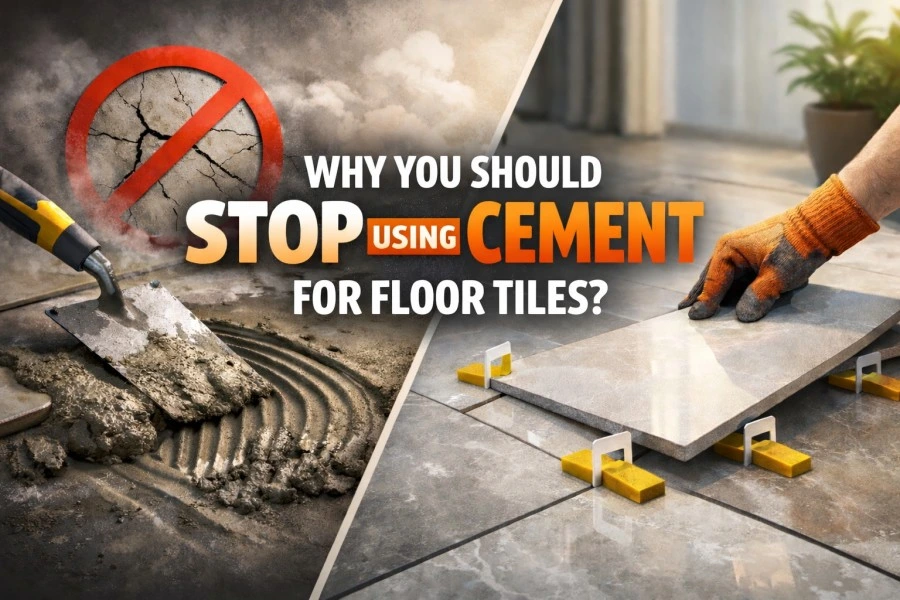
Cement has been used for fixing floor tiles for many years. It is usually readily available and has an established presence on construction sites.
Because construction methods have changed so much and tile sizes have also increased in size, the materials used for flooring today are much larger, thinner, heavier, and much more advanced than tiles of the past.
Table of Contents
Yet, many projects still rely on traditional cement for tile installation, often leading to problems like hollow tiles, cracks, uneven surfaces, and early failures.
This raises an important question that modern builders, contractors, and developers must ask: Why You Should Stop Using Cement for Floor Tiles?
The answer lies in understanding the limitations of cement and recognizing how modern tile adhesives, enhanced with advanced construction additives such as RD Powder, offer far superior performance, durability, and efficiency.
How Tile Installation Has Changed Over Time?
In the past, tiles were considerably smaller than modern ones and also heavier. The cement works reasonably well due to several reasons:
- The tiles will take up moisture from the Cement.
- Thicker beds of cement compensate for an unlevel substrate.
- Fewer finishing details are required for precision.
With modern floor tiles having almost no water absorption (large format tiles, Vitrified-porcelain), the standard method of installing them is on a thinner bed of cement with greater importance on leveling, precision, and long-term performance.
This alone would justify you not to use cement-based mortar to fix floor tiles in the contemporary construction industry, as floor manufacturers now use adhesives for their products.
What are tile adhesives and how is it different than cement-based mortars?
Tile adhesives are designed exclusively for the purpose of attaching tiles to a subfloor. Unlike traditional cement, tile adhesives are specifically designed to contain:
- Cementitious binders.
- Fillers of a variety of sizes.
- Polymers and performance additives.
- Other special ingredients such as RD Powder.
The combination of these ingredients provides a bonding matrix that effectively and permanently attaches tiles to their substrate with enough flexibility to allow for movement, moisture and temperature changes.
Limitations of Using Cement for Floor Tiles
The limitations of using cement to fix tiles are numerous and significant given both historical and contemporary use.
1. Weak Bonding with Modern Tiles
Cement relies heavily on mechanical grip and moisture absorption. Modern vitrified and porcelain tiles do not absorb water, resulting in weak bonding and frequent tile failures.
2. Shrinkage and Cracking
Cement shrinks as it dries. This shrinkage can:
- Create internal stresses.
- Lead to cracks.
- Cause tiles to debond over time.
3. Hollow Tiles and Poor Load Distribution
Uneven cement application often creates air pockets beneath tiles. These hollow areas:
- Produce hollow sounds.
- Increase breakage risk.
- Reduce load-bearing capacity.
4. Thick Application Requirement
Cement requires a thick bedding layer, which:
- Increases material consumption.
- Adds unnecessary weight.
- Makes leveling more difficult.
5. Poor Performance in Wet Areas
Cement absorbs water easily. In bathrooms, kitchens, and balconies, moisture penetration can weaken cement bonding and lead to tile loosening.
6. High Dependence on Labor Skill
Achieving consistent results with cement depends heavily on the applicator’s skill, making outcomes unpredictable across different sites.
All these factors reinforce why you should stop using cement for floor tiles in modern projects.
Tile Adhesive vs Cement: A Clear Comparison
| Parameter | Cement | Tile Adhesive |
| Bond strength | Moderate, inconsistent | High and reliable |
| Flexibility | Rigid | Flexible |
| Shrinkage | High | Minimal |
| Application thickness | Thick bed | Thin bed |
| Hollow tile risk | High | Very low |
| Water resistance | Poor | Superior |
| Suitability for modern tiles | Limited | Excellent |
| Finish quality | Uneven | Smooth and professional |
The Role of RD Powder in Tile Adhesives
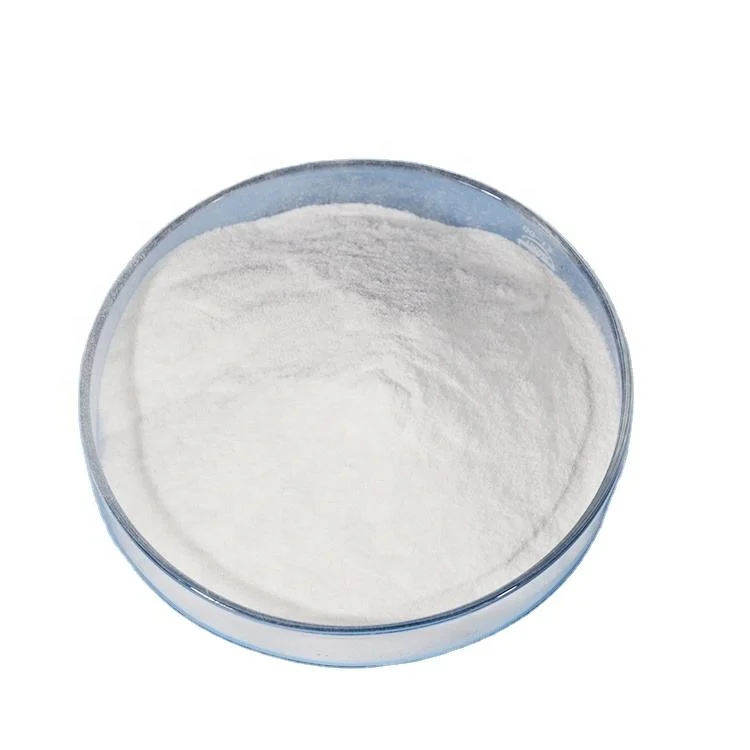
One of the key reasons tile adhesives outperform cement is the inclusion of RD Powder (Redispersible Polymer Powder).
What Does RD Powder Do?
When RD Powder is combined with H2O, the result is the conversion of RD Powder to fine polymer particle, which will:
Create a flexible polymer film.
Increase adhesion between the tile and the substrate.
Improve elasticity and resistance to cracking.
RD Powder Benefits for Tile Adhesives
- A stronger bond even on low porosity tile surfaces.
- Less shrinkage and cracking during drying cycles.
- More effective stress absorption.
- Improved moisture (water) resistance.
- Longer Life of Tiled Floors.
The use of RD Powder as an additive for tile adhesives utilizes chemistry that is quite different from any chemistry used for cement-based products and provides many reasons to eliminate cement from your flooring tile installation.
Advantages of Using Tile Adhesive vs Cement for Tiling
1. Superior Bonding Strength to Both Tile and Substrate.
Cement-based products attach strongly to both the tile and the substrate to hold the tile in place and create a far lower failure rate under heavy foot traffic.
2. Feed Back from Flexibility and Movement Allowance
Every building will move slightly due to temperature changes and structural loads; the flexibility of the tile adhesive accommodates this movement, while the cement does not have this property.
3. Thin-Bed Application
The tile adhesive system can be installed in very thin bedding applications, due to all of the advantages of:
- Better leveling.
- Using less product.
- Cleaner job site installations.
4. Hollow Tile Reduction
The uniform consistency of tile adhesive will minimize air entrapment in the system, therefore eliminating most hollow sound tiles.
5. Faster and Cleaner Installation
Tile adhesives:
- Are easy to mix
- Spread smoothly
- Reduce site mess
- Improve productivity
6. Compatibility with Modern Tiles
Tile adhesives are designed specifically for:
- Vitrified tiles
- Porcelain tiles
- Large-format tiles
- Low-absorption surfaces
Why Cement Fails with Large-Format Tiles?
Large tiles demand:
- Uniform load distribution
- Strong adhesive contact
- Minimal movement tolerance
Cement struggles to meet these requirements due to:
- Uneven thickness
- Poor bonding
- High shrinkage
Tile adhesives, especially those modified with RD Powder, are engineered to support large tiles without increasing failure risk.
Common Myths About Using Cement for Tiles
Myth 1: Cement Is Stronger Than Tile Adhesive
It is true that cement can withstand heavy loads, but can only be used for tile adhesion and requires flexibility in order to adhere properly, whereas tile adhesives are much better suited for those applications.
Myth 2: Tile Adhesives Are Too Expensive
Although tile adhesives may have a higher cost per bag than cement, they:
- Will reduce tile waste.
- Will reduce any rework you have to do.
- Will extend the life of your floor.
Over time, these items will create savings on the total cost.
Myth 3: Cement Has Always Been Used, Therefore It Has to Be Better for Modern Tile Materials
The fact that something has been used forever does not mean that it is appropriate for modern tile materials. With all of the advancements made in construction, it is clear that construction methods continue to evolve for all industries.
Some Of The Problems With Using Cement Based Adhesives Are
Even today, many problems can be traced back to problems with a cement-based installation.
- Tiles will pop up within months after being installed.
- Cracking will form behind the grout.
- There will be hollow sounds under the floors.
- Water will ruin the tile installation if it gets into the wet areas of the house.
Most of these problems were caused by the way the tiles were installed and would have been completely avoided if modern tile adhesives had been used instead.
How To Select The Right Type Of Tile Adhesive?
In order to get the best results from your installation:
- Make sure you are matching the type of adhesive with the size and type of tile you are using.
- Use water-resistant grades of adhesives for wet areas.
- Follow the manufacturer’s directions on how to mix and apply.
- Be sure you have prepared the surface correctly.
Quality Tile Adhesives that meet RD Powder standards will provide the quality and consistency you need to successfully install tile in any environment.

How Sakshi Chem Sciences Supports Modern Tile Fixing Solutions?
Sakshi Chem Sciences plays a crucial role in advancing tile installation technology by supplying high-performance construction chemical additives, including:
- RD Powder for improved bonding and flexibility.
- Admixtures that enhance durability and workability.
- Solutions that align with global construction standards.
Through advanced R&D and strict quality control, Sakshi Chem Sciences helps manufacturers and applicators move away from outdated practices and toward efficient, durable flooring systems.
Long-Term Benefits of Moving Away from Cement
When you stop using cement for floor tiles and switch to tile adhesive:
- Floors last longer.
- Maintenance costs decrease.
- Tile failures reduce dramatically.
- Installation quality becomes more consistent.
- End-user satisfaction improves.
This shift is not just about better materials, it’s about better construction outcomes.
Conclusion
Cement served its purpose in the past, but it no longer meets the demands of modern flooring systems. Today’s tiles require stronger bonding, better flexibility, and higher precision, qualities that cement simply cannot deliver.
Understanding why you should stop using cement for floor tiles is essential for anyone aiming to build durable, professional, and future-ready spaces. Tile adhesives, enhanced with advanced additives like RD Powder, provide the performance, reliability, and efficiency that modern construction demands.
By embracing these solutions, builders and developers can ensure long-lasting floors that stand the test of time, without the recurring problems associated with traditional cement-based tile fixing.

Sagar Telrandhe is a Construction Engineer with a B.Tech in Construction Engineering & Management. Passionate about infrastructure development, project planning, and sustainable construction, he specializes in modern construction techniques, project execution, and quality management, contributing to efficient and innovative building.