
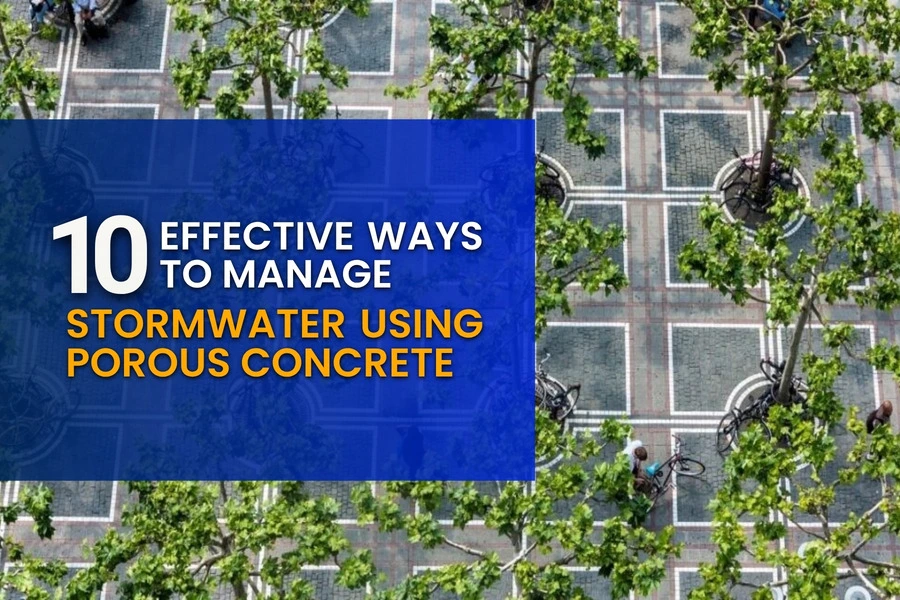
As urban areas broaden, road systems increase, and lands transform into places with concrete, another silent challenge emerges beneath our feet, the challenge of stormwater.
Heavy rains seem to be everywhere now, yet our drainage systems struggle more than ever. Flooding, waterlogged soils, soil erosion, and municipal drains pushed to capacity are very normal now.
Table of Contents
Fortunately, engineers today are equipped with innovative, sustainable building products that allow us to address these challenges in a natural way. One of the most adaptable, most effective of these sustainable building products is porous concrete.
At Sakshi Chem Sciences, we know how important advanced concrete solutions are for stormwater management now and in the future.
This blog will discuss why porous concrete is a great solution for stormwater management, and some of the 10 applicable and effective ways to utilize porous concrete for stormwater management throughout urban and suburban environments.
What is Porous Concrete?
Porous concrete, also known as previous concrete or permeable concrete, is a specially formulated mix of concrete that contains less fines (sand) and a carefully controlled, large void space.
This interconnected void allows for the free-flows of rainwater through the concrete and infiltration under the ground.
Dissimilar to standard impermeable concrete, porous concrete allows for:
- Less Surface Runoff.
- Controlled Percolation.
- Less flooding.
- Groundwater Recharge.
Porous concrete is commonly used in urban contexts to relieve stresses on stormwater systems and increase climate resiliency.
10 Effective Ways to Manage Stormwater Using Porous Concrete
1. Porous Driveways
Residential driveways may seem innocuous, but they prevent large areas of soil from absorbing rainfall. With porous concrete in driveways, homeowners allow stormwater to infiltrate the soil instead of draining to the streets.
This greatly mitigates small urban waterlogging.
2. Permeable Parking Lots
Parking lots produce tremendous stormwater runoff for their size.
Permeable concrete parking surfaces can help to:
- Reduce runoff volume.
- Increase groundwater recharge.
- Reduce water pollution.
These last a long time after all the years of rainfall.
3. Stormwater-Friendly Road Surfaces
Roadways convey water quickly to low areas that cause localized flooding.
Porous concrete sections of roadway help to:
- Absorb rain bounded by the footing of the road where the rain falls.
- Reduce ponding.
- Improve tyre traction.
This is particularly valuable for safe driving.
4. Footpaths/Walkways
Most footpaths create stagnant puddles after rain. Porous concrete helps eliminate all puddling since the water can flow vertically through the interface.
This reduces slipperiness and algae growth.
5. Flood-Prone Zone Recovery
Flood-prone areas could simply replace the typical concrete paving with porous concrete surfaces to reduce water build-up.
This is one of the fastest-running interventions a municipality can take.
6. Permeable Landscaping Blocks
Porous concrete is quite popular for:
- Pathways through parks
- Yards
- Outdoor seating areas
It blends functionality and aesthetics beautifully.
Landscaping teams appreciate it because:
- It protects soil.
- It prevents erosion.
- It improves water-cycle sustainability.
7. Tree Surrounds
Urban trees struggle due to:
- Lack of water.
- Compacted soil.
- Heat retention.
Porous concrete rings around tree bases allow water and oxygen to reach roots naturally.
This supports healthier and faster tree growth.
8. Water-Permeable Pavements for Public Areas
Plazas, stadiums, school campuses, as well as public buildings, can experience accumulations of rainwater on their surfaces.
Permeable pavements greatly reduce runoff and actively promote infiltration of stormwater into the ground.
9. Porous Concrete Retaining Walls
Porous retaining walls allow stormwater flow through as opposed to ponding behind the wall.
This resolves issues like:
- Hydrostatic pressure buildup
- Cracks in the wall
- Structural failure of the wall
Ideal choice for hills and slopes on a property.
10. Infiltration Trenches and Storm Channels
Storm channels and infiltration trenches are composed of:
- Aggregates
- Drainage materials below grade
- Porous concrete or rigid covers
Stormwater infiltrates quickly and safely distributes water underground with little or no visible pooling.
How Porous Concrete is an Intelligent Solution for Urban Areas?
Here are a few reasons porous concrete is rapidly gaining traction:
- Reduction to stormwater runoff
- Flood prevention
- Groundwater levels are maintained
- Surface pollutants are filtered
- Enables sustainable building practices
- Reduces stress on municipal systems
The environmental benefit is substantial, particularly in dense urban areas.
How Sakshi Chem Sciences is Implementing Modern Innovations in Concrete?
Sakshi Chem Sciences Pvt. Ltd. has over 20 years of experience supplying sustainable construction chemicals.
We support porous concrete systems’ performance without any compromises in:
- High-performance admixture performance
- Concrete strength upgrades
- Longevity adds mixtures
- Waterproofing systems
- Repair chemistries
Each batch is formulated to maintain sustainable, performative, and longevity specific to international longevity and safety expectations.
We also assist contractors and engineers with product selection, application guidance, and project support.
Conclusion
Managing stormwater responsibly is no longer optional, it’s essential for resilient cities. Using porous concrete in strategic applications is one of the most practical, sustainable, and efficient ways to protect communities from rainwater-related challenges.
By adopting these 10 effective methods, builders, infrastructure planners, and residents can collectively reduce runoff, prevent floods, and recharge groundwater naturally.
Porous concrete isn’t just a material, it is a long-term environmental investment.

Sagar Telrandhe is a Construction Engineer with a B.Tech in Construction Engineering & Management. Passionate about infrastructure development, project planning, and sustainable construction, he specializes in modern construction techniques, project execution, and quality management, contributing to efficient and innovative building.