
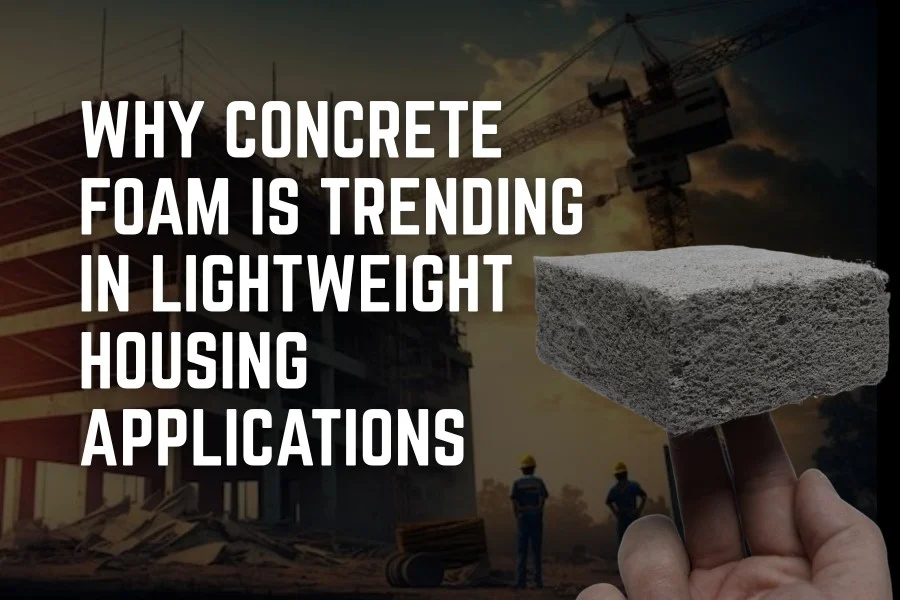
The construction industry is undergoing a significant transformation. Due to increasing urbanization, rising energy demands, and growing sustainability concerns, builders are seeking materials that are strong, efficient, lightweight, economical, and sustainable.
Foam concrete is one of the materials of note. For many centuries, traditional concrete has been the material of choice in construction, but foam concrete is now seriously competing with traditional concrete as a smart building alternative for lightweight housing.
Foam concrete is already being considered a preferred choice for developers and block manufacturers because of its thermal insulating properties, fire-resistant properties, and sustainability considerations compared to conventional concrete.
Table of Contents
At the core of this innovation is the foaming agent, an essential ingredient of foam concrete that allows it to be produced into lightweight foam concrete blocks.
Foaming agents generate stable air bubbles to produce lightweight foam concrete blocks that have enhanced insulation and improved ease of handling and installation, and these lightweight foam concrete blocks are starting to take hold in the affordable housing, prefabricated, and modular housing.
In this blog, we will examine foam concrete products and important elements of foam concrete to understand the popularity of foam concrete, how foaming agents are utilized, and what it means for the future of housing construction systems.
What is Foam Concrete?
Foam concrete, also known as cellular concrete or lightweight concrete, is a form of concrete that substitutes a percentage of the material with air.
This is accomplished by blending cement, water, fine aggregates, and a foaming agent to produce a mix with stable, microscopic bubbles that become incorporated into the slurry.
Result?
Concrete that is:
- Significantly lighter than conventional concrete.
- Thermally insulating and energy efficient.
- Environmentally friendly by using lower amounts of cement.
- Easier to transport and install on-site.
Typically, foam concrete is not used in heavy structural load-bearing applications; however, it has a great fit with housing where walls, partitions, insulation, and prefabricated components are required.
Why Foam Concrete is Gaining Traction in Lightweight Housing
1. The Lightweight Advantage
Conventional concrete is durable but extremely heavy. In many instances, structures are built with steel reinforcement and need a well-designed foundation to endure or support the weight of the concrete itself. Foam concrete is up to 50% less in weight because foaming agents add minute air bubbles into the concrete mixture.
Benefits for housing applications include:
- Less structural load on the foundation.
- Easier and faster to handle the blocks.
- Lower transportation costs.
- Safer and faster transportation on site.
This makes foam concrete a perfect fit for low-cost housing projects and prefabricated modular homes, which are all about speed and efficiency.
2. Superior Thermal Insulation
Energy efficiency is one of the primary aspects motivating the use of foam concrete. Foam concrete has less thermal transmission than regular concrete, so it is a natural insulating material in buildings.
Foam concrete reduces the amount of heat that enters buildings in hotter climates. For colder climates, foaming concrete retains heat when temperatures drop. These benefits:
- Less need for heating or air conditioning.
- Lower electricity bills for the homeowner.
- More comfort for the homeowner all year round.
In modern eco-housing projects, lightweight building blocks made using foaming agents are quickly becoming the standard for thermal performance.
3. Environmental sustainability
Construction generates a good portion of carbon emissions worldwide, with a large portion of that resulting from cement. Foam concrete provides a direct solution to these environmental impacts through:
- Less cement than a traditional concrete mix.
- Inclusion of fly ash or recycled by-products in many mixes.
- Less weight means lower fuel consumption and costs during transportation.
Manufacturers are embracing the use of foaming agents to produce lighter blocks, which saves money and reintroduces the green and low-carbon ethos into construction.
4. Fire resistance and safety.
Another important aspect of foam concrete is fire resistance. The structure of foam concrete significantly slows the spread of flames and the movement of heat.
- Safer for the residential home.
- Gives you more time to evacuate during a fire.
- Does not release toxins and is pest-resistant.
For homeowners, this translates into peace of mind, knowing their houses are safer and longer-lasting.
5. Cost Effectiveness
One of the reasons foam concrete is gaining popularity so rapidly is its cost advantage.
- Uses less raw material (cement and aggregates).
- Reduces the need for heavy lifting equipment.
- Cuts down construction timelines due to easy handling.
Block manufacturers also benefit because foam concrete blocks are in high demand, especially in affordable housing projects supported by governments and private developers.
Comparison: Foam Concrete vs Traditional Concrete
| Feature | Foam Concrete | Traditional Concrete |
| Density | 300 – 1600 kg/m³ | 2200 – 2500 kg/m³ |
| Compressive Strength | 1 – 15 MPa | 20 – 40 MPa |
| Thermal Insulation | Excellent (low conductivity) | Poor (high conductivity) |
| Weight | Lightweight | Heavy |
| Material Usage | Less cement, recycled fillers | High cement & aggregates |
| Applications | Blocks, partitions, insulation, prefabs | Foundations, load-bearing structures |
| Eco-Friendliness | High | Moderate to low |
This table shows why foam concrete is considered ideal for lightweight housing applications, though it does not fully replace traditional concrete for structural components.
Role of Foaming Agent in Lightweight Blocks
The foaming agent is what turns ordinary concrete blocks into lightweight foam concrete blocks. The foaming agent is similar to whipping cream in a coffee.
The foaming agent foams up the concrete mixture – changing the weight without changing the quality of the mixture. The foaming agent forms tiny air bubbles that create voids in the concrete mix, which reduces the weight while keeping the paste to a level of strength used in applications.


A foaming agent is just a chemical solution that will foam when added to cement slurry and thus create a stable, long-lasting foam. The foaming agent adds bubbles to the ready-made cement slurry that stay stable and do not collapse during mixing, pouring, or setting.
The bubbles must be stable since the properties of foam density and its voids will determine the characteristics (quality, strength, durability, etc.) of the end foam block.
The reasons foaming agents are essential for producing lightweight blocks are:
They allow for a uniform distribution of voids in the final material, or the block, so that there are no weak spots in the block.
They weigh less than normal-weight concrete, which makes them easier to handle on the job site.
They provide better thermal insulation, which keeps the building cooler in the summer and warmer in the winter.
They are a resource saver since they require less cement per block and thus lessen the environmental footprint.
These blocks provide a reasonable compressive strength while still being lightweight, making them suitable for a variety of structural and non-structural uses.
In simple words, without a good foaming agent, foam concrete would just be a weak, unstable mix. With the right foaming agent, it transforms into durable, eco-friendly, and cost-effective building blocks that modern construction increasingly depends on.
Applications of foam concrete in lightweight housing
Foam concrete’s versatility is a big reason for its success. Here is a list of some of its major applications:
Lightweight Blocks
- Non-load-bearing wall applications.
- Internal partitions.
- External insulation walls.
Prefabricated Panels
- Floor panels, wall panels, and roofing sheets.
- Used in modular and prefabricated houses.
Roof Insulation
Foam concrete layers are applied for insulating against thermal and sound.
Filling Material
Used in void filling, trench filling, and leveling.
Low-Cost Housing Projects
Mass housing schemes use foam concrete blocks for affordability and rapid construction.
Limitations of Foam Concrete
Foam concrete has many advantages, and you must remember its disadvantages as well:
- When the compressive strength ranges between 1–15 MPa, it cannot be used for heavy loads.
- It is more brittle than dense concrete.
- It is difficult to quality control the foam concrete if the foaming agent is of poor quality.
- Foam concrete requires appropriate care and finishing to ensure moisture absorption and durability.
This is mainly the reason foam concrete can be found used in non-structural elements rather than in the foundation and load-bearing structures.
Market Trends and Anticipated Developments
The use of foam concrete is more than a trend; it is part of a global transformation in building.
Urban Housing Needs: Rural migration requires developers to build quickly and cheaply.
Green Building: Laws and government rules will push the use of green materials.
Prefabricated Housing: Foam concrete blocks and panels are ideal for factory-built housing.
Technological Advances: Artificial intelligence applied to mix designs and foaming agents improves foam concrete.
In much of countries such as India, where affordable housing projects are a national imperative, foam concrete blocks are going to continue to play a larger role.
Conclusion: The Role of Sakshi Chem Sciences
Foam concrete is no longer an experimental material; it has become a mainstream lightweight housing solution. Its lightweight, insulating, fire-resistant, and cost-saving features make it the most viable solution for unearthing housing projects to fit your lifestyle.
At the heart of foam concrete production is the foaming agent, which provides stability, consistency, and durability to make lightweight blocks. Here’s where Sakshi Chem Sciences Pvt. Ltd. fits in.
0With over 20 years of experience in construction chemicals, Sakshi Chem has established a solid portfolio of foaming agents that allow block producers the ability to provide the best lightweight blocks available for housing projects globally.
By working with established chemical partners, manufacturers and developers can be assured that foam concrete will be grown correctly in a sustainable way while meeting the demands of affordable and efficient households.
FAQs
1. What is the primary benefit of foam concrete construction for housing?
It is a lightweight material combined with exceptional insulating qualities that make housing construction less time-consuming and energy-efficient.
2. What foaming agent is used?
The foaming agent produces air bubbles throughout the mix that are stable within the structural components, reducing density and providing the insulating qualities of foam concrete.
3. Is foam concrete structurally sound, can it be used for structural elements?
No foam concrete is not used structurally; it’s appropriate for non-load-bearing applications: blocks, walls, ceilings, and insulation.
4. Is foam concrete environmentally safe?
Yes, it uses less cement, often includes recycled materials, and lowers carbon footprint.
5. Who uses foaming agents?
Primarily, block manufacturers who produce lightweight foam concrete blocks for housing and prefabricated construction.

Sagar Telrandhe is a Construction Engineer with a B.Tech in Construction Engineering & Management. Passionate about infrastructure development, project planning, and sustainable construction, he specializes in modern construction techniques, project execution, and quality management, contributing to efficient and innovative building.