
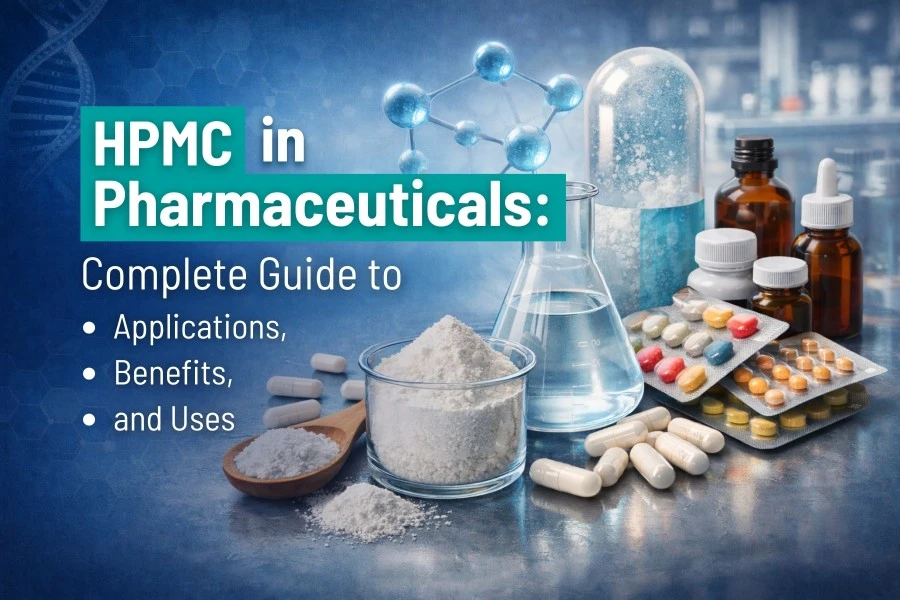
In the pharmaceutical sector, the efficacy of a medication does not depend only on the active compound, but also on the standard of other supporting components that are included in the form of “excipients.”
Excipients have a significant influence on enhancing stability, manufacturing efficiency, and performance associated with drug delivery.
Table of Contents
Hydroxypropyl Methylcellulose (HPMC) is among the most common excipients being used today, as they are versatile and stable. Due to their flexibility and consistency in providing support for many drug forms, such as; Tablets, Capsules, Suspensions, Gels and Controlled-Release Delivery Systems have contributed to making HPMC an essential ingredient in a lot of pharmaceutical formulations.
Sakshi Chem Sciences Pvt Ltd is focused on producing high-quality chemical solutions through the use of advanced research and manufacturing methods.
Although we specialize in construction chemicals, our combined capabilities of our experienced R & D team and commitment to quality; it allows us to produce advanced polymer materials for use in many other markets, including Pharmaceutical applications and industries.
This blog will give you an insight into the use of HPMC as an excipient in Pharmaceuticals, provide you with information on the properties, uses, and benefits of HPMC as part of its use as an excipient in Pharmaceuticals, and identify HPMC grades, including HPMC E5 and HPMC E15.
What is Hydroxypropyl Methylcellulose (HPMC)?
Hydroxypropyl Methylcellulose, commonly referred to as HPMC, is a non-ionic cellulose ether derived from natural cellulose obtained from refined cotton or wood pulp. Through a controlled chemical process known as etherification, hydroxyl groups in cellulose are partially replaced with methoxy and hydroxypropyl groups.
The resulting product is a fine white or off-white powder that is:
- Odorless
- Non-toxic
- Biocompatible
- Chemically stable
When mixed with cold water, HPMC dissolves to form a clear or slightly cloudy solution. Because it is chemically inert, it does not easily react with most pharmaceutical ingredients, making it highly compatible with a wide range of drug formulations.
Another important feature of HPMC is its availability in different viscosity grades. These grades allow pharmaceutical manufacturers to select the most suitable form depending on the specific application.
Among the most commonly used grades are HPMC E5 and HPMC E15, which offer different viscosity levels and performance characteristics for various formulations.
Why HPMC is Important in Modern Drug Formulation?
Regulatory agencies have developed regulations for the development of pharmaceutical products to guarantee their stability, safety, and effectiveness. Medications must be stored appropriately, achieve an exact dosage, and provide a consistent level of therapeutic effect.
HPMC is used to provide pharmaceutical products with physical, manufacturing, and release control properties.
1. The physical stability of drug formulations is improved through the use of HPMC because it protects drug formulations from moisture, heat, and the environment.
2. HPMC enhances efficiency in the manufacturing of pharmaceuticals by improving the granulation, compressibility, and coating processes.
3. HPMC also plays a critical role in controlling the rate at which drugs are released from dosage forms into the body. For all types of drug products, many of today’s more modern drugs need to be continuously released to maintain a steady concentration of the medication in the blood stream, and HPMC has properties that allow it to gel and be an appropriate candidate for establishing these types of delivery systems.
Due to all of these advantages, HPMC has become one of the most trusted excipients in the production of pharmaceuticals.
HPMC is a binder and disintegrant in the production of tablets.
Tablets are the most prevalent form of pharmaceuticals throughout the world. HPMC is a common excipient used in the production of tablets.
In the production of tablets, HPMC often acts as a binder during the granulation phase of production. When HPMC is dissolved in water, it produces a solution that binds the particles together, forming solid, uniform granules during the granulation step. This aids compressibility of the mixture of powders and prevents tablet cracking and/or lamination.
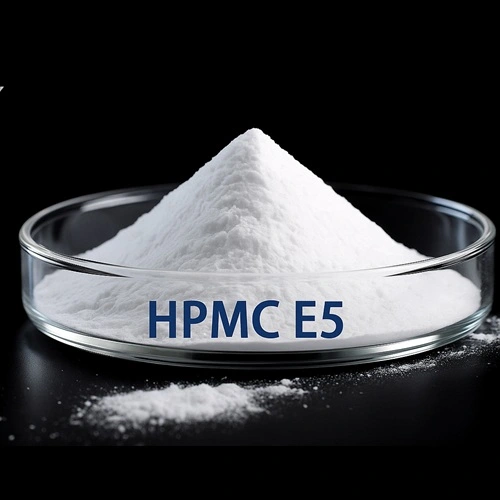
Lower viscosity grades such as HPMC E5 are particularly suitable for binding applications because they dissolve easily and distribute evenly throughout the formulation.
In addition to acting as a binder, HPMC can also function as a disintegrant. Once the tablet enters the digestive system, the polymer absorbs water and swells. This swelling action helps the tablet break apart and release the active ingredient efficiently.
The ability to balance tablet hardness with proper disintegration makes HPMC an essential component in many tablet formulations.
HPMC for Film Coating Applications
One of the most common uses of HPMC in Pharmaceuticals is tablet film coating.
HPMC forms a thin, transparent, and durable film when applied to the surface of tablets. This film provides several important advantages.
First, it improves the appearance of tablets, giving them a smooth and uniform finish. This enhances product appeal and makes tablets easier to swallow.
Second, the coating protects the drug from environmental factors such as moisture, oxygen, and light. This improves shelf life and product stability.
Third, the film coating can help mask unpleasant taste or odor, improving patient compliance.
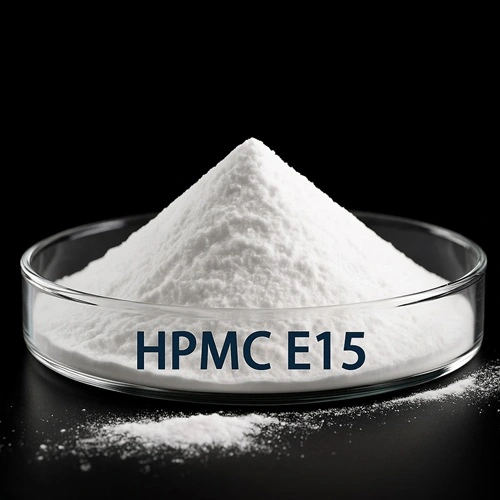
Grades like HPMC E15 are commonly used in film-coating formulations because their higher viscosity allows for strong and flexible coating layers.
Compared with traditional coating materials such as gelatin, HPMC coatings offer better stability and fewer processing challenges during manufacturing.
HPMC in Sustained-Release and Controlled-Release Formulations
In recent years, pharmaceutical research has increasingly focused on developing sustained-release and controlled-release medications.
These formulations allow drugs to be released slowly over time rather than all at once. This helps maintain consistent drug levels in the body and reduces the frequency of dosing.
HPMC in Pharmaceuticals plays a major role in these formulations.
When a tablet containing HPMC comes into contact with water, the polymer forms a gel layer around the tablet surface. This gel layer acts as a barrier that controls the rate at which the drug dissolves and diffuses into the body.
By adjusting the viscosity grade and concentration of HPMC, formulators can design tablets that release medication over several hours.
This approach is particularly useful for treating chronic conditions such as diabetes, hypertension, and cardiovascular diseases, where maintaining steady drug levels is important.
HPMC Capsules as an Alternative to Gelatin Capsules
Capsules made of gelatin (the traditional capsule shell material) are derived from animal sources and can be vulnerable to heat and moisture. But HPMC capsules have become an alternative to gelatin capsules because of their many advantages:
- Stable against moisture variance.
- Fewer chances of cross-linking during storage.
- Suitable for Vegans and Vegetarians.
- Stable disintegration performance.
Because HPMC is plant-based, it meets the requirements of many different diets and religions, thus making it a great alternative product option in the global pharmaceutical marketplace.
HPMC as a Suspending and Thickening Agent
In pharmaceutical formulations (liquid forms), like oral suspensions, keeping the active ingredients in uniformity throughout the liquid is important.
HPMC helps to create a homogeneous material by providing viscosity to the medium being used to keep the active ingredients from settling out.
Also, HPMC makes it easier for patients by improving how well the product will go back into suspension after being shaken before administration.
In topical & semi-solid formulations, HPMC provides thickeners and gel formers to produce the characteristic solid but smooth & homogeneous gel form most commonly found in:
- Ophthalmic solutions.
- Nasal sprays.
- Dermatological gels.
- Topical creams.
These applications benefit from the polymer’s safety, stability, and compatibility with other ingredients.
Choosing the Right Grade: HPMC E5 and HPMC E15
The viscosity grade selection is essential for pharmaceutical formulations to achieve their intended performance. The low viscosity HPMC E5 is most widely used for tablet binding and film coating applications and has good solubility characteristics; therefore, it is also used in some liquid formulations.
HPMC E15 is used for applications that require higher viscosity and better film formation characteristics, such as tablet coatings, controlled release applications, and thicker gel systems.
The pharmaceutical manufacturer can select the appropriate viscosity gradation so as to control various properties such as viscosity, drug release rate, and coating strength.

Factors That Should Be Considered When Selecting Pharmaceutical Grade HPMC
To make informed purchasing decisions for pharmaceutical-grade HPMC, pharmaceutical manufacturers should consider the following:
- Viscosity grade and level of substitution.
- CPM (Constant Particle Size Distribution).
- Moisture Content.
- Purity and Regulatory Compliance.
- Batch-to-Batch Consistency.
To ensure that optimal performance is achieved, pharmaceutical product manufacturers should only work with reliable suppliers that have strong quality management systems to support consistent and reliable formulation performance throughout the manufacturing process.
The quality control programs for Sakshi Chem Sciences Pvt Ltd are an established program for meeting regulatory and quality control requirements for products manufactured.
Rigorous testing capabilities combined with innovative chemical knowledge help ensure compliance with the regulations for any product manufactured.
Pharmaceutical Industry’s Future and Outlook
The pharmaceutical industry continues to grow rapidly and develop new technology. As this growth continues, the need for many-excipient materials will continue to grow.
HPMC has been proven to be extremely versatile in its use and has a solid foundation to support new pharmaceutical projects, whether developing new drug delivery systems or manufacturing plant-based capsules.
With a long history of safety, regulatory acceptance, and ability to provide other support, HPMC is the most valuable excipient to be used to manufacture modern medicines.
Conclusion
In sum, HPMC, as used in pharmaceuticals, is more than a simple filler; it is a multifunctional excipient capable of providing tablet binding, film coating, and sustained drug release, capsule formation, and stabilising suspensions.
The use of different grades of HPMC (i.e. HPMC E5 and HPMC E15) enables pharmaceutical manufacturers to develop their formulations specifically suited for unique applications while maintaining consistent quality and performance.
Sakshi Chem Sciences Pvt. Ltd. has decades of experience working with chemistries, state-of-the-art R&D capabilities, and comprehensive quality control procedures to provide reliable chemical solutions for the global chemical market.
Our focus on innovation and performance continues to support manufacturers in developing stronger, safer, and more effective products.
As the pharmaceutical industry continues to advance, versatile materials like HPMC will remain essential in shaping the future of drug formulation and delivery.

Sagar Telrandhe is a Construction Engineer with a B.Tech in Construction Engineering & Management. Passionate about infrastructure development, project planning, and sustainable construction, he specializes in modern construction techniques, project execution, and quality management, contributing to efficient and innovative building.