
Introduction: How We Build Has Changed
Since human civilization began, shelter has been one of the three critical life-sustaining human needs, along with food and clothing. Initially, our ancestors protected themselves in caves and made walls covered with mud, but then they learned better ways to make buildings.
Over time, superior methods of construction have emerged, and the masonry processes conceptually transformed into what modern-day housing and infrastructure are based on today.
Table of Contents
People used to construct with materials such as burnt bricks and stone, but due to the demand for building today, the need for materials that can be constructed faster and less expensively has emerged.
As a result, concrete blocks, especially hollow concrete blocks, have emerged as a building unit that is more time-efficient and less pricey to provide a strong, conventional structure.
This blog will cover hollow concrete blocks, including what they are, their advantages and disadvantages, types, and their impacts on construction.
What Are Concrete Blocks?
Concrete blocks are rectangular-shaped masonry units. Blocks can be either solid or hollow concrete blocks. While these building units can vary in density, style, and purpose, they are both made to be easy to manipulate, as well as measure the same size.
Just to be clear, concrete blocks are not concrete slabs or concrete panels. A concrete block’s height is never greater than its length and never greater than six times its width. They are very convenient when performing structural masonry.
There are two primary types of concrete blocks.
- Concrete Blocks
- Masonry Units
- There are two primary types of concrete blocks when used in masonry:
- Solid Concrete Blocks
- Hollow Concrete Blocks
Let’s investigate the two types, with special emphasis on the hollow concrete block.
1. Solid Concrete Blocks
Solid concrete blocks are made up of Portland cement, sand, and aggregates, but they are solid, which means that a minimum 75% of the block’s volume is filled with solid material. This makes them quite dense but also very strong.
Because of their great strength and soundness, solid concrete blocks are typically used in load-bearing and non-load-bearing walls.
Concrete blocks are large units, which means that you will need fewer of them, and that increases the speed and efficiency of the build process.
2. Hollow Concrete Blocks
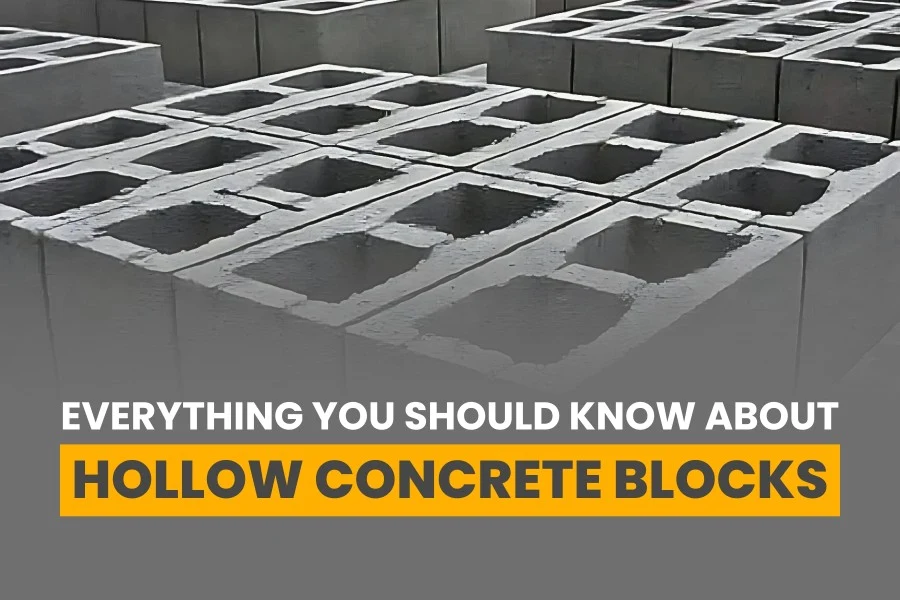
Hollow Concrete Blocks are rectangular-shaped units that are manufactured with cast concrete. Their density varies with the density of the concrete they are made from, with some using sand and gravel aggregate, or low-density materials like fly ash or bottom ash. These lightweight versions are often called cinder blocks or breeze blocks.
According to IS 2185 (Part-1) 2005, hollow blocks are blocks that have large cavities that are either open (fully penetrate the block) or closed.
The solid portion of the blocks volume is anywhere from 50-75% solid volume. The lighter hollow portions make the blocks lighter and easier to handle.
Hollow concrete blocks are very popular in the construction industry today because they allow for fast work, less cement and steel, and reduce labor costs. They are also easy to incorporate the electrical conduits and plumbing into the walls.
Sizes of Hollow Concrete Blocks
Hollow concrete blocks are available in full and half sizes. Full-size hollow concrete blocks are rectangular in shape and have two hollow cores, while the half-size hollow blocks are shaped like a cube and consist of one core.
According to the Research Designs & Standards Organization of Indian Railways, the sizes are:
Length – 400, 500 or 600 mm
Height – 200 or 100 mm
Width – 50, 75, 100, 150, 200, 250 or 300 mm
Types of Concrete Blocks
According to IS 2185 (Part-1) 2005, there are three main categorizations that fall under concrete blocks:
A. Hollow Concrete Blocks
Grade A:
Load-bearing type:
Minimum density = 1500 kg/m3; Compressive strength range = 3.5 – 15.0 N/mm2
Grade B:
Load-bearing also
Density = 1100 – 1500 kg/m3; Compressive strength: = 3.5 – 5.0 N/mm2
B. Solid Concrete Blocks
Grade C:
Load-bearing
Density = not less than 1800 kg/m3; Compressive strength = 4.0 – 5.0 N/mm2
Physical Properties of Hollow Concrete Blocks
According to Building Materials & Technology Promotion Council (Ministry of Housing & Urban Affairs, India), hollow blocks have the following physical properties:
Moisture Movement = ≤ 0.09%
Water Absorption = ≤ 10%
Drying Shrinkage = ≤ 0.06%
Compressive strength (grade A – = 3.5 – 15.0 N/mm2 and grade B = 3.5 – 5.0 N/mm2)
Density (grade A – = 1500kg/m3 and grade B = 1100-1500 kg/m3)
Use of Hollow Concrete Blocks
Hollow blocks can be used in many ways including:
- External and internal load-bearing wall construction
- Curtain wall construction
- Partition or panel wall construction
- Wall backing for stone or brick veneer
- Fireproofing structural elements
- Stairwells and elevator shaft walls
- Piers, columns, and retaining walls
- Boundary fencing
Advantages of Using Hollow Concrete Blocks
Faster Construction: These innovative blocks are easy to install to allow for faster schedules than traditional brick construction. The larger blocks are able to be installed by workers more easily and quickly, resulting in a higher level of time savings on the job site.
Cost Effective: Larger blocks allow for fewer joints, which provides several advantages as the amount of mortar ultimately used is reduced and also reduces labor costs of installation.
This level of efficiency results in significant cost savings for comparative construction without losing quality.
Easy to Work With: The lightweight and manageable size of the blocks makes it easy to use and allows semi-skilled workers to install them easily.
The ease of handling provides an opportunity for easy training of workers and rapid deployment, with minimal training required.
Low Maintenance: Designed to last, blocks are built substantially durable with very low maintenance, giving property owners lower long-term costs due to less maintenance and repair, or replacements for the end-users.
Eco Friendly: Typically produced from recycled waste or by-products of industrial processes, such as fly ash, blocks can be produced from waste commissioning, exactly how the product lowers the ecological footprint of what was typically only used through more traditional means of manufacturing traditional blocks. The use of waste materials also reduces the amount of waste generated to goes to the landfill.
No Need for Extra Formwork: The configuration of these blocks has made the reinforcing process easier, as there is no need for any additional formwork, which can help save on both materials and labor.
Greater Durability: These blocks are made with a higher density through high-pressure compaction and vibration, giving them greater strength and durability. Their durability enables them to withstand stresses and environmental impacts.
Lighter Weight: The lighter weight of these blocks leads to a lighter structural load, which can lessen the amount of reinforcement in Reinforced Cement Concrete (RCC) construction. The lighter weight of the block can save further cost and design possibilities in the project. The chemical foaming agent used in manufacturing of lighter weight blocks.


Better Bond: The texture of the surface makes for a better bond when mortar is applied, and therefore increases the complete bond between blocks. This will make the structure more stable and built to resist cracking and separation over the years.
Space Saving: The blocks also have thinly profiled walls, leading to more usable, liveable space inside the building. This may be especially advantageous in urban areas that are constrained for available square footage in their residential and commercial designs.
Earthquake resistance: The hollow cores can be filled with steel and concrete, which greatly enhances the structural integrity and earthquake resistance of such buildings. This would provide for safer design in earthquake-prone areas.
Thermal and Sound Insulation: The intrinsic qualities of these blocks provide excellent thermal and sound insulation. They help to keep indoor temperatures comfortable while also minimizing sound propagation between interior spaces, therefore improving the indoor experience for people who live or work inside.
Lower Moisture Vulnerability: These blocks are manufactured to perform far better at resisting dampness than normal bricks, which further reduces cold weather problems and improves the integrity of the structure when exposed to variable weather changes.
Weather Resistant: These blocks are made for use in a range of environments, with no need for additional treatments for added protection, which also saves time and costs associated with the project. And they will last!
Fire-Resistant: The material contained in these blocks provides great fire protection. The blocks improve the safety of the entire structure. As an alternative to other materials, the fire-resistant properties can help reduce risk on the project and meet safety regulations for the fire department, and provide security for all occupants.
Disadvantages of Hollow Concrete Block
While there are so many advantages, there are some disadvantages with respect to hollow concrete blocks:
More Expensive: The cost is higher than traditional bricks.
Seismic Risk: Commonwealth hollow block walls with no rebar reinforcement do not fare well in an earthquake.
Classification of Hollow Concrete Block
There are numerous designs of hollow concrete blocks that are aimed at specific construction needs, and they will provide various benefits and applications:
1. Concrete Stretcher Blocks
These are very different forms of concrete block used almost universally, and they provide the basic structure for all masonry walls. They are generally rectangular blocks and are installed on their longest side.
These blocks are manufactured to uniform sizes so they can be simply placed flush with one another in the correct alignment, making it easier to ensure a wall is vertical when actually built.
2. Lintel Blocks
Also called beam or channel blocks, lintel blocks are U-shaped. When installed, they are filled with concrete and concrete reinforcement that will offer significant support for areas above openings, such as doors and windows.
The design allows the load from the wall above to be transferred to the wall ends and load-bearing structure underneath without crushing the wall openings.
3. Partition Concrete Block
Partition concrete blocks are great for non-load-bearing walls and generally have multiple hollow cores, which contribute to the lightweight of the block itself.
These blocks do tend to be taller than wide making them easy to handle and install. These blocks offer an easy way to separate areas while offering some measure of sound insulation and aesthetic qualities.
4. Concrete Pillar Block
Often called double corner blocks, because they can also be used as doubled walls (double corner blocks), concrete pillar blocks are designed to be used at the particular viewable ends of columns or as standalone piers.
This type of block is made very robust for good compressive strength, which means it can work with some very vertical load bearing.
5. Concrete Corner Blocks
These blocks are built to be used at wall corners, doorways or window ends. The corner block has one side flat and visible for a neat finish, while the other side has a female interlocking pattern that will lock together with a stretcher block, which adds stability to the wall structure.
6. Jamb Concrete Blocks
Jamb concrete blocks provide a place for window frames to be applied, and are necessary in walls that have elaborately designed window openings.
The dimensions of these blocks work to fit standard window-sized openings. These blocks will allow for a secure fit and ease of installation for window frames.
7. Bullnose Concrete Blocks
Bullnose concrete blocks are similar to corner blocks, except they have a rounded edge. Bullnose concrete block can be used for both aesthetic and safety reasons.
Using bullnose places a softer look on masonry corners and stops people from getting hurt against sharp edges.
8. Frogged Brick Blocks
Frogged brick blocks will have a depression or ‘frog’ at the top that improves mortar bond with a block being placed above. Not only does frogged improve mortar bond, but it also reduces the weight of the block, therefore making it easier to manoeuvre.
Each one of a number of hollow concrete block designs can assist you and speed up construction processes while addressing both structural and aesthetic requirements.
Summary
Hollow concrete blocks are game-changers in construction. They are quicker than using traditional bricks, more durable, and generally more effective when it comes to insulation.
With so many different sizes and types, and structural advantages, they are now one of the most important materials in the construction business.
They are cheaper when you can avoid the costs needed to utilize bricks, and some blocks are made from recycled materials and chemical admixtures that contribute to sustainability in building, too.
So, whatever project you are building, a residential home, commercial building, or any kind of infrastructure, hollow concrete blocks will give you an easy, more efficient solution that is more compatible with the future than using traditional materials.

Sandip Agrawal, Polymer Engineer and MD of Sakshi Chem Sciences Pvt. Ltd., leads innovation in construction chemicals, shuttering oils, and industrial lubricants. With expertise in polymer science and eco-friendly solutions, he drives R&D and sustainable advancements, ensuring high-performance products for India and global markets.