
In today’s construction world, reinforced cement concrete (RCC) has become the standard durable and long-lasting material to create most structures.
RCC is a combination of two strong materials: steel for tension and concrete for compression. Together, they create a permanent, flexible building material used to build projects ranging from small residential homes to large bridges.
Table of Contents
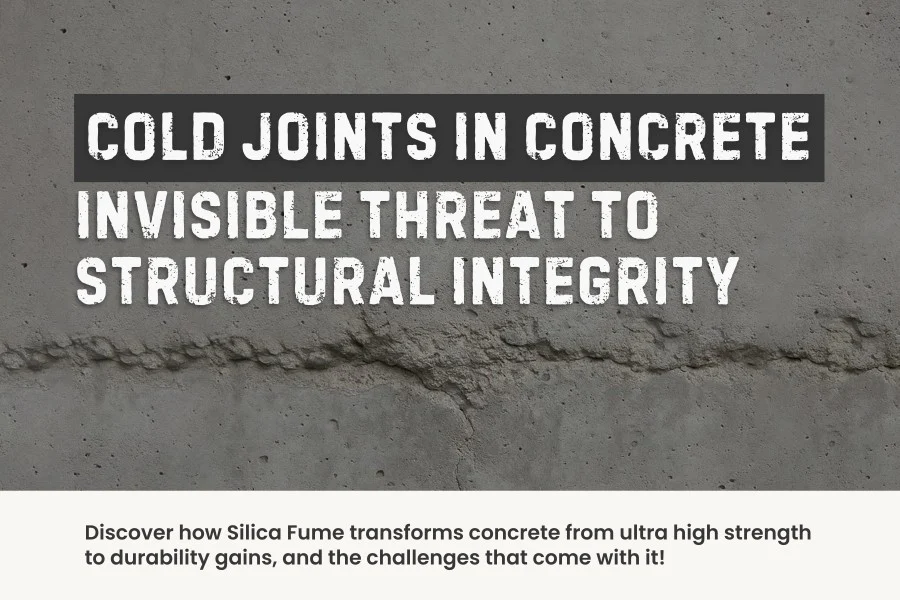
While RCC is generally a sound material, one potential defect that can seriously impact the performance of an RCC project is cold joints in concrete.
These can sometimes be undetectable, but they are a danger to the stability of any concrete project. This guide will discuss the definition of cold joints, the reasons for their occurrence, and the potential impacts and mitigation plans available to prevent or repair them.
What Are Cold Joints in Concrete?
Cold joints occur when there is an interruption or delay in the pouring of concrete, resulting in a weak connection between two pours. Simply put, imagine you pour concrete, stop for a period of time, and later, pour another layer.
By that time, the first pour has had time to set, and you have defined a physical, visible, or invisible connection between the two pours, causing a cold joint.
Although concrete is engineered to act as one solid mass, cold joints disrupt that flow of concrete and create places where it never quite fuses together, causing weaknesses within the structural integrity.
Please remember, not every cold joint is readily visible or ready to fail – they merely create possible fail points, especially under certain conditions.
Reasons for Cold Joints
Cold joints are formed for a variety of reasons:
Delays in pouring – Usually, the cause is having too long a time gap between two batches of concrete while it’s still in the process of being poured.
Poor planning – If the actual quantity of concrete required is underestimated, or the resources are improperly managed, it’s more likely to have cold joints.
Limited manpower or equipment – Not all companies and contractors have unlimited access to enough vibrators, mixers, and skilled labor to enable the continued compaction and pouring of concrete in a timely manner, leading to cold joints.
Hot weather conditions – Obviously, one of the worst things that can happen is to work in high temperature conditions, where concrete sets quickly. When hot, unless put in admixtures (that will extend the suitable working time of sets), cold joints may happen.
The Role of Concrete Admixture
One viable option to decrease the occurrence of cold joints is to utilize a concrete admixture, specifically, a retarding admixture.
Retarding admixtures can slow down the initial setting time of concrete allowing more time between pours to facilitate time for a good bond without worrying about the quality of the bond.
In hot weather conditions, admixtures can be a necessity to limit the initial setting and/or premature hardening of concrete, which typically causes issues with cold joints.

Establishing Areas to Consider for Cold Joints in Concrete
Cold joints in concrete can be more than just an aesthetic problem. Here are some of the ways these imperfections can impact a structure.
1. Cracking
Cold joints do not typically result in a gap or void in the concrete, but they do produce linear seams in the mass of the concrete.
These seams can typically be seen because of slight color variations between the two pours. Ultimately, and with enough time (and stress), it is possible that cold joints will develop isotropic cracks.
2. Weak Bonding
When concrete is poured onto concrete that has already cured, the fresh pour does not bond very well to the hardened pour.
This issue of integration can cause a significant reduction in the effective strength of the structure if no surface preparation is completed before the fresh pour.
3. Structural Failures in Tension Zones
Concrete is naturally very strong under compression, but difficult when it comes to tension. That’s when steel reinforcement kicks in. But if there’s a cold joint in a tensile location – that’s a problem.
Over time, the area will (not certainly, but likely) start to crack or separate, and it could become a massive issue that requires urgent repairs.
4. Water Leakage
Cold joints are often paths for items such as water to seep through in places like bathrooms or terraces. The “floor” slabs placed in both locations are generally tested, sealed, and waterproofed for expected water exposures. If a cold joint is not addressed in these locations, it may end up causing expensive damage.
5. Increased Deterioration
Cold joints allow moisture and air into the structure, and when not addressed, can damage concrete over time, especially in bad environmental conditions. This can dictate the pace at which deterioration occurs, and, of course, the power of a tone in flexure.
Best Practices to Avoid Cold Joints in Concrete
You can typically avoid most cold joints by following a few simple yet significant actions when planning and executing your project:
1. Careful Planning and Execution
Prior to commencing any concrete work, always evaluate the scope of work, manpower, equipment, and volume of concrete or “pour” you will require by working. If you expect to require multiple pours, plan for construction joints to control where cold joints will occur.
2. Layered Pouring and Compaction
Do not dump concrete indiscriminately. Instead, pour in 18″ thick layers and use a vibrator to intermingle the layers. When forming walls and beams, have the truck start pouring from the corner and move inward.
In the case of slabs, have it pour fresh concrete on the iras as if it were the previous batch into a single continuous layer.
3. Use of Retarding Admixtures
In hot climates, retarding admixtures can help to lengthen pouring time and will be a positive thing because they allow that if you’re running behind, the previous batch will not have set before you’ll add the next.
4. Vibration
When attempting to bond two batches of concrete together, firm and even vibration is an absolute must. There must be continuous deep vibration to help in removing air pockets and assisting in the bond of the two layers of concrete.
Make sure that the vibrator gets down to the bottom of the first pour in order to merge the two layers into one.
How to Fix Cold Joints in Concrete?
Even with the best planning, sometimes cold joints occur. Here is what you can do when they do occur at various times:
A. Fixing Cold Joints During the Plastic Stage
If the concrete has not set yet and the surface is soft, you can put some fresh concrete right on top of the old concrete. You will use a vibrator to vibrate the two layers together, and hopefully, this is your perfect cold joint repair.
B. Repairing After Initial Set
If the concrete is stiff but not fully hard, we will rake the surface to remove any weak concrete and then lay a 12 mm mortar bed on which we can pour new concrete. Again, vibration is the key to ensure the two layers become one.
C. Repairs If Fully Hardened
If the concrete is hard, surface preparation will be more involved. You will most likely perform some cuts or roughen the surface, then rely on bonding agents, mortars, and pour the next batch. Again, vibration to the joint will create bonding with the maximum area to rely on.
Other Tips for Dealing with Cold Joints
Here are some extra methods to help either prevent or contend with cold joints:
Bonding agent: This, of course, helps the old/new layers adhere better.
Epoxy injections: In structural repair, where cracks develop, epoxy can fill and seal.
Polyurethane injection: useful in water-seepage areas and larger voids.
Dowel bars: Dowel bars act as connectors. For large pours, they build into strength and align the two pads.
Underpinning: A method used in concrete foundations, it will strengthen areas of concern under the effect of a cold joint.
Elastomeric waterproofing membranes: This can be useful to seal off non-structural cold joints for the prevention of leaking.
Avoid mold oil: No chemicals containing mold oil or anything that could inhibit bonding, should ever have contact with potential joint areas.
Carefully examine your [proposed] structure for areas where a cold joint is most likely, and plan to implement the preventative measures proactively.
Cold Joints vs Construction Joints: What is the difference?
Cold joints sound similar to a construction joint, but they are not the same, and the difference is that construction joints are planned with the proper preparation, compared to some intervening with cold joints.
Construction joints consist of bonding agents, reinforcement, and surface cleaning that make them cleaner, safer, and more consistent.
A cold joint will frequently occur unplanned and will be rarely found unless the system has already failed.
Final Thoughts
A cold joint in concrete may appear minor at the time of construction; however, long-term cold joints can have serious long-term effects.
They undermine the structural integrity of the system, lessen load-bearing capacity, and can open up water infiltration possibilities or develop cracks.
If treated correctly through procedures, planning, and the use of proper concrete admixtures, most cold joints can be avoided. If any do occur, prompt repair and intervention can help rectify the shortcomings of cold joints.
Whether you’re building a high-rise tower or a simple patio, knowing how to handle cold joints could be the difference between a structure that lasts a decade and one that stands for generations.

Sagar Telrandhe is a Construction Engineer with a B.Tech in Construction Engineering & Management. Passionate about infrastructure development, project planning, and sustainable construction, he specializes in modern construction techniques, project execution, and quality management, contributing to efficient and innovative building.