
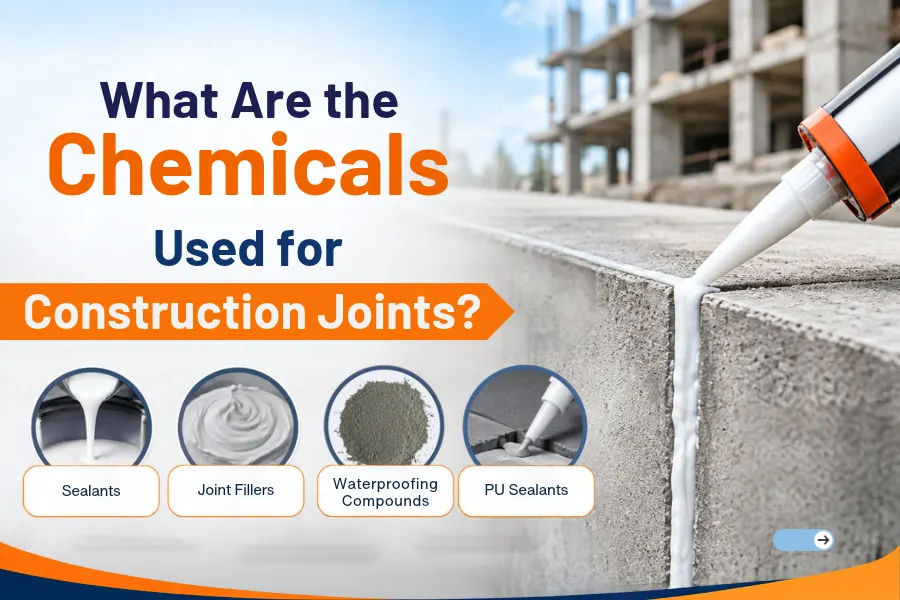
It is uncommon for any construction task to have a single-day pour of concrete. Most construction works occur in stages, which means there are joints where freshly poured concrete meets the already cured concrete.
Although the construction joints are necessary, improper application at the joints may result in water leaking through it, poor adhesion, and deterioration.
Table of Contents
It is important to choose the right kind of chemicals used for construction joints in order to improve adhesion, sealing, and durability. This blog will provide you with some information regarding different types of chemicals used for construction joints and how to choose the best solution for your needs.
What Are Construction Joints?
Construction joints are designed joints that connect concrete components that were cast at different times. Construction joints are often used in a variety of structures, including buildings, bridges, foundations, tanks, tunnels, or floors.
If the joint is designed correctly and well made, it can serve as a solution for achieving structural continuity. However, sometimes it is necessary to apply additional treatment techniques to ensure waterproofness, provide better adhesion, or allow movement.
Common Chemicals Used for Construction Joints
1. Agents for bonding using Epoxy
Epoxy bonding agents are made use of for creating a strong adhesion between old concrete and new concrete. They are preferably applied on jobs where bonding is highly required.
Application of bonding agents:
- Bonding old concrete with new concrete
- Repair of structures
- Joining precast concrete
- Rehabilitation
One has to keep in mind that the adhesive is of the right type suitable for the current condition of the bonding surface, temperature and structure.
2. Agents for bonding using Polymer
Polymer bonding systems such as acrylic and SBR are some of the agents that offer better adhesion properties between the existing concrete and the repair materials.
The best bonding agent must be selected for the bonding procedure.
Application of bonding agents:
- Concrete resurfacing
- Using of repair mortar
- Floor repair
- Other cement-based applications
3. Sealants for Polyurethane
Construction joints subjected to temperature change or movement need to be treated by flexible material.
Polyurethane sealants are cured sealants that retain flexibility even after the process is over.
Applications:
- Parking structures
- Concrete floors
- Basement
- External construction joint systems
4. Polysulfide Sealants
Polysulfide sealants are flexible sealing materials that are suitable for places where there is a need for resistance to weathering and certain environmental conditions.
It can be used for industrial floors, external concrete joints, and certain water-related structures.
It is important to check for compatibility with certain chemicals and exposure conditions.
5. Hydrophilic Waterstops
Water ingress is a major issue in underground and water-retaining structures.
Hydrophilic waterstops are installed in the construction joints, and they swell upon the introduction of water, helping to restrict the movement of water through joints.
Some common uses are:
- Basements
- Water tanks
- Tunnels
- Sewage treatment facilities
- Underground structures
6. Polyurethane Injection Chemicals
Polyurethane injection resins are utilized in sealing water leaks in existing cracks and construction joints.
Particular formulations would react with water and expand.
Polyurethane can be used in the repairs of basements, tunnels, and other underground constructions.
Construction Joint Chemicals at a Glance
| Chemical or Material | Primary Purpose | Common Application |
| Epoxy Bonding Agent | Strong concrete bonding | Old-to-new concrete |
| Polymer Bonding Agent | Improved adhesion | Repair and resurfacing |
| Polyurethane Sealant | Flexible joint sealing | Movement joints |
| Polysulfide Sealant | Weather-resistant sealing | Industrial and exterior joints |
| Hydrophilic Waterstop | Restrict water passage | Basements and water tanks |
| PU Injection Resin | Seal existing leakage | Cracks and leaking joints |
How to Choose the Right Chemicals Used for Construction Joints?
Choosing the appropriate chemical construction joint depends on a number of factors.
Type of joint: Whether it is a fixed joint or a moving one will determine the type of treatment needed.
Water exposure: Underground structures and those with a system to store water require certain water management systems.
Movement requirement: Flexible sealants are usually required if joint movements are anticipated.
Structural needs: Some applications may need strong bonding systems.
Chemical requirements: There are some industrial situations when special chemicals have to be used, and certain materials have to be utilized.
Surface finishing: The surface affected by dust, oil, loose concrete, and laitance has to be taken into account.
An understanding of the above-listed factors should help contractors select appropriate materials.
Why Is Proper Construction Joint Treatment Important?
Poorly maintained joints in building construction can be susceptible to leaking, cracking, or damage.
Proper treatment of joints improves durability and allows functioning of joints.
However, the use of chemicals does not fully compensate for poor design or technical work.
Surface treatment, adherence to the manufacturer’s recommendations, and correct application of the technology remain important.


Why Choose Sakshi Chem Sciences?
Sakshi Chem Sciences Pvt. Ltd. is one of the prominent manufacturers, suppliers, and exporters of construction chemicals with two decades of experience in the industry.
Sakshi Chem Sciences Pvt. Ltd. manufactures more than 50 construction chemical products ranging from concrete admixtures, waterproofing solutions, grouts, release agents, and repair and restoration products.
With the help of the latest R&D, advanced production technology, and effective quality control processes, the company provides reliable and economical construction chemical solutions.
There is a qualified technologist in the company who can advise customers on the best solution suitable for their construction project.
Conclusion
Depending on the specifications, different construction joint chemicals will be used for various purposes. Epoxy and polymer-based bonding agents should provide better adhesion. Flexible sealants should allow for movement. Waterstops and injection chemicals should provide a means of controlling leakage.
The selection of the material should be made according to joint design, exposure conditions, structural requirements, and application methods. With the right products and good workmanship, construction joints can be expected to perform well for a long time.
Frequently Asked Questions
1. What chemicals are commonly used for construction joints?
Common materials include epoxy bonding agents, polymer-based bonding systems, polyurethane sealants, polysulfide sealants, hydrophilic waterstops, and PU injection resins.
2. Which Bonding Agent is suitable for joining old and new concrete?
Epoxy bonding agents are commonly used when strong adhesion between existing and newly placed concrete is required. Product selection depends on structural requirements and site conditions.
3. How can water leakage through construction joints be prevented?
Properly designed waterstops, suitable joint sealants, and waterproofing systems can help prevent leakage. PU injection resins may be used to address certain existing leaks.
4. Can polyurethane sealants be used for construction joints?
Yes. Polyurethane sealants are suitable for certain construction joints where flexibility and movement accommodation are required.
5. Why is surface preparation important before applying joint chemicals?
Proper surface preparation removes contaminants such as dust, oil, loose concrete, and laitance that can interfere with adhesion and reduce the effectiveness of joint treatment.

Sagar Telrandhe is a Construction Engineer with a B.Tech in Construction Engineering & Management. Passionate about infrastructure development, project planning, and sustainable construction, he specializes in modern construction techniques, project execution, and quality management, contributing to efficient and innovative building.