
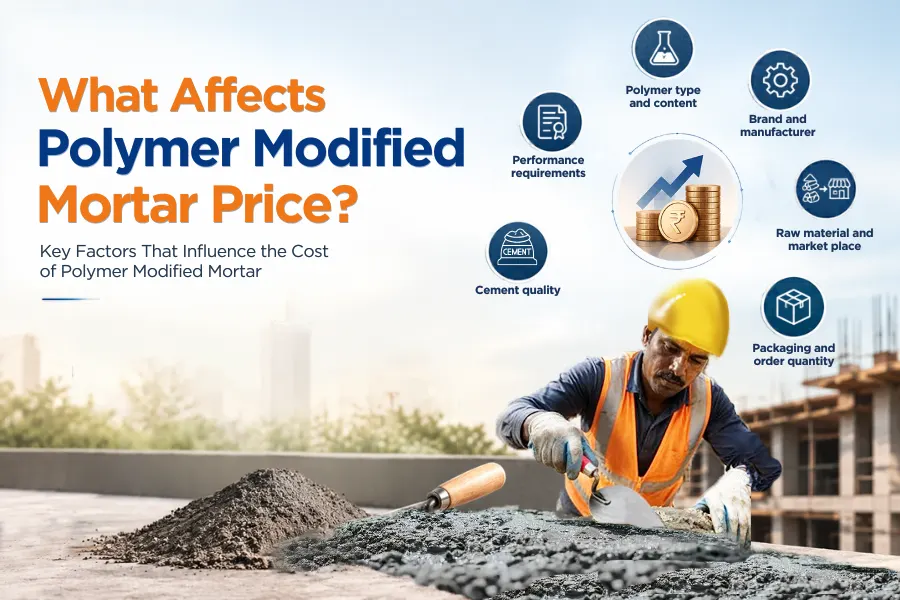
Polymer modified mortar (PMM) is popular in various construction applications like concrete repairs, waterproofing, patch repairs, and enhancing the strength of structures, owing to its exceptional adhesion, durability, and crack resistance.
Table of Contents
Factors like product formulation, application thickness, condition of the surface, size of the project, cost of labor, and transportation cost all affect the Polymer Modified Mortar Price. Read on to find out what other factors need to be taken into account when deciding on whether to choose PMM or not.
Key Factors Affecting Polymer Modified Mortar Price
1. Types and Quality of Polymers
The cost of polymers depends on their types and quality. Different polymers have different properties in terms of adhesion, flexibility, strength, and productivity. Higher performance formulations may be more expensive, but they are more suitable for heavy-duty repairs.
2. Quality of Cement and Additives
Cement quality and the technology of performance-enhancing products influence the overall cost. A good mortar may have better:
- Adhesion
- Strength
- Crack resistance
- Durability
Choosing a product only because it costs less does not make sense if it requires frequent repairs.
3. Thickness of Use
The thicker the application of the material is, the more material will be used for its application. A thin repair layer will require smaller quantities of material. Hence, the necessary thickness is to be considered while making calculations.
4. Surface Situation
The state of the surface is also an important factor determining the overall price. A decent surface can be prepared easily, while a damaged one would require cleaning and repair operations.
5. Type of Application
PMM is applicable to various projects ranging from structural and patch repairs to waterproofing and strengthening applications. Different formulations and quality levels may be needed for different applications; therefore, a product suitable for one project may be absolutely unfit for the next one.
6. Quantity and Size
The quantity of PMM affects the project price. Small orders can be less economical than larger orders or project purchases. It is advisable to discuss specific needs with vendors for large orders.
7. Workforce and Implementation
The price of materials is not the sole factor in the overall costs. The overall costs also depend on skilled workers, surface preparation, mixing process, and manner of application.
A product that simplifies application might lead to better productivity.
8. Position and Movement of materials to job site
Costs of transportation vary from project to project depending on the location of a project, the amount of material ordered, and the distance of delivery. Remote projects may be more expensive than those held close to production or distribution centers.
How to Choose PMM Based on Cost and Performance?
It is not always the case that the cheapest Polymer Modified Mortar Price also ends up with the cheapest overall project costs. You need to take into account the intended application, coverage, required thickness, performance characteristics, surface preparation, and expected service life of the application.
When carrying out critical structural repairs, it is better to pursue formulation based on technical specifications and not rely solely on the price.
Why Choose Sakshi Chem Sciences?
Sakshi Chem Sciences Pvt. Ltd. is one of the prominent manufacturers, suppliers, and exporters of construction chemicals, operating for around two decades.
In its portfolio, you can find over 50 construction chemical solutions like concrete and cement admixtures, waterproofing products, grouts, mould release agents, and rehabilitation and repair products.
Sakshi strives to provide effective construction chemical solutions via its advanced R&D facilities, state-of-the-art manufacturing techniques, and quality assurance. In addition, the technical team provides assistance in selecting the right product based on various applications and needs.
Conclusion
Several factors determine Polymer Modified Mortar Price, including polymer quality, cement and additives, application thickness, surface condition, project quantity, labour, and transportation.
Rather than comparing products on price alone, buyers should consider the complete cost of application and the performance required for the project. Choosing the right formulation from a reliable construction chemical supplier can help achieve a balance between cost, durability, and long-term performance.
FAQs
1. Why does polymer modified mortar cost more than conventional mortar?
PMM contains polymers and performance-enhancing components that can improve properties such as adhesion, flexibility, strength, and durability. The formulation and quality of these components influence the price.
2. What are the main factors affecting Polymer Modified Mortar Price?
The main factors include polymer and cement quality, additives, application thickness, surface condition, quantity, labour, transportation, and the specific application.
3. Does buying PMM in bulk reduce the cost?
Bulk or project-based orders may offer better per-unit pricing, depending on the supplier, quantity, and project requirements.
4. Is cheaper polymer modified mortar always the better option?
Not necessarily. Product suitability and performance should be considered alongside price, particularly for structural repair and other demanding applications.
5. Where is polymer modified mortar used?
It is commonly used for concrete repair, patch repairs, waterproofing-related applications, and structural strengthening, depending on the formulation.

Sagar Telrandhe is a Construction Engineer with a B.Tech in Construction Engineering & Management. Passionate about infrastructure development, project planning, and sustainable construction, he specializes in modern construction techniques, project execution, and quality management, contributing to efficient and innovative building.