
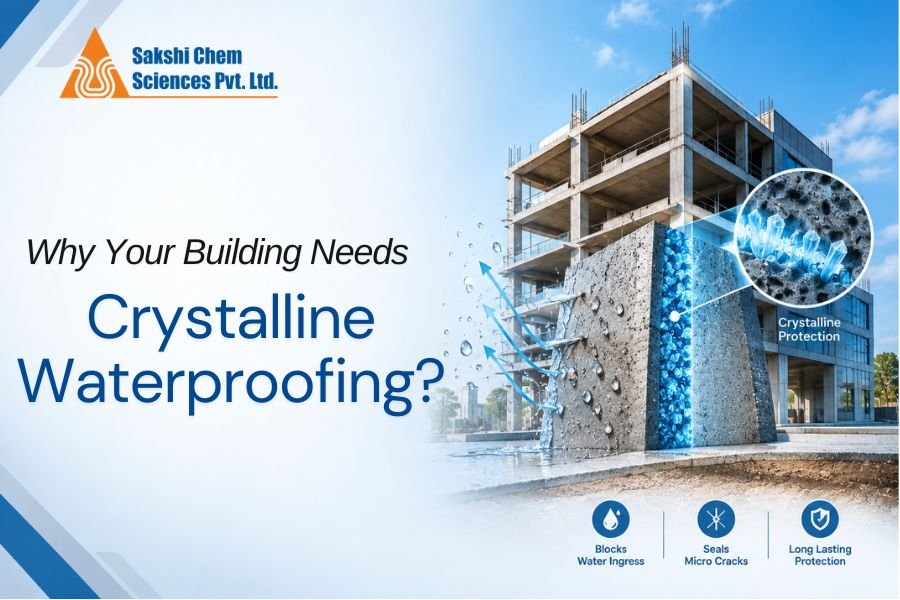
The infiltration of water into the pores of concrete can cause extensive yet hidden damage over time but Crystalline Waterproofing provides a solution by forming water-blocking crystalline structures in concrete.
Table of Contents
Crystalline technology functions at the molecular level, in contrast to other waterproofing techniques that only cover the surface of the concrete.
In this blog, we will learn about how crystalline waterproofing works, its advantages, usual applications in concrete, as well as how effective it is compared to other methods.
What Is Crystalline Waterproofing?
Crystalline waterproofing refers to the process of waterproofing of concrete in which active substances specially formulated interact chemically with a concrete-based mixture, resulting in formation of insoluble crystalline structures.
Crystal formations occur in micro-cracks, pores, and capillaries of concrete, hence minimizing the paths for water to pass.
Crystalline waterproofing can be used to either create a concrete mix or to treat the surface of existing concrete, depending on the technology and product used.
While in conventional coating methods the waterproofing process is going to create a coating on the surface of concrete, with crystalline waterproofing the process involves integrating the technology into concrete.
There are several applications of crystalline waterproofing technology:
- As an additive to the concrete mixture
- As a slurry or coating applied to the surface
- As a dry shake treatment
The method to be used for treating the concrete is determined by the product and static conditions of concrete during the construction process.
How Does Crystalline Waterproofing Work?
The scientific basis for crystalline waterproofing is built upon a series of chemical processes that occur in the cement-based environment.
The concrete itself is already saturated with water and its hydration products, which consist of substances like calcium hydroxide. Once the chemical ingredients of a crystalline mixture come into contact with adequate water and concrete’s chemical situations, they will interact to create low-solubility crystalline formations.
Those crystalline formations will keep filling in the pores and capillaries of the concrete. The presence of such formations makes the ability of liquid water to flow through concrete substantially limited. What is more interesting in the given method is that it relies on moisture activation.
Where the adequate reactive material is still present, another contact with moisture can create crystal formations. This peculiarity of crystalline waterproofing is the reason for its association with self-sealing properties.
Nevertheless, it does not mean that all cracks of any nature or size will fix themselves without any effort put into the repairing process.
The core process can be recapped as follows:
Active ingredients come in contact with moisture as well as certain cement hydration products.
A crystal form develops in the concrete.
Crystals fill the pores and the capillary channels.
The movement of water through the channels is decreased.
Under favorable conditions, crystallization can take place whenever moisture is present.
The inner working is what separates crystalline waterproofing from the traditional surface barrier.
Why Does Your Building Need Crystalline Waterproofing?
Waterproofing is much more than simply keeping a structure dry. In fact, controlling the movement of water can help protect the building and minimize future maintenance costs.
1. Provides Protection from Water Movement
When talking about crystalline waterproofing, it can be noted that the main purpose of this method is to minimize the transportation of water through the structure by using its properties.
It can be achieved due to the fact that the presence of crystalline substances creates barriers in certain spots, which provides a lot of protection for the structure that is exposed to groundwater, rainwater, water pressure, or constant moisture.
2. Provides Integrated Protection
In the case of a membrane waterproofing method, the membrane remains on the surface. If the membrane gets punctured, damaged, or improperly adhered, it might lose its waterproofing ability.
In case of crystalline waterproofing, things are different. When this type of waterproofing is exposed as an integrated treatment method, the active waterproofing method becomes a constituent of concrete. This type of waterproofing can be useful in places where the waterproofing would otherwise be physically damaged by construction work, backfilling, abrasion, etc.
3. Aids Long-Term Durability
Moisture can be one of the reasons for different types of concrete damage. The concrete can absorb water, which along with the presence of aggressive substances, including chlorides, can lead to corrosion of steel reinforcement.
Crystalline waterproofing technology can help reduce moisture penetration and enable the durability strategy for the structure.
However, it should be treated as one of the components of a total durability system instead of a replacement for correct concrete design, sufficient design cover, right curing, crack control, and quality construction.
4. May Help Stop Small Cracks
One of the advantages of crystalline technology is its possibility to be activated in a humid environment.
If the concrete contains suitable crystalline material, its activation may occur once a small crack develops, allowing the moisture to pass through the crack and generate crystals.
However, it would not work if the crack is too large or if it is moving, requiring alternative repair methods.
5. Resist Water Pressure
In the case of concrete structures, which include basements, retaining walls, tanks, and subsurface structures, the impact of hydrostatic pressure is to be confronted.
A good crystalline waterproofing system can prevent water from being able to enter in a positive water pressure scenario and also, depending on the water pressure organization being used – in a negative water pressure environment. Always consult product-specific testing and documentation when recommending a substandard type waterproofing system.
Key Benefits of Crystalline Waterproofing
Inclusive Waterproofing
Due to the occurrence of the active crystal reaction being within the concrete matrix, the waterproofing process does not depend on any specific surface application.
Self-Sealing Features
Under appropriate conditions, moisture can bring back the crystallization process and seal minor fissures and cracks.
Lower Chances of Mechanical Damage
Integral waterproofing systems do not face the same risks of punctures or peeling off from the base as membranes.
Long-Lasting Protection
When installed and designed appropriately, crystalline systems are efficient and long lasting.
Applicable to Newly-Constructed and Old Structures
Depending on the product, some crystalline products can be added to new concrete or to be applied as surface treatment.
Practical Use of These Systems
The use of crystals is most beneficial in cases when plastering or applying membranes may be complicated, especially in underground works.
Where Is Crystalline Waterproofing Used?
The adaptability of crystalline waterproofing allows it to be used in a number of different concrete buildings.
1. Foundations and Basements
Basements and foundations are exposed to moisture in the ground and, in some cases, also to groundwater pressures.
As access may be difficult after construction, integral waterproofing can serve as an additional level of protection inside the concrete material.
2. Reservoirs and Water Tanks
Water-retaining structures need to ensure proper control of water movement. Crystalline systems can be appropriate for reservoirs, tanks and other similar buildings that have been specifically designed for specific water-contact conditions.
3. Facilities for Water Treatment
Water treatment facilities and treatment structures might be exposed to constant moisture and aggressive chemical environment.
Crystalline waterproofing can form a defense in a greater plan that requires chemical and water resistance. However, the chemical compatibility must always be checked for the particular exposure.
4. Tunnels
Tunnels suffer groundwater, seepage and complex maintenance conditions. Waterproofing made from inside may benefit in those situations, where one cannot use conventional systems.0
5. Parking Structures
Subterranean and aboveground parking units may suffer from excessive moisture, humidity, and impurities. Damp reduction will ensure the safety of concrete and embedded steel reinforcements throughout the structure’s life cycle.
6. Commercial and Residential Buildings
Waterproofing solutions can be utilized for basements, retaining walls, podiums, foundations, and other below-ground concrete parts of structures. The choice should depend on the influences, water pressure, concrete quality features, and crack characteristics.

Crystalline Waterproofing vs Conventional Waterproofing
Crystalline waterproofing and traditional membrane systems differ fundamentally in terms of the way they waterproof any element in the structure.
Usually, membrane creates a protective layer that acts right on the outside of the structure.
It works quite effectively if its choice and application are done properly, though its application can be undermined by physical damage, improper adhesion of the elements, and other installation defects.
In the case of crystalline waterproofing, waterproofing takes place:
this type of system waterproofs the inside of the construction material and forms crystalline structures throughout the pore system.
It does not mean, however, that the application of crystalline waterproofing will eliminate any need for membranes in the project.
In highly demanding construction conditions, different waterproofing systems may be applied simultaneously taking into account the project design and risk profile.
The choice of the solution depends on:
- Groundwater conditions.
- Hydrostatic pressure.
- Movement of the structure.
- Quality of concrete.
- Cracks’ size and activity.
- Accessibility for service operations.
- Construction process.
- Project requirements.
As such, the particular waterproofing system should be chosen in regard to the specifics of construction rather than according to the characteristics of the chosen waterproofing system.
What Makes a Good Crystalline Waterproofing Formulation?
The performance of crystalline waterproofing material does not merely rely on the introduction of an active ingredient into concrete mix. In fact, it is necessary that the formulation of the compound cooperates with the system of concrete and its application method.
Hence important matters that need to be taken into account include the compatibility of active components with cement substances, the dosage of the mixture, dispersion of substances into concrete mix, concrete workability, curing of the structure, and conditions of the substrate, among others.
For crystalline waterproofing method based on add-mixtures, it is important to have the active ingredients thoroughly dispersed into concrete. For the method applied to the surface, the preparation of the substrate is of great importance.
Additionally to these facts, the concrete must be properly designed and manufactured since low quality compaction of concrete, poor conditions of curing, cracking and honeycombing can allow water to penetrate into concrete and make waterproofing efforts useless.
Crystalline Waterproofing for New and Existing Structures
Crystalline technology comes with one specific merit, which is its versatility in being applicable at all stages in a structure’s life span.
New Construction
For newly built concrete compositions, the optimal crystalline waterproofing additive can get added to the concrete mixture. In doing so, waterproofing can be easily integrated into the concrete from the very start.
This technology is particularly suitable for foundations, water-retaining constructions, basements, tunnels, or any other case when long-term water exposure is needed.
Existing Structures
Regarding already existing structures in concrete, the correct crystalline slurry or coating systems may come in handy during the restorative waterproofing process.
However, the concrete would first require certain assessment and preparation activities. Surface contamination, weak concrete, cracks and slots, as well as active leakage should be dealt with in compliance with the technical specifications of the chosen system.
Being able to conduct repairs on already existing structures allows using crystalline waterproofing during renovations and repairs.
Is Crystalline Waterproofing a Cost-Effective Solution?
The first cost of materials should not be the sole factor to consider while comparing waterproofing systems.
A waterproofing system that is cheap to install but will require expensive repairs or replacements later will end up being a costly decision during the lifetime of a building.
Crystalline waterproofing has some lifecycle advantages because an integral treatment doesn’t call for the same kind of replacement as a membrane does. Moreover, it minimizes risks associated with damage to outer waterproofing layers.
Nevertheless, actual cost-efficiency is highly project-oriented and depends on the choice of technology, materials, installation method, construction technologies, and performance requirements. When making comparisons, one has to view both initial and life-cycle costs instead of looking only at the purchase price.
Why Choose Sakshi Chem Sciences?
Sakshi Chem Sciences Pvt. Ltd. is one of the prominent producers, distributors and exporters of construction chemicals in India. With its 20 years of experience in this field of manufacturing; the company has the most comprehensive product portfolio.
Sakshi offers more than 50 different construction chemical solutions which cover the entire segment of construction chemicals namely concrete and cement admixtures, waterproofing solutions, mould release agents, grouts, repair compounds and rehabilitation chemicals.
Sakshi clearly emphasizes on quality product and innovation. All products go through strict quality control system while its sophisticated R&D laboratory and modern production facilities help it in the development of effective and trustworthy construction chemical solutions.
The company exports construction chemicals to international markets and is expanding its reach to the Middle East, Africa, Europe and South East Asia.
The combination of product and technical support from construction experts enables manufacturers, contractors and construction professionals to make the right choice of construction chemicals in accordance with their formulation and application requirements.
How to Get the Best Results from Crystalline Waterproofing?
Even the best waterproofing technology requires proper application. In order to achieve good results:
Start with high-quality concrete. Good concrete is essential for proper mix design and compaction.
Manage cracking. Waterproofing systems require special concrete and structural measures for preventing cracking.
Prepare the surface. Surface crystalline systems require suitable substrate preparation.
Carefully design joints and penetrations. Waterproofing systems must have special details for construction joints, pipe penetrations, tie holes, and other weak points.
Use the dosage prescribed by the manufacturer. For integral products, it should not be assumed that increasing dosage will automatically improve waterproofing quality.
Follow the technical specifications of the manufacturer. Mixing, application, curing, and compatibility requirements should be strictly followed.
Evaluate the treated active leaks separately. Large water leaks may require different repair measures before or during crystalline waterproofing.
Conclusion
Crystalline waterproofing offers an innovative method for keeping concrete dry. In contrast to traditional water barriers, this approach uses chemicals to manufacture crystalline structures inside the concrete that block the penetration of water.
Crystalline waterproofing enables integral waterproofing of concrete, ensures long-lasting protection, resists pressure from the water, and restarts its protective activities when water is present.
However, this does not mean that crystalline waterproofing should be considered a universal solution for all water-proofing issues. The quality of the concrete, design features of the structure, control over cracking process, joining details, preparation of the surface, selection of the waterproofing solution, and its correct application are still important key factors for waterproofing.
If you need reliable waterproofing and building chemical solutions, Sakshi Chem Sciences will provide you with the most useful solutions based on their extensive experience in working with different types of products, their exceptional capabilities in research and development, and their commitment to quality.
Frequently Asked Questions
1. What is crystalline waterproofing?
Crystalline waterproofing refers to the use of sustainable cement-based waterproofing solutions that will use active elements to produce crystals within porcelain to significantly reduce the rate of water penetrated by the material.
2. How does crystalline waterproofing work?
The active element will react with moisture and adequate cement to provide a crystalline structure that fills the pores through which the water flows.
3. Can crystalline waterproofing be used on the existing concrete?
Yes, however, it depends on type of product to be used. Some crystallization systems can also be applied on existing concrete as a kind of surface treatment or coating.
4. Can crystalline waterproofing help seal the cracks?
In certain conditions, it is possible to seal some minor cracks with the help of crystalline waterproofing. However, for larger calls or those requiring separate repairs, additional treatment will be necessary.
5. Where can crystalline waterproofing be applied?
The applications could also include basements, foundation walls, tunnels, reservoirs, tanks, and others.
6. Is crystalline waterproofing an alternative for all types of waterproofing?
Not necessarily. The preferred waterproofing technique is determined by the level of exposure of the project to water, the structural layout, construction methods, and performance requirements. In certain projects, crystalline technology is used together with other waterproofing methods.
7. Can crystalline waterproofing be used for new constructions?
Yes, crystalline waterproofing, depending on the product used, can be introduced in the new concrete as a component or applied as a treatment in the course of construction.
8. What is the lifespan of crystalline waterproofing?
Because crystalline waterproofing is able to get integrated into the concrete matrix, it provides protection for an extended period of time, rather than for a short-term surface protection. Actual lifespan depends on concrete features, the used product, exposure conditions, and quality of installation.

Sagar Telrandhe is a Construction Engineer with a B.Tech in Construction Engineering & Management. Passionate about infrastructure development, project planning, and sustainable construction, he specializes in modern construction techniques, project execution, and quality management, contributing to efficient and innovative building.