
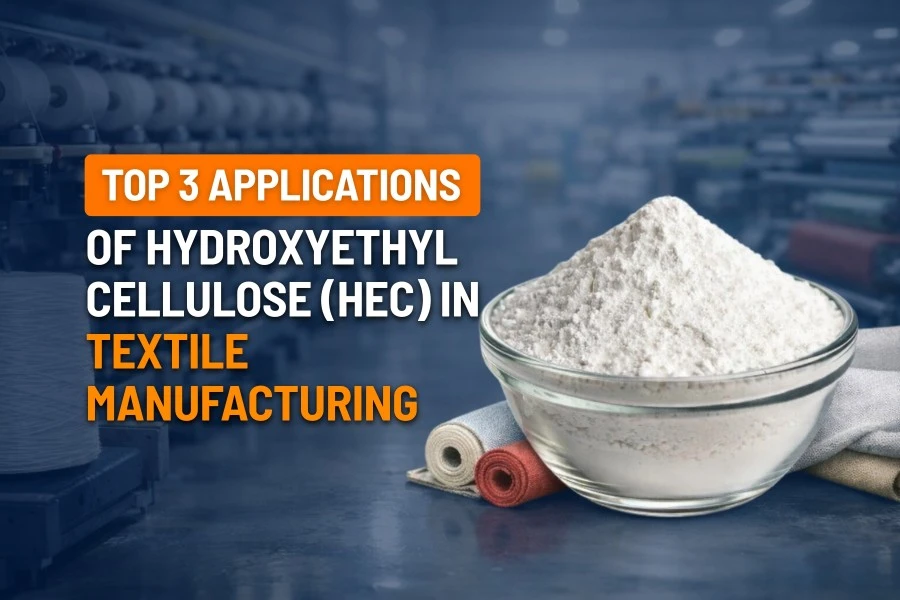
The textile sector has a complex manufacturing supply chain with an emphasis on quality, consistency, and efficiency throughout. Production starts: spinning yarn; ends: finishing fabric; has speciality chemical additives for: improving performance; maintaining a consistent product line.
Table of Contents
One of the many types of additives used to perform these functions is Hydroxyethyl Cellulose (HEC). HEC is considered a multifunctional additive due to its ability to thicken, stabilise, form films, and disperse with other materials; it has become an essential material when performing many processes in textile manufacturing.
Today, HEC plays an important role in the modern textile manufacturing process by providing benefits, such as increasing the strength of yarns, improving the quality of dyed products, and enhancing fabric finishes.
Because HEC is an environmentally friendly substance that can also be used in conjunction with other textile chemicals, it has become a valuable tool in modern textile manufacturing.
At Sakshi Chem Sciences Pvt. Ltd. (Sakshi Chemicals), we develop advanced chemical solutions to meet the needs of many industries through innovation and reliable manufacturing.
With more than 20 years of experience and extensive research capabilities, we offer high-quality chemical products that help industries operate more efficiently and produce more durable products.
This blog explains the top three applications for HEC in Textile Manufacturing and shows the benefits that HEC provides to textile manufacturers.
What is Hydroxyethyl Cellulose?
Hydroxyethyl Cellulose, HEC, is a non-ionic, water-soluble cellulose ether made from naturally occurring cellulose from plants.
It appears as a white or off-white powder that dissolves easily in water to form a clear, viscous solution.
Its unique chemical properties make it highly suitable for industrial applications. These properties include:
- Excellent thickening ability.
- Strong film-forming properties.
- High stability in different pH environments.
- Good compatibility with other chemicals.
- Eco-friendly and biodegradable composition.
HEC is commonly found in many different forms of textile manufacturing. Many textile manufacturing processes, such as fabric finishing, textile printing and dyeing, and yarn sizing use HEC. All of the above-mentioned applications take advantage of HEC’s improved viscosity control, stability of formulation, and improvement in performance of the finished product.
Main Application Areas of Hydroxyethyl Cellulose in Textile Manufacturing
Hydroxyethyl cellulose in Textile Manufacturing is used throughout various stages of textile production; however, three steps primarily use HEC to improve production efficiency, product quality, and consistency:
- The Spinning and Sizing Step.
- The Printing and Dyeing Step.
- The Fabric Finishing Step.
Let’s examine the three main application areas of HEC in Textile Manufacturing in more detail:
1. The Spinning and Sizing Step
As yarns are woven into fabric, they must be able to withstand the mechanical stress that occurs during the weaving phase of production. The breaking of yarns due to insufficient strength will cause a delay in the production of fabric and result in wasted material.
In the sizing phase of production, yarns receive a protective coating called sizing paste. The paste increases the overall strength of the yarns and provides them with abrasion resistance.
The use of Hydroxyethyl Cellulose in yarn sizing
Hydroxyethyl cellulose in Textile Manufacturing is often used in conjunction with other traditional yarn-sizing agents, such as polyvinyl alcohol (PVA) and/or starch. Hydroxyethyl cellulose acts as an agent to adjust the viscosity of the complete sizing solution and forms a flexible film around the surface of the yarn fibres.
This film offers several advantages:
- Improves yarn cohesion.
- Enhances abrasion resistance.
- Reduces yarn breakage during weaving.
- Improves weaving efficiency.
By strengthening the yarn surface, HEC significantly reduces production downtime and improves fabric quality.
Another important advantage is its excellent water solubility. During the desizing stage, the protective coating can be easily removed, making the process cleaner and reducing wastewater treatment complexity.
Because of these benefits, HEC has become a preferred additive in modern textile sizing formulations.
2. Printing and Dyeing Process
In textile production, one of the key processes is dyeing and printing. The colour quality and the clarity of printed patterns are greatly influenced by how stable the dyes, or dye baths, and printing pastes are when applied to goods. However, there are several problems associated with the printing and dyeing processes, including:
- Dye settling.
- Unbalanced distribution of dye colour.
- Poor printing and colour pattern clarity; and
- Low durable colourways.
This is where Hydroxyethyl Cellulose (HEC) in textile manufacturing is very helpful.
HEC as a thickener and stabiliser.
HEC is mainly a thickener and a stabiliser in textile printing and dyeing.
It will improve the flow behaviour (viscosity) of the printing paste and dye solutions through the control of rheological properties.
Benefits of the utilisation of HEC include:
- Prevention of dye particles settling.
- Uniform dye distribution.
- Control of paste penetration into the textile during the printing process.
Improved clarity and definition of the printed pattern through better control of the viscosity of the printing paste and prevention of excessive spreading of the dye on the fabric surface.
The fact that HEC provides good usage with different forms of dye and other auxiliary chemicals contributes to a higher uptake of dye, greater colour durability, and, as a result, as far as the textile manufacturers are concerned, will result in:
- More intense colours.
- Less waste of dye.
- Lower wastewater disposal costs.
- Better quality products.
These advantages make Hydroxyethyl Cellulose an essential additive in modern textile printing operations.
3. Fabric Finishing Process
After dyeing and printing, fabrics undergo finishing treatments to improve their appearance, durability, and functional properties.
During this stage, Hydroxyethyl Cellulose in Textile Manufacturing plays a key role as a finishing agent.
Role of HEC in Fabric Finishing
HEC creates a thin, breathable coating on the surface of garment fabrics that positively influences many characteristics of the fabric. Some of the many advantages of HEC include:
Softening Fabric
By adding HEC, fabric becomes softer to the touch.
Smoother Fabric (Hand Feel)
The addition of HEC creates a smoother hand feel for garments made from HEC-treated fabric.
Improving Wrinkle Resistance
The addition of HEC provides a more wrinkle-resistant finish to garments made from HEC-treated fabric.
Improved Durability
HEC provides fabric with increased durability.
Natural Fiber Fabrics (Cotton and Viscose) are Greatly Enhanced by Finishing with HEC.
Cotton and viscose fabrics typically experience fabric issues such as rough hand feel and poor wrinkle resistance, as well as changing shape from washing.
HEC forms an additional layer on top of the fabric, which supports the entire fibre structure, while still allowing the fabric to breathe.
In addition, HEC has antimicrobial and antifungal properties that inhibit mould from growing when the fabric is being stored. Ultimately, this helps support the quality and lifespan of textile products.
Solutions for Common Textile Manufacturing Problems Using HEC
Manufacturers are able to effectively remedy many of the problems associated with textile production when utilising HEC in production. Some of the most significant of these include:
Improving Yarn Stability
Low yarn strength and excessive breaking of yarn while weaving will create decreased productivity. The addition of HEC to the yarn allows for additional bonding between yarns, which helps to reduce the breaking of yarn.
Better Dye Uniformity
Dyeing problems frequently occur during the dyeing process, such as unevenly distributed dye across the fabric, dye bleeding out of pattern lines, etc. The addition of HEC stabilises dye solutions and enhances the overall printing quality.
Improving Fabric Feel
Rough or stiff fabrics can reduce customer satisfaction. HEC finishing treatments improve softness and smoothness.
Supporting Environmental Compliance
Modern textile industries must comply with strict environmental regulations. HEC’s biodegradable and non-toxic nature makes it a safer alternative to many synthetic additives.
Precautions When Using Hydroxyethyl Cellulose in Textile Production
To achieve the best performance, proper handling and usage of HEC are essential.
Proper Dissolution Method
HEC powder should be slowly added to water while stirring continuously to avoid clumping. The solution should be mixed until it becomes clear and uniform.
Controlled Dosage
The dosage of HEC depends on the specific application:
- Spinning slurry: approximately 2–10% of slurry weight
- Printing or dyeing paste: approximately 1–5% of slurry weight
Excessive amounts may increase viscosity too much, affecting application quality.
pH Stability
The optimal pH range for HEC solutions is between 6 and 9. Extreme pH levels can reduce its thickening efficiency.
Storage Conditions
HEC should be stored in sealed containers in cool, dry conditions to prevent moisture absorption and degradation.
Following these guidelines ensures stable performance during textile production.


Why Choose Sakshi Chem Sciences?
Sakshi Chem Sciences Pvt. Ltd. is one of India’s leading manufacturers and exporters of construction chemicals and industrial additives.
With over 20 years of industry experience, we have developed a strong reputation for quality, innovation, and reliability.
Our strengths include:
- Advanced R&D laboratories
- High-tech manufacturing facilities
- Strict quality control procedures
- Compliance with global safety standards
- Supply networks across the Middle East, Africa, Europe, and Southeast Asia
Our goal is to provide industries with high-performance chemical solutions that improve productivity, durability, and cost efficiency.
In addition to construction chemicals, our expertise in advanced polymer materials allows us to support multiple industries with innovative chemical technologies.
Conclusion
Hydroxyethyl Cellulose has become a valuable additive across the textile production chain. From yarn sizing to printing and finishing, its multifunctional properties help manufacturers improve product quality and production efficiency.
The use of Hydroxyethyl Cellulose in Textile Manufacturing helps solve several critical industry challenges, including yarn breakage, uneven dyeing, poor print definition, and fabric roughness.
As sustainability and efficiency become increasingly important in modern textile production, HEC in Textile Manufacturing will continue to play an essential role due to its eco-friendly nature and versatile performance.
With proper usage, high-quality sourcing, and reliable technical support, textile manufacturers can fully leverage the benefits of Hydroxyethyl Cellulose to produce stronger, more durable, and higher-quality fabrics.

Sagar Telrandhe is a Construction Engineer with a B.Tech in Construction Engineering & Management. Passionate about infrastructure development, project planning, and sustainable construction, he specializes in modern construction techniques, project execution, and quality management, contributing to efficient and innovative building.