
Performance in new architecture and industrial manufacturing has a commonality – their success is attributed to incorporating both small and highly effective substances.
The majority of high-quality adhesives, paints, mortar, and coatings utilize specialized additives that enhance durability, workability, and stability. Hydroxy Ethyl Cellulose (HEC) is an extremely versatile chemical agent.
Table of Contents
Hydroxy Ethyl Cellulose (HEC) is a polymer that plays an essential part in many industries because it has very good thickening, water retention, and stabilizing characteristics.
It improves the performance of many types of formulations from personal care products to construction materials.
Sakshi Chem Sciences Pvt Ltd uses chemical expertise and innovation in developing the products we manufacture. We manufacture construction chemicals with more than twenty years of construction chemical manufacturing experience, continually evolving new and advanced materials to assist builders and manufacturers in achieving cost-effective, durable, and efficient results worldwide.
This guide will describe what Hydroxy Ethyl Cellulose (HEC) is, its properties, benefits, and the variety of industries that utilize it.
What is Hydroxy Ethyl Cellulose?
Hydroxy Ethyl Cellulose (HEC) is a water-soluble, non-ionic polymer derived from natural cellulose. The cellulose will come from plant-based fibers so it is a chemically modified multifaceted natural material.
During its manufacturing process, cellulose undergoes a chemical reaction where hydroxyethyl groups are introduced into the cellulose structure. This modification enhances the polymer’s solubility, stability, and thickening ability.
The production process typically includes:
- Treating cellulose with an alkaline solution such as sodium hydroxide.
- Reacting the activated cellulose with ethylene oxide.
- Forming hydroxyethyl ether groups within the cellulose chain.
- Neutralizing and stabilizing the product for industrial use.
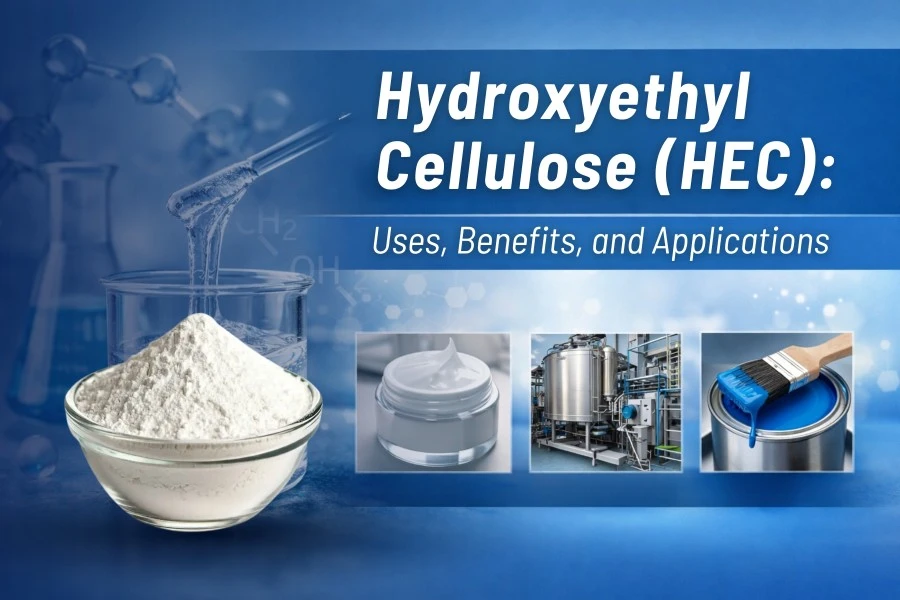
The final product is usually a fine white powder that dissolves easily in water to form a clear or slightly hazy solution.
Because of its adjustable viscosity and compatibility with many formulations, Hydroxy Ethyl Cellulose has become one of the most widely used cellulose ethers across industries.
Key Properties of Hydroxy Ethyl Cellulose
Hydroxy Ethyl Cellulose (HEC) is a popular ingredient due to its exceptional physical and chemical characteristics.
In water-based systems, HEC serves as an extremely effective thickening agent. very small amounts of HEC added to formulations can result in dramatic increases in viscosity.
HEC will easily dissolve in water; thus, when mixed correctly with water, an HEC/water mixture will produce a very smooth solution (no clumps).
HEC is not an ionic compound; therefore, it has good compatibility with many ingredients and chemicals with no negative impact/reaction.
HEC maintains its performance over a wide pH range (good stability), which makes it suitable for use in many different industrial applications.
HEC’s highly hydrophilic molecular structure helps to absorb and hold water effectively; it improves workability in construction products.
Major Industrial Applications of Hydroxy Ethyl Cellulose
One of the biggest advantages of Hydroxy Ethyl Cellulose is its versatility. It is widely used in industries ranging from construction to pharmaceuticals.
1. Construction Industry
- Adhesives For Tile
- Cement Mortars
- Putty
- Plaster
Application Of Water-Retention Characteristics Of HEC To Provide The Required Level Of Moisture To Cement-Based Products. This improves:
- Workability.
- Adhesion strength.
- Open time for application.
It also prevents premature drying, which is especially useful in hot climates.
At Sakshi Chem Sciences, we incorporate advanced polymers like Hydroxy Ethyl Cellulose in various construction chemical formulations to enhance performance and ease of application.
2. Paints and Coatings
HEC is widely used in water-based paints as a rheology modifier and thickener.
It helps to:
- Control paint viscosity.
- Prevent pigment settling.
- Improve brushability.
- Reduce sagging during application.
Because of these properties, coatings maintain a consistent texture and smooth finish.
3. Adhesives and Sealants
In adhesive formulations, Hydroxy Ethyl Cellulose functions as a binder and stabilizer.
It improves:
- Bond strength
- Water resistance
- Application consistency
This makes it a valuable ingredient in construction adhesives and sealants used in both interior and exterior applications.
4. Personal Care Products
Many everyday personal care products contain HEC.
It is commonly found in:
- Shampoos
- Hair gels
- Skin lotions
- Creams
- Toothpaste
In these products, Hydroxy Ethyl Cellulose improves texture and consistency while stabilizing the formulation.
5. Food Industry
HEC can also be used in certain food products as a stabilizing and thickening agent.
It helps enhance the texture of products such as:
- Sauces.
- Dressings.
- Dessert toppings.
By preventing ingredient separation, it ensures a smooth and consistent product.
6. Pharmaceutical Applications
In pharmaceutical formulations, Hydroxy Ethyl Cellulose is used as:
- A tablet binder.
- A thickener in syrups.
- A stabilizer in ointments.
Its safety and compatibility make it suitable for medical products.
Key Benefits of Hydroxy Ethyl Cellulose
One of the main reasons for the widespread use of Hydroxy Ethyl Cellulose is the many benefits it can provide across a variety of industries.
1. Excellent Suspension Stability
HEC is effective in stabilizing solid particles in suspension within liquid systems. For example, this property has a huge impact on paints/coatings and cement mixtures in an attempt to achieve uniformity in distribution throughout the system.
2. Improved Workability
HEC improves mortar and adhesive workability and pumpability when used as an additive in construction materials.
3. Effective Water Retention
HEC is good at retaining water, which helps keep cement systems workable longer, leading to better hydration.
4. Rheology Modifications
HEC allows for flow modification by controlling the viscosity of a formulation, allowing products to flow and spread easily while not dribbling or sagging.
5. Film Formation
HEC will form a thin film when applied to surfaces, providing improved durability to coatings and allowing for uniform coverage.
6. Environmentally Friendly
HEC is derived from natural cellulose material, so it’s biodegradable and considered to be more environmentally safe than most synthetic polymers.
7. Non-Toxic & Safe
When used in accordance with recommended usage guidelines, HEC is a generally non-toxic and safe material to work with.
How to Use Hydroxy Ethyl Cellulose?
Proper handling and mixing are important to achieve the best performance from Hydroxy Ethyl Cellulose.
Selecting the Right Grade
Hydroxy Ethyl Cellulose is available in various grades with a range of viscosities so the right grade needs to be selected based on the intended use.
Correct Mixing
HEC should be added gradually to the water while stirring continuously in order to eliminate the formation of lumps.
Hydration and Dissolution Time
The ability for HEC to fully hydrate and dissolve may take some time to complete, depending on the formulation.
Test for Compatibility
When HEC is to be used on a large scale, it is recommended that a compatibility test be conducted with each of the other ingredients in the formulation to ensure optimum performance.
Storage and Handling Guidelines
Maintaining proper storage conditions is essential to maintaining the quality of Hydroxy Ethyl Cellulose.
Recommended storage practices are to:
- Store in a cool dry place.
- Keep containers tightly sealed.
- Avoid exposure to moisture.
- Identify each container with clear information about the product.
Follow the “first in/first out” inventory control method in order to maintain product consistency and performance.


Why Use Sakshi Chem Sciences?
Sakshi Chem Sciences Pvt Ltd has over 20 years of experience and is among the top manufacturers and exporters of construction chemicals in India.
We have the following strengths:
- Advanced research and development labs
- Very strict quality control procedures
- Very high tech manufacturing facility
- A wide product portfolio of over 50 construction chemical solutions
- A strong global presence in the Middle East, Africa, Europe, and Southeast Asia
We are committed to providing reliable and affordable chemical solutions that help construction professionals build stronger and more durable structures.
Our expert team also provides technical support to help clients select the right additives for their specific applications.
Final Thoughts
Hydroxy Ethyl Cellulose is a highly versatile polymer that plays an important role in improving the performance of countless products across industries. From enhancing the workability of cement mortars to stabilizing paints and personal care formulations, its benefits are wide-ranging.
Its thickening ability, water retention properties, environmental friendliness, and compatibility with many formulations make it a valuable additive in modern manufacturing.
At Sakshi Chem Sciences Pvt. Ltd., we continue to focus on developing high-performance chemical solutions that support innovation and efficiency in construction and industrial applications.
Through continuous research, strict quality control, and customer-focused service, we aim to deliver products that meet the evolving needs of the global market.
With the right materials and the right expertise, building stronger and more durable solutions becomes possible, and Hydroxy Ethyl Cellulose is one of the key ingredients making that happen.

Sagar Telrandhe is a Construction Engineer with a B.Tech in Construction Engineering & Management. Passionate about infrastructure development, project planning, and sustainable construction, he specializes in modern construction techniques, project execution, and quality management, contributing to efficient and innovative building.