
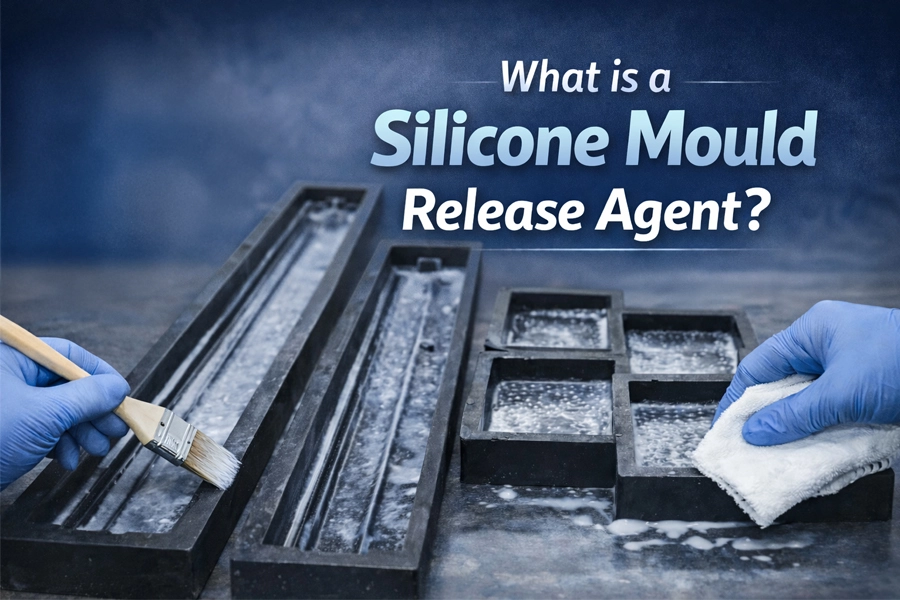
When working in an industrial setting (manufacturing and construction) the smallest detail can make the difference between running a job smoothly or having a costly headache.
One of those details is how the molded product will release from the mold after it is produced. After watching concrete stick to a shuttering plate or take the edge detail off of a finished part when being demolded, will help you understand the overall importance of a Silicone Mold Release Agent.
Table of Contents
Sakshi Chem Sciences Pvt. Ltd. provides chemical solutions with high-performance for construction professionals, precast manufacturers, and industrial clients worldwide.
Our range of construction chemicals includes many products; however, the mold release agents are an important part of product production because they produce clean finishes, increase mold life, and speed production.
Now that you know how important a Silicone Mold Release Agent is, let’s explain what they are in a simple, illustrated, and practical way.
Understanding a Silicone Mold Release Agent
A Silicone Mold Release Agent is a specialized chemical product designed to be applied to molds to assist in preventing the molded product from sticking to the mold during the process of casting/molding the product.
When properly applied, Silicone Mold Release Agents will form an ultra-thin film that provides a complete barrier between the product that is being cast and the surface of the mold (be it concrete, rubber, plastic, resin, or metal).
This barrier ensures:
- Easy removal of the molded product.
- Protection of mold surfaces.
- Smooth surface finish on the final product.
- Reduced breakage and defects.
Without a proper mold release agent, demolding can become difficult, time-consuming, and damaging to both the product and the mold.
How Does a Silicone Mold Release Agent Work?
The science behind it is quite interesting but easy to understand.
When applied to a mold surface, the silicone-based formulation spreads evenly and forms a microscopic lubricating film.
This film is typically made from silicone compounds such as polydimethylsiloxane (PDMS). Once cured, it creates a stable, low-friction interface between the mold and the material.
Here’s what happens during the process:
- The mold is cleaned and dried.
- The Silicone Mold Release Agent is sprayed or wiped onto the surface.
- The silicone layer forms a thin protective coating.
- The molding material is poured or injected.
- After curing, the molded part separates easily from the mold without sticking.
This simple but powerful mechanism saves time, reduces damage, and increases productivity.
Role of Silicone Emulsion in Mold Release Agents
One of the key components often used in these formulations is Silicone Emulsion.
A Silicone Emulsion is a stable mixture where silicone oil is dispersed in water with the help of emulsifying agents. This allows:
- Easy dilution.
- Uniform spreading.
- Reduced solvent use.
- Better environmental safety.
Silicone Emulsion-based mold release agents are especially popular in construction and precast industries because they are:
- Easy to apply.
- Cost-effective.
- Safer to handle.
- Environmentally friendlier compared to solvent-heavy alternatives.
At Sakshi Chem Sciences, our R&D team ensures that our Silicone Emulsion formulations provide consistent performance while meeting global safety and durability standards.
Silicone vs Other Mold Release Agents
There are different types of mold release agents available in the market. Let’s compare silicone-based options with others.
1. Silicone-Based Release Agents
- Excellent release performance.
- Suitable for multiple cycles.
- High heat resistance.
- Minimal residue transfer.
- Ideal for detailed molds.
2. Wax-Based Release Agents
- Lower initial cost.
- May leave residue.
- Usually suitable for a single release.
- Require frequent reapplication.
3. PVA Film Release Agents
Single Use Silicone molds conform to the details of the part being produced and create additional waste because they can be very costly for high-volume production.
Silicone can provide a reliable choice when users are looking for durability, precise dimensions, and efficiency from their manufacturing process, which is often achieved by using silicone mold release agents with stringent quality control standards.
Key Properties of a High-Quality Silicone Mold Release Agent
1. Excellent Release Capability
Easier release of parts helps with production rates.
2. Heat Resistance
Silicone will perform well at elevated temperatures, making it useful for the injection and casting of metal.
3. Smooth Surface Finish
An effective mold release agent does not change the surface finish of the molded product.
4. Chemical Resistance
Silicone protects molds from corrosion and exposure to aggressive materials.
5. Multiple Release Cycles
One application typically supports the release of multiple molded products.
Sakshi Chem Sciences requires that all formulations be thoroughly tested for quality assurance so that consistent performances occur during the production of all products.
Applications in the Construction Industry
Silicone Mold Release Agents are commonly used in the Construction Industry for:
- Precast Concrete Products.
- Pavers.
- Tiles.
- Concrete Panels.
- Pipes & Poles.
- Rubber Molds.
- Resin Castings.
In construction, especially in precast, time is money. A sticking mold may cause delays in the production cycle; therefore, by utilizing a reliable, well-developed silicone emulsion product as a mold release agent, you are more likely to increase your production rates.
- Faster turnaround.
- Cleaner edges.
- Reduced labor effort.
- Extended mold lifespan.
Types of Silicone Mold Release Agents
Depending on the application, different forms are available:
- Spray-On Release Agents.
- Easy to use on large surfaces or multi-cavity molds.
- Wiping On for Controlled Application & Reduced Waste.
- Aerosol Products are Convenient & Ready-To-Use.
- Semi-Permanent Coatings are for Long Runs with Minimal Reapplication.
The type of agent will depend on the size of your production run, complexity of the mold and costs.
Benefits of Using Silicone Mold Release Agent
- Preventing Sticking.
- Decreasing Product Damage & Mold Wear.
- Improving Surface Quality.
- Keeping Fine Details Intact.
- Extending the Life of the Mold.
- Reducing Friction and Abrasion.
- Increasing Production Efficiency.
- Reducing Time to Demold & Reducing Downtime.
- Cost Effectiveness Over Time.
- Fewer Defects Mean Less Rejection Rates.
For manufacturers wanting to maintain high quality while controlling costs, Using Silicone Release Agents Appears to be a Practical Investment.
Factors to Consider Before Choosing a Silicone Mold Release Agent
Before Making A Decision Regarding Which Silicone Mold Release Agent To Use, Manufacturers Need To Be Aware Of Their Production Environment.
- What Material is Your Mold Made Of (Steel, Aluminum, Rubber etc.)
- What is The Operating Temperature?
- How Complex is The Mold Design?
- What is The Desired Surface Finish?
- What is The Production Speed?
- What are Your Budgetary Constraints?
At Sakshi Chem Sciences Pvt. Ltd, We Have A Highly Experienced Technical Team Available to Help Our Customers Select The Correct Mold Release For Their Specific Application Needs.
Best Practices for Application
Even the best product will underperform if applied incorrectly. Follow these steps:
- Clean the mold thoroughly.
- Ensure the surface is dry.
- Apply a thin, uniform coat.
- Allow proper curing time.
- Inspect coverage before pouring material.
Over-application can lead to residue, while under-application may cause sticking. Balanced usage is key.
Common Troubleshooting Issues
Problem: Molded part sticking
Solution: Ensure proper drying and complete coverage.
Problem: Residue on final product
Solution: Reduce excess application.
Problem: Frequent reapplication required
Solution: Switch to higher-performance Silicone Emulsion formulation.
Problem: Mold surface damage
Solution: Ensure compatibility between the release agent and molded material.
Understanding these common issues helps maintain consistent production quality.


Why Choose Sakshi Chem Sciences?
Our company, Sakshi Chem Sciences Pvt. Ltd, has 20+ years of experience as a manufacturer/supplier/exporter of construction chemicals – providing quality, efficiency, and ease of use.
We provide:
A broad product line of >50 construction chemical products
- R&D center.
- Quality assurance/quality control.
- Global regulatory compliance for safety.
- Cost-effective and reliable products.
Strong international presence/changeable through-out the world (Middle East, Africa, Europe and Southeast Asia)
We develop our Silicone Mold Release Agent & Silicone Emulsion product line using cutting-edge research/testing technologies. We test each product to ensure they are efficient, durable and easy to use for today’s construction industry.
Conclusion
One of the reasons to invest in a professional-grade mold release agent is that it is an essential component of the overall production process, allowing for improved quality of the finished product, enhanced surface quality, increased production efficiency, and reduced production costs.
In any industry, production requires precision, and ensuring correct mold release products will definitely pay for itself over time.
We at Sakshi Chem Sciences Pvt. Ltd. are dedicated to providing quality construction chemicals, helping our clients create stronger, smoother, and longer-lasting structures.
Through innovation, quality assurance, and customer-focused support, we continue to serve the evolving needs of the construction industry, both in India and across global markets.
When quality, reliability, and efficiency matter, the right choice begins with the right chemistry.

Sagar Telrandhe is a Construction Engineer with a B.Tech in Construction Engineering & Management. Passionate about infrastructure development, project planning, and sustainable construction, he specializes in modern construction techniques, project execution, and quality management, contributing to efficient and innovative building.