
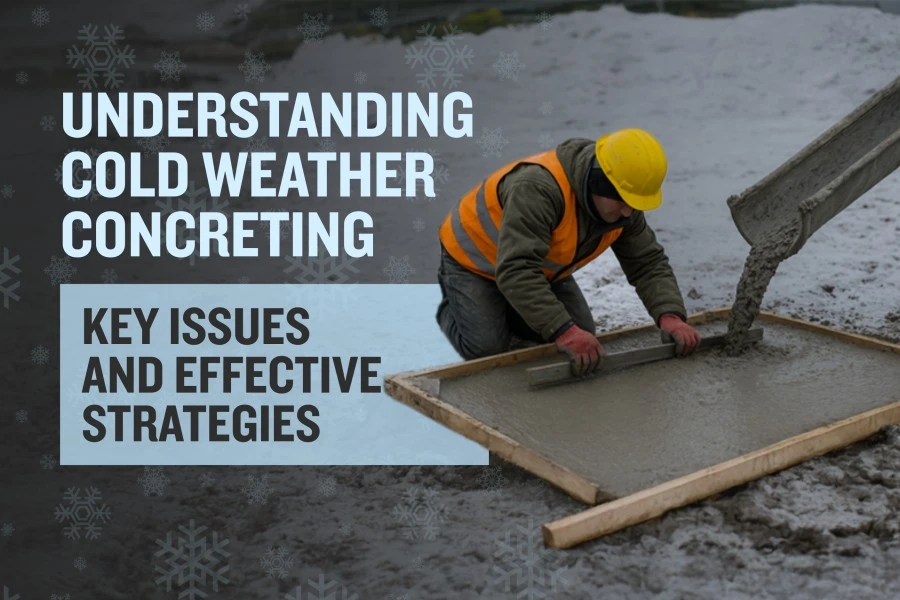
Introduction: When the Weather Works Against Concrete
Concrete, when freshly mixed, is an active living material. It breathes, reacts, develops heat, and goes from a soft paste to a dense, stone-like form. But when the temperature drops, especially in winter or the colder parts of the world, this process can slow dramatically.
The concrete becomes compromised, hydration is stalled or weakened, and, if properly cured, the dependence on environmental temperatures can put the reliability of the structural outcome at risk.
Table of Contents
This is why around the world, industries use the term Cold Weather Concreting, a process in maintaining the concrete under lower temperature conditions while placing, curing, and protecting the concrete as it hardens.
At Sakshi Chem Sciences, we understand that cold weather is NOT an impediment, but a condition that requires planning, preparation, precision, and scientific care.
Our mission is to help builders, engineers, and contractors understand what that extra care is meant for, and how to use the best materials, particularly performance-enhancing Concrete Admixtures, in order to ensure durable outcomes.
What is Cold Weather Concreting?
As defined by the American Concrete Institute:
Cold Weather Concreting is any period in which the average daily temperature is expected to be lower than 5°C (40°F) for three (3) consecutive days.
That means:
- The temperature doesn’t need to be freezing.
- It doesn’t need snow.
- It doesn’t even have to feel “cold”.
Even marginally lower temperature stretches can adversely impact hydration and strength.
Why?
Because the hydration of cement is temperature-related.
When the temperature goes down?
- The chemical reaction decreases in speed.
- water turns into ice more easily.
- The pores stay filled longer and
- The time to develop strength is delayed.
- The consequences can quickly compound if the concrete is not protected.
Why Cold Weather Matters to Concrete?
Concrete needs an adequate internal temperature to hydrate and harden. For the first 72 hours, concrete is extremely sensitive to changes.
During this time
- Hydrate heat is building the internal matrix.
- The paste is a bonding aggregate.
- micro-pores start sealing.
- initial strength starts to form, and
- Crystalline growth is beginning to stabilise.
- Cold weather disrupts all of this.
Thus, cold weather concreting is not merely about placing concrete in cold weather.
It is all about managing hydration temperature, curing protection, strength gain, and crack prevention with the greatest precision.
How Low Temperature Affects Concrete at the Chemical Level?
Concrete hardening is activated via the hydration of cement particles.
This is a temperature-sensitive reaction.
When fresh concrete is placed in conditions with cold weather:
1. Hydration Slows
Low temperature reduces the energy level of particles.
This, in turn, means
Fewer chemical bonds are formed per hour.
Early crystallisation becomes inconsistent.
and strength is formed at half or, in extreme cases, one-third of its ability.
2. Internal Water Freezes
At 0 degrees Celsius:
- Water expands by around 9%.
- This expansion in pores creates internal tensile stress.
- Micro-cracks start to develop.
- Even if the concrete continues to hydrate, thereafter, the loss in strength is irreversible.
3. Pores Remain Larger
If hydration is slow:
- The pore structure remains coarse.
- Permeability increases.
- Durability will decrease.
- Resistance to sulphate and freeze-thaw cycles will reduce sharply.
4. Increased Thermal Shock Risk
When day temperatures increase, and there is a rapid decrease at night:
- Concrete repeatedly contracts and expands.
- This puts stress on the young concrete matrix.
Cold Weather Concreting is NOT Just About Fresh Concrete
It has a negative impact on the entire process of construction:
✔ mixing
✔ transporting
✔ placing
✔ compacting
✔ curing
✔ protecting
✔ early loading
✔ stripping formwork
✔ structural integrity
This is why careful planning is a must.
Real Life Circumstances Where Cold Weather Concreting Went Wrong
At Sakshi Chem Sciences, we are often involved with projects where the concrete failed because of a winter concreting error.
We have observed a variety of:
slabs exhibiting surface scaling, serious internal cracking, early spalling, delamination, mixed strength gain, low ultimate strength, and white salt contamination.
as well as the peeling caused by bond failure.
The most common reasons include:
- The concrete froze before the 24–48 hour period.
- no curing cover.
- thermal mass absorbing heat.
- insufficient cement.
- and the absence of a suitable concrete admixture.
- workers adding extra water to improve workability.
- Concrete delivered too cold.
- These failures are expensive and avoidable.
How Concrete Generates Its Own Heat (and Why It Often Isn’t Enough)
- Cement hydration generates heat.
- This is referred to as the heat of hydration.
- During a regular warm period of time.
- This heat is retained and allows concrete to gain strength faster.
In cold weather:
heat dissipates too quickly, a concrete hardens/falls below the acceptable level, which can diminish hydration levels, and also, if it’s too cold, freezing can take place.
So we must use insulation, heating methods, or acceleration of hydration is key.
When is the concrete out of danger safely?
Concrete starts becoming resistant to free/thaw damage at around:
- 500 psi (≈3500KN/m2 ) compressive strength.
- This will usually happen if and when:
- The concrete temperature is maintained high of ~10 to 13℃ internally,
- hydration continuously happens for 48 hours.
- There are no shocks in temperature.
Below this strength:
→ There are no plans for the dependent weather, and further setbacks can and do cause irreparable damage.
→ and even if it does, freezing occurs temporarily, by the second thawing can develop irreparable internal cracking.
Why strength good or bad is so important in winter?
Because having strength relates to your density.
Having less density produces a lower impermeability to the hydrostatic pressure of water/soil.
gives you less durability, thus less load capacity.
and losing both conditions is no return.
The answer to this question is especially important for post-structural and structural construction:
- commercial slab pour.
- decking slab for bridge.
- older, unrepaired retaining walls.
- columns and shearwalls.
- founding blocks.
- precast elements.
- industrial flooring.
- water to be held in structures.
- Failure in the elements is catastrophic over time lapse.
Why Cold Process Congruence requires planning
Dealing with lower dependent temperatures requires a mapping-out process,
Engineers, etc, will have to plan, for instance and before a weather event:
- mix design adjustments.
- curing method.
- insulation method.
- concrete temperature targets.
- heating strategy.
- protection duration.
- strength monitoring.
- formwork removal timing.
- finishing procedure.
- expected night temperature changes.
Nothing can be left to guesswork.
Why Sakshi Chem Sciences Emphasizes Scientific Cold Weather Practices
At Sakshi Chem Sciences, we prioritize:
- dependability
- trustworthiness
- extended lifespan
- construction productivity
Cold Weather Concreting affects ALL THREE.
This is why we produce performance boosters and concrete admixtures to address concrete performance under temperature stress conditions.
Where science meets material engineering –
buildings endure longer, perform optimally, and are maintenance-friendly.
Challenges To Expect With Cold Weather Concreting
Cold Weather Concreting is not dangerous solely because of low temperatures; it is dangerous because concrete is vulnerable during the start of its transition phase.
Once temperatures drop, the following risks occur to a greater degree:
1. Hydration Generates Slow Development
Concrete hydration slows down dramatically under cold conditions.
This closely relates to:
- slower set time
- slower hardening
- slower removal of forms
- slower gain of strength
- slower completion of curing
The delay not only creates stress and inconvenience.
It produces long-term structural damage.
2. Early Strength Weakens
Early strength is exceedingly critical.
If low strength persists too long:
- Internal crystalline development becomes unbalanced.
- The porous framework remains wide.
- Water is still able to move inside.
- The potential for freezing damage compounds.
Early strength weakness negatively impacts long-term durability more than short-term stability.
3. Freezing of Mixing Water
This is the greatest enemy in Cold Weather Concreting.
When water turns to ice in fresh concrete:
- It expands approximately 9%.
- and creates internal stress.
- and cracks.
- and micro-fractures in the matrix.
- and density loss.
- and severe permeability increase.
Even if the frozen concrete thaws during the day,
its structural integrity is already compromised.
4. Improper Setting
In cold weather concrete can to:
- set too slowly.
- or set unevenly.
- the surface may set first.
- and the interior is still soft.
This differential causes:
- scaling.
- or lamination failure.
- or flaking.
- or layer separation.
- or peeling.
We often see this in slabs, sidewalks, driveways, roads, and decks.
5. Increased Water Demand
Cold weather conditions cause workers to add water sometimes for workability.
This results in:
- higher water–cement ratio.
- lower final strength.
- poor density.
- higher permeability.
- greater shrinkage.
- surface dusting.
- scaling in the long term.
This is a serious error.
6. Cold Formwork Issues
Formwork (shuttering) absorbs heat out of fresh concrete quickly.
Cold formwork:
- creates thermal shock.
- cools concrete instantaneously.
- stops hydration development early.
This is the reason thermal treatment for formwork is important.
7. Thermal Cracking
- Concrete getting warm from hydration.
- and cooling very quickly at night.
- causes the outside to cool faster than the inner core.
This results in internal stresses. Ultimately:
→ shrinkage cracking develops.
→ thermal cracking develops.
→ plastic cracking develops.
→ longitudinal and surface cracking develops.
These cracks are NOT cosmetic.
It reduces the lifespan of structures by years.
Some of the ways Cold Weather affects long-term performance of concrete
Poor cold-weather concreting can result in significant long-term failures.
Significant long-term effects include:
• Lower Long-Term Strength
If early strength lags, the final compressive strength can be permanently reduced.
• Higher Permeability
Concrete remains permeable and retains porous qualities, which can lead to:
- Water absorption.
- A chloride intrusion.
- A sulphate intrusion.
- Carbonation.
- Rusting of reinforcement.
• Lower Service Life
A crack is a future maintenance expense.
• Compromised Safety of Structure
In particular, structures that:
- are bridges.
- are water tanks.
- are tunnels.
- are built retaining walls.
- are columns.
- are pre-stressed structures.
• Freeze–Thaw Damage
When trapped water undergoes the following sequence, referencing the Freeze-Thaw Damage process:
freeze → thaw → freeze → thaw
Eventually:
- spalling begins.
- scaling progresses.
- The surface weakens.
- The structural layer delaminates.
In cold regions, this is the most common reason for slab deterioration.
Here are the known mix design changes to consider for Cold Weather Concreting
The standard mix cannot be utilised in temperatures that are but 6C or lower.
Changes must occur.
1. Increase Cement Content
Cement content is increased because:
- It creates more heat of hydration.
- It increases the early strength.
- It increases bonding.
- It decreases permeability.
- This prevents freezing damage.
2. Reduce Water–Cement Ratio
A low W/C ratio results in:
- better durability.
- better strength.
- lower permeability.
- tighter pore structure.
- reduced cracking.
Water must be precisely controlled.
3. Reduce Supplementary Cementitious Materials
Especially:
- Fly ash
- GGBS
- Slag
These slow the strength development in winter.
Better to use reduced percentages for cold-season casting.
4. Use Warm Water Instead of Cold Water
Water temperature is the quickest way to increase concrete temperature. Using warm water will keep the concrete temperature above the critical hydration temperature.
5. Heat Aggregates
Particularly Helpful when the night temperatures drop significantly. Aggregates will lose heat quicker than cement.
6. Use Acceleration type concrete admixtures
This is critical.
In cold weather, during hydration, it needs to be helped.
This is why Sakshi Chem Sciences promotes performance enhancing additives for use below ambient temperature.
Role of Concrete Admixtures in Cold Weather Conditions:
Concrete Admixtures are the backbone of a successful cold weather placement.
Sakshi Chem Sciences focuses on offering admixtures that can assist with maintaining performance when using materials at lower temperatures.
The following four functions directly relate to positive cold-weather concreting results:
1. Accelerating Admixtures
Produce an increased speed of cement hydration that will assist the concrete to achieve a successful outcome.
Accelerating admixtures can help concrete to:
• gain strength faster.
• reduce the setting time.
• develop early structure.
• increase resistance to freezing temperatures sooner.
The intended outcome of accelerating admixtures is the protection of the concrete from early difficulties related to cold weather.
2. Water-Reducing Admixtures
Produce a lower quantity of required water to accomplish a performance level similar to the control mix while still providing adequate workability.
Advantages of Water-Reducing Admixtures include:
• decreased permeability.
• decreased shrinkage cracking.
• increased density.
• improvement of mechanical performance for cold weather.
3. High-Range Water-Reducing Admixtures (especially Polycarboxylate based)
High Range Water Reducer (HRWR) admixtures will
• help keep the flow longer.
• provide a remarkable reduction in the quantity of water required.
• promotes easier compaction.
• reduces cold-weather segregation.
HRWR admixtures are especially useful in supporting concrete that will be:
• pumped.
• taken/stored long distances.
• heavily reinforced construction.
4. Air-Entraining Concrete Admixtures
They are necessary for areas that are subject to freeze-thaw regions.
They introduce microscopic air voids, which:
- provide space for water expansion during freezing.
- protect against scaling.
- prevent spalling.
- improve resistance to deicing salts.
- increase longevity dramatically.
This is scientifically proven.
5. Retarding Admixtures
BUT, retarding admixtures must be used cautiously in cold weather.
They slow hydration.
In warm regions during sudden cold, a balanced dosage helps regulate setting.
But in deep winter, Accelerators must be prioritised over retarders.
Why Sakshi Chem Sciences Focuses on Performance-Based Admixtures?
The ability of admixtures to:
- modify hydration.
- enhance density.
- improve strength gain.
- and increase durability.
Makes them the most reliable method for managing Cold Weather Concreting challenges.
Because concrete is science, and admixtures allow us to fine-tune that science.
For over 20 years, Sakshi Chem Sciences has engineered advanced seasonal solutions that help contractors achieve strong, durable concrete despite environmental fluctuations.
Effective On-Site Strategies for Cold Weather Concreting
Cold Weather Concreting isn’t just about mixing concrete differently; it’s about managing the entire environment in which concrete is delivered, placed, finished, and protected. This requires planned, coordinated steps across teams, the batching plant, transit, site engineers, supervisors, and masons.
Below are strategies applied globally in successful winter concreting operations.
1. Prepare in Advance (Before Temperature Drops)
Preparation is half the battle.
Contractors should:
- Source heaters before the cold starts.
- Arrange insulated blankets well in advance.
- Pre-check curing materials.
- Prepare formwork days earlier.
- Raise technical coordination with suppliers.
- Monitor weather forecasts.
- Communicate with batching plants in real-time.
Cold Weather Concreting fails most often due to a lack of preparation, not cold.
2. Maintain Concrete Temperature from Plant to Site
Fresh concrete cools extremely fast in winter.
Practical Site Solutions:
- Insulate truck drums.
- Reduce transit duration.
- Schedule early-afternoon pour windows (not late evening).
- Avoid long wait times on-site.
- Maintain planned manpower to avoid delays.
The goal is to prevent temperature loss during transport.
3. Keep Base Surface Warm Before Pouring
One of the most forgotten steps is.
DO NOT pour concrete on:
- frozen base.
- icy base.
- dew-covered base.
- frost-covered base.
- snow.
- extremely cold shuttering.
Once fresh concrete is on a cold surface:
- Hydration immediately starts to slow.
- Temperature drops, and ice can form at the interface.
- Microcracks can start to form at the interface undetected.
Best practice:
Wherever possible, pre-heat the contact surface.
4. Avoid pouring during the night or early morning
Sometimes, even if it is warm during the day, the temperature can drop at night.
This is when:
- Freezing occurs.
- Shrinkage is at its highest.
- Thermal stress is at its highest.
- Hydration stops.
The best window of time for cold weather is ideally 11 AM-3 PM.
This small change can avoid large disasters.
5. Increase monitoring frequency
Cold weather requires a constant monitoring process.
To monitor, you will want to measure:
- air temperature.
- the temperature of the surface of the concrete.
- the temperature of the internal concrete.
- wind speed.
- humidity.
- forecast drops.
You want to monitor at least two times a day, but preferably every 3-4hours for pours that are critical.
Monitoring it is more powerful than repairing it.
6. Use appropriate finishing methods
Finishing concrete in cold weather can take some adjustments. You want to prevent:
- Finishing too early with a trowel.
- Overworking the surface.
- Adding water to the surface to redo finishing work.
In winter, you can use a steel trowel only after bleed water dries off the surface. Any other finishing method will trap water below an impermeable seal on the surface, which means you will have scaling and flaking later.
Essential Protection Methods
Protection- The most essential component to cold weather concreting.
Ensure protection is planned and not spontaneous.
1. Thermal Blankets
Insulation blankets trap hydration heat.
These prevent:
- surface freezing.
- rapid cooling.
- moisture loss.
Blankets must:
stay on for several days.
not just overnight.
2. Heated Site Enclosures
Particularly for:
- slabs.
- industrial floors.
- bridges.
- large rafts.
Heated enclosures stabilize temperature around concrete bodies.
This method is widely used in:
- Canada
- USA
- Scandinavia
- Japan
- Northern China
3. Temperature-Controlled Concrete Mixes
Using proper Concrete Admixtures allows internal heat retention without compromising workability.
This is a signature method used by Sakshi Chem Sciences clients.
4. Leave Formwork Longer
Shuttering provides insulation.
Therefore:
Removing formwork early is fatal.
Keep formwork longer to allow uniform strength development.
This alone prevents:
- freezing damage.
- cracking.
- surface distress.
5. Avoid Water-Based Curing
Never use water for curing in freezing risk conditions.
Why?
Because:
If water freezes.
hydration stops.
Instead:
→ membrane curing compounds.
→ insulated curing.
Top Mistakes to Avoid in Cold Weather Concreting
Professionals globally repeatedly make the SAME mistakes.
We have compiled the most dangerous ones.
Mistake #1 – Letting Concrete Freeze within 24-48 hours
This is the SINGLE reason for failure.
No exceptions.
Mistake #2 – Pouring on Frozen Ground
Contractors don’t think it will “warm up under concrete.”
It NEVER warms up under concrete.
It destroys the integrity.
Mistake #3 – Adding Water On-Site to Increase Slump
This is EXTREMELY common in India.
Adding water weakens concrete MORE than temperature.
Mistake #4 – Remove Blankets Too Soon
Heating + removing blankets = instant cooling.
→ cracking: guaranteed.
Mistake #5 – Assuming Concrete is Safe Once It Has Hardened
Concrete will LOOK hard,
but it will remain WEAK for days on the inside.
DO NOT trust what it looks like on the surface.
Cold Weather Concreting Conditions from Region to Region
Cold-weather conditions clearly vary from region to region.
For example:
India’s cold-weather conditions consist of:
- Northern plains.
- Himachal hills.
- Kashmir valleys.
- North-East highlands.
- Winter nights in Rajasthan.
International examples include:
- Canada
- Norway
- Finland
- Russia
- Korea
other areas of the world with elevations
Each region requires its own strategy.
This is where Sakshi Chem Sciences can help.
Cold Weather Concreting for Various Types of Structures
1. Slabs
Very high risk for:
- Rapid heat loss.
- Freeze/thaw exposure.
- Surface scaling.
WHAT IS NEEDED?
air-entrained admixtures + insulation + careful pacing
2. Columns & walls
More volume = slower cooling
however:
Surface freezing is still an issue.
3. Foundations & Rafts
- Ground temperature plays a bigger role than air.
- Warm base preparation is essential.
4. Precast Elements
Temperature-controlled curing is mandatory.
5. Repair Concrete in Cold Weather
- Cold makes repair patches fail easily.
- Rapid strength development is essential.
Conclusion – Cold Weather Concreting is About Control, Not Fear
Cold Weather Concreting should not be considered a risk to evade, it is a performance environment to handle intelligently.
When the right techniques are used:
✔ concrete gains strength safely.
✔ cracking is avoided.
✔ hydration occurs accurately.
✔ durability is improved.
✔ service life is extended.
The most important fact is:
Concrete CAN be placed successfully in the winter when the science is respected.
At Sakshi Chem Sciences,
Our Concrete Admixtures play an important role in assuring cold-weather work is successful, both reliably and safely.
From research-grade admixture formulation to performance consulting on-site, we are committed to help the construction industry work safely, effectively, and confidently at any temperature.
Frequently Asked Questions (FAQs)
Q1. Can concrete be poured below 5°C?
Yes, but only with some special measures and proper admixtures.
Q2. What is the worst-case scenario for winter?
Freezing before concrete achieves 500 psi (approximately 3.5 MPa).
Q3. Does concrete lose its strength permanently due to cold?
If mishandled: YES
If handled correctly: NO
Q4. Are Concrete Admixtures critical?
In winter: Yes – without question!
Q5. Are there more concrete cracks in colder weather?
Absolutely. Thermal cracking is extremely common in cold weather.

Sagar Telrandhe is a Construction Engineer with a B.Tech in Construction Engineering & Management. Passionate about infrastructure development, project planning, and sustainable construction, he specializes in modern construction techniques, project execution, and quality management, contributing to efficient and innovative building.