
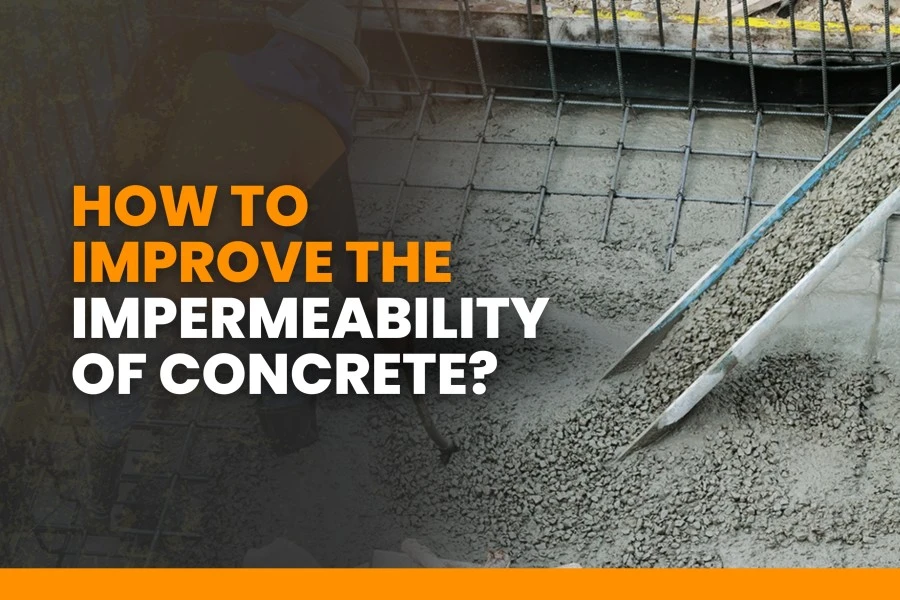
Concrete continues to be the backbone of construction around the world. No structure, however, is ever entirely secure unless the concrete used is dense, durable, and less prone to water intrusion. Of all issues affecting the internal condition of buildings, one of the primary culprits is water intrusion.
Water can be one of the primary causes for a building to deteriorate internally, lose strength, cause corrosion of reinforcement and cracks to form, all leading to either damage or failure of the structure.
It is for these reasons that engineers focus on strategies that improve the impermeability of concrete, beginning with the mixing phase (where possible).
Table of Contents
Sakshi Chem Sciences Pvt. Ltd. is a speciality construction chemical company that is active in assisting builders, contractors, and developers of infrastructure to increase density and reduce capillary voids while improving long-term durability with the use of high-performance concrete admixture technology.
In the blog, we review what impermeability is, its importance, and how to ride impermeability as best and as cost-effectively as possible.
What is Impermeability in Concrete?
Impermeability is defined as the property of concrete to resist the infiltration or penetration of water or other external liquids. The more impermeable the concrete is, the better it behaves against:
- Water seepage.
- Chemical intrusion.
- Chloride intrusion.
- Freezing and thawing damage.
- Corrosion of reinforcement.
Concrete is never 100% dense – even with the densest concrete, there are microscopic voids or pores and channels that are able to accommodate liquid/water. If those paths are not minimised, water will eventually make its way through the concrete.
Why Improving Impermeability Matters?
When concrete has low permeability risk of future damage is significantly higher:
- Reinforcing steel will start to rust.
- Micro-cracks will grow to structural cracks.
- Waterproofing membranes will fail.
- Protective surface finishes will deteriorate.
- Maintenance costs will increase.
- Life expectancy of the building will shorten.
In short, if impermeability fails, durability fails.
Increased impermeability is by far the best way to avoid costly repairs and lengthen the life of a building.
Several effective techniques to increase impermeability can be identified, listed below, along with proven trustworthy practices from around the world.
This is the basis for dense concrete.
1. Reduce the water-to-cement ratio
If there is more water in concrete than is needed, excess water will evaporate at a later time, resulting in millions of interconnected pores. Pores or voids will act as conduits for water movement.
Reducing water in the mix means:
- fewer voids
- lower permeability
- higher density
- better bonding matrix
- better durability
However, as with everything, reducing water in the mix should be balanced with workability.
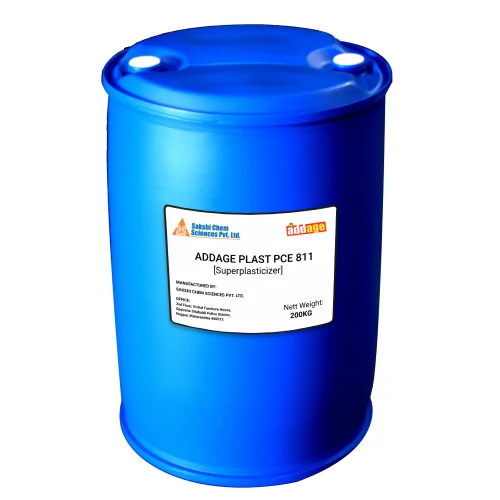
This is where a concrete admixture – such as water-reducers and superplasticizers can be beneficial.
By using the admixtures, they permit the concrete to have lower water for adequate workability, resulting in a stronger and more compact effect.
2. Use the appropriate concrete admixture
Modern-day construction relies on speciality admixtures to improve the impermeability of concrete.
Different admixtures can assist different aspects of impermeability.
Water-Reducing Admixtures
Minimise the water requirement while allowing for adequate workability.
Superplasticizers
Eliminate all water-cement ratio challenges while preventing mix stiffness.

Air-Entraining Agents
Create microscopic air pockets that inhibit water through them.
Integral Waterproofing Admixtures
Fill internal capillary pores and micro-pores.
Mineral Admixtures (SCMs)
such as:
- Fly Ash
- GGBS
- Silica Fume
This helps maximise concrete density and significantly reduce permeability within the structure.
At Sakshi Chem Sciences, these additives are specifically formulated to increase density and decrease moisture to air permeability without sacrificing strength gain or workability.
3. Use Proper Raw Materials
In addition to the use of waterproofing additives, the quality of your base ingredients invariably affects concrete density.
Material considerations:
Cement
Use the correct grade of cement (not less than 43 grade, ideally 53 grade)
Low-heat binders for large pours are recommended.
Sand
Use:
- properly washed
- well graded
- medium size
- river or M sand
- with low silt content.
Aggregates
Use:
- correct size distribution
- low dirt content
- angular
Proper material selection alone can drastically improve the impermeability of Concrete before additives are introduced.
4. Minimise Cracks Through Proper Practice
Once the densest Reinforced Concrete cracks, it puts the entire structure at risk.
Cracks allow water to bypass the surface strengths of the reinforced concrete to gain entry deep into the structure.
To minimise cracking, the concrete contractor must control:
- plastic cracking.
- thermal stress cracking.
- settlement cracking.
- over-vibration.
- Improper joint spacing.
Some key measures include:
- Minimize water.
- Ensure the concrete is mixed for the right time.
- Avoid evaporation.
- Finish the concrete at the right time.
- Compact uniformly without over-compaction.
- Incorporate shrinkage-reducing admixtures.
- Use curing compounds in hot temperatures.
- Good execution on-site is as important as a good concrete mix.
5. Improve curing methods
No matter how good the concrete mix is, if it dries out during curing, you will experience drying, shrinkage and early surface cracking, resulting in permeability.
Concrete must retain moisture during hydration.
Best noticed practices:
- Keep concrete moist for at least 14 days.
- Use wet hessian or wet cover curing for the first two weeks.
- Use curing compounds during the summer months.
- Avoid sudden temperature fluctuations.
Correct curing will develop:
- Higher density.
- Higher bonding.
- Less micro-cracks.
- Potential to reach full strength.
Without correct curing, no matter how good the mix, it has the potential to fail even after a build.
How Sakshi Chem Sciences Can Help?
Sakshi Chem Sciences has more than 20 years of production experience, and we are very much involved in assisting the construction ecosystem in overcoming permeability.
We have a full product suite that brings solutions such as.
- Concrete waterproofing additives.
- Integral pore-blocking admixtures.
- Water-reducers (high-range).
- Superplasticizers.
- Repair products.
- Surface waterproofing systems.
Our laboratory testing and QA process is robust, and we ensure our products meet the standards of durability outside of Canada.
Our technical experts assist construction teams with:
- mixture optimization.
- on-site support.
- troubleshooting moisture issues.
- durability planning.
- long-life concrete strategies.
This ensures every structure achieves higher impermeability and lower long-term maintenance.
Final Thoughts
When concrete becomes permeable, water is its worst enemy. But when impermeability is improved, concrete transforms into a long-lasting, resilient, low-maintenance material.
To improve the Impermeability of Concrete, the key focus should be:
- minimising internal pores.
- applying the right concrete admixture.
- controlling the water-cement ratio.
- proper raw material selection.
- preventing cracking.
- ensuring correct curing practices.
Building durability is not a one-step action; it is a combination of thoughtful design, correct formulation, chemical enhancement, and disciplined workmanship.
At Sakshi Chem Sciences, we remain committed to supporting durable, efficient, and future-ready concrete worldwide.

Sagar Telrandhe is a Construction Engineer with a B.Tech in Construction Engineering & Management. Passionate about infrastructure development, project planning, and sustainable construction, he specializes in modern construction techniques, project execution, and quality management, contributing to efficient and innovative building.