
Table of Contents
Introduction
Concrete has always been a fundamental element of contemporary construction, from the ground up, in tall skyscrapers to the highways that connect cities.
However, with a continued rise in the demand for strength, speed, and suitability to the environment, traditional standards of concrete often have met their limits.
Today’s construction projects are not only concerned with concrete being strong; they want it to be durable, workable, and long-lasting in extreme environments.
At Sakshi Chem Sciences Pvt. Ltd., we acknowledge that this is an evolving problem. For over 20 years, we have helped push the limits of construction chemicals to help projects stand stronger and last longer.
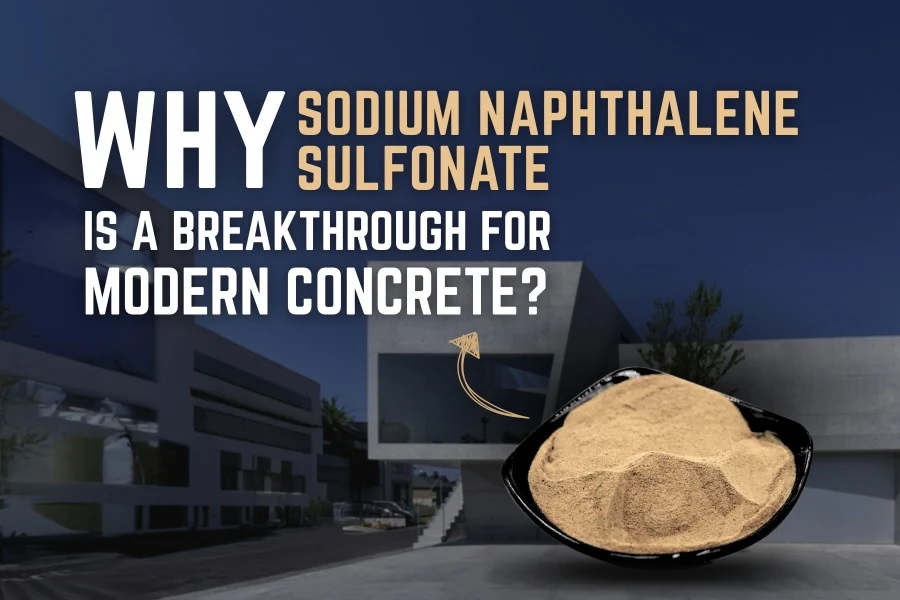
One of these chemicals is Sodium Naphthalene Sulfonate (SNS), a chemical that has quietly changed the concrete industry into how we blend, pour, and form modern infrastructure into reality.
Sodium Naphthalene Sulfonate should be considered a revolutionary chemical classified in the Superplasticizer family. It is invaluable in both enhancing the performance of concrete and increasing the overall longevity of concrete: truly, a breakthrough chemical for today’s construction industry.
What is Sodium Naphthalene Sulfonate?
Sodium Naphthalene Sulfonate (SNS or SNF) is a superplasticizer, which is a high-range water-reducing agent. Sodium Naphthalene Sulfonate (SNS or SNF) is derived from naphthalene, which is a hydrocarbon that has been sulfonated and neutralized to create a water-soluble polymer.
This polymer has excellent dispersing capability. In essence, this compound prevents cement particles in a concrete mix from clumping together. It disperses them so that they can mix better and provide strength with less water.
How It Works in Concrete?
The strength of concrete depends primarily on the distribution of the cement particles and how well they bond with water. Cement particles would typically like to stick together into lumps, which trap both water and air, resulting in reduced strength and workability.
This is where the sodium naphthalene sulfonate can work on the concrete. When added to the concrete, it adsorbs onto the surface of the cement particle. This causes the cement particles to develop a negative charge, and as a result, they repel each other. This action leads to:
- Improving flowability, even with little water content.
- Enhanced hydration, as water can reach every cement grain uniformly.
- Reduced water-cement ratio, which directly leads to higher compressive strength.
In other words, Sodium Naphthalene Sulfonate acts like a silent architect, optimizing every aspect of the concrete mixture for better strength, smoothness, and durability.
Key Benefits of Using Sodium Naphthalene Sulfonate
Sodium Naphthalene Sulfonate has many obvious benefits when it is added to modern concrete. Here are five reasons why this compound is said to be a building block of modern concrete technology:
1. Enhanced Workability
The addition of SNS ensures the concrete mix is workable and will remain smooth, with no need for excess water. This is particularly effective for large pours, complicated formworks, and applications where accuracy and consistency are important.
2. Increased Strength & Durability
By decreasing the water-cement ratio, Sodium Naphthalene Sulfonate can create concrete with greater density and an overall lower porosity. This all equates to higher compressive strengths and a lower chance of cracking, shrinkage, and environmental damage.
3. Cost-Efficient
Less water, less cement, and faster workability all create cost savings. Contractors are always looking to create better products with fewer materials, quicker curing time, and less labor.
4. Compatible with Most Cements
One of the most important aspects of Sodium Naphthalene Sulfonate is that it is compatible with almost all cements. In ready-mix concrete, precast, high-strength concrete, and made with many different cement compositions are all compatible.
5. Controls Setting Time
Depending on formulations, SNS can also control setting times, allowing the engineer to design the mix for hot and cold conditions, or for site conditions.
6. Improved Surface Finish
Since it has a dispersing effect, concrete treated with Sodium Naphthalene Sulfonate has a smoother, defect-free surface and better minimizes honeycombs and voids during form removals.
Utilization in Modern Construction
The reason Sodium Naphthalene Sulfonate has been a popular choice throughout current construction applications is simply its consistency and superior-performing behavior.
1. Ready-Mix Concrete
Thanks to SNS, slump retention is enhanced, which allows for longer transport times before slumping adversely affects workability.
2. Precasting
SNS achieves smoother finishes and faster turnaround frequency of molds, specifically in places of mass-production activities.
3. High-Rise and Infrastructure
SNS has a high-range water-reducing characteristic, allowing for durable and flowable mixtures ideal for buildings, bridges, or tunnels as they relate to tall structures.
4. Mass Pours
SNS mitigates segregation and bleeding of the concrete mix during pouring, which is important when curing large quantities of concrete, such as dams and foundations.
5. Self-Compacting Concrete (SCC)
Due to the dispersing attribute of SNS, SCC can flow and self-level better than conventional concrete mixtures when a reduction in vibration and other placement issues is optimal.
Each of these applications demonstrates how Superplasticizers like Sodium Naphthalene Sulfonate have become indispensable to achieving performance and efficiency in modern construction.

Comparison with Other Superplasticizers
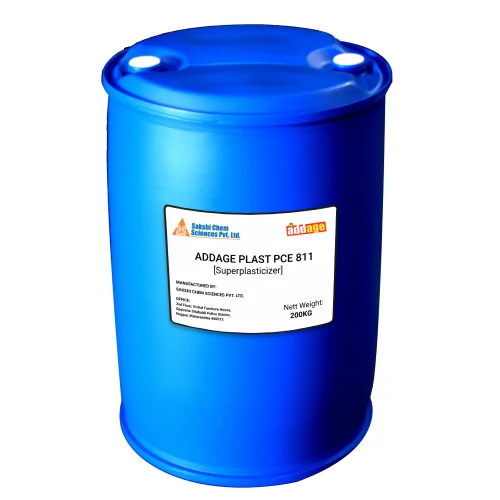
While there are several types of Superplasticizers in the market, such as those based on lignosulfonates, melamine, or polycarboxylate ethers (PCEs), Sodium Naphthalene Sulfonate continues to hold a strong position for many practical reasons:
| Property | Sodium Naphthalene Sulfonate | Polycarboxylate Ether (PCE) | Melamine-Based Superplasticizer |
| Water Reduction | Excellent | Excellent | Moderate |
| Workability Retention | Very Good | Excellent | Moderate |
| Cost Efficiency | High | Moderate | Low |
| Compatibility | Broad | Sometimes Limited | Limited |
| Setting Control | Adjustable | Fast Setting | Variable |
While advanced Superplasticizers such as PCEs have taken the lead in the higher-end spectrum, Sodium Naphthalene Sulfonate (SNS) remains a valuable and inexpensive opportunity for projects that require proven performance without sacrificing quality or cost.
Environmental Benefits
As the construction industry does its best to incorporate sustainability, Sodium Naphthalene Sulfonate offers multiple advantages:
- Reducing the volume of water used reduces environmental impact.
- Reduced cement placed reduces CO₂ emissions during production (and savings in cement);
- Lasting performance means less repairing and rebuilding occurs, increasing a structure’s life cycle
Moreover, Sakshi Chem Sciences has a dedicated approach to exploring eco-friendly formulations and adopting eco-friendly processes in producing our Superplasticizers that provide building and construction industries with results, as well as adhering to and improving sustainable reputations as they deliver building materials for environmentally conscientious projects.
Future Outlook: Building Better With Chemistry
The future of concrete building is smart chemistry, where innovation meets accountability. The need for newer, advanced Superplasticizers, like Sodium Naphthalene Sulfonate, will only grow.
Sakshi Chem Sciences Pvt. Ltd. is proud to be part of this constructive change! With our advanced R&D laboratories, high-tech manufacturing facilities, and a legacy of over 20 years of experience, we are continuously developing next-generation concrete admixtures that perform beyond expectations.
Our products are designed not just to strengthen structures but to build a more sustainable and efficient future for the construction industry.
Conclusion
Sodium Naphthalene Sulfonate has truly revolutionized our perspective and production of concrete. Its strength-enhancing capabilities and advantageous properties of allowing reduced water use and enhancing workability make it one of the best Superplasticizers in modern construction.
At Sakshi Chem Sciences Pvt. Ltd., we believe that innovation is not just about stronger and more productive construction chemicals but facilitating builders to design safer, stronger, and more consistent structures.
As we continue to grow globally, our commitment is unchanged: to deliver high performance, high quality, low cost, and reliable chemistry to deliver on construction performance.

Sagar Telrandhe is a Construction Engineer with a B.Tech in Construction Engineering & Management. Passionate about infrastructure development, project planning, and sustainable construction, he specializes in modern construction techniques, project execution, and quality management, contributing to efficient and innovative building.