
Understanding time management in construction projects is not just a checklist of activities because it requires an understanding of the interdependencies of many moving parts, understanding fluctuations in the plan and work direction, understanding people and their role(s) on the job site, and engaged activity on the job site.
Poorly managed time can have significant repercussions, including missed deadlines, cost overruns, wasted resources, and frustrated and disaffected teams.
Conversely, properly managed time can enhance productivity, assure quality, and eliminate uncertainty, thus satisfying all individuals involved, from the worker to the stakeholder.
Table of Contents
In this guide, we will provide available practical and specific examples for improving time management in construction projects, by which you can become better organized, arrive ahead of schedule and better prepare for the unexpected, whether forwarded by a process instance, as a project manager and leader of your team or as a contractor.
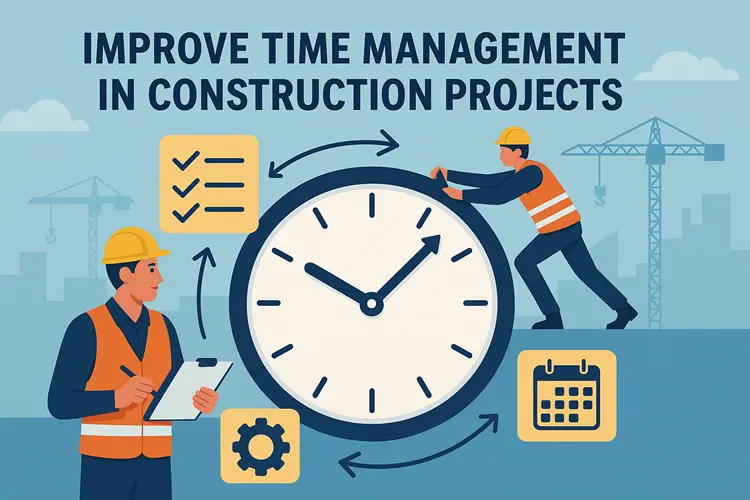
1. Begin with a Strong Plan
Without going into an extended detail of preparing the required documentation of planning, permit the following to guide you in your level of construction understanding and experience. The plan should consider:
Define project scope – Articulate the work that needs to be done – identify tasks, identify who will accomplish the tasks, and ascertain by when the tasks will be accomplished.
Create reasonable timelines – It is easy to fall into the trap of promising to finish early – this will lead to the underestimating of time. This is a safe assumption in construction is the most common oversight – it is the precursor to rush jobs, mistakes, and poor quality.
Dealing with Schedule – You will want to break the project into phases, milestones and activities and identify a time duration for each activity, as well as what resources will be required (and their availability) and whether they are dependent on the completion of other activities.
The goal is to develop a roadmap. Its easier to manage time if you know where you are going and what could potentially stop you from getting there.
2. Use Construction Project Management Software
Construction schedules can no longer be managed with a pen and paper. There are software solutions available that can simplify your life immensely. For example, Procore, Buildertrend, or Microsoft Project are platforms that allow users to:
- Report on the real-time status of activities
- Delegate tasks to a worker
- Manage documentation and updates
- Communicate with teams (on and off-site)
- Forecast delays and budget spending
Construction software allows you to see where time is slipping away, or what activities might not be as productive.
By holding each user accountable for spending the expected amount of time on given activities, construction scheduling software provides everyone with a tracker for expectations and deadlines.
3. Define roles and responsibilities
Managing time is only as effective as how much of ambiguity there is. Therefore, it is vital for everyone involved to be aware of:
What tasks each person is responsible for?
When those tasks need to be delivered?
Who each person needs to report to or partner with?
All workers need to have expectations established early on. Every worker needs to know their specific role in the context of the overall timeline of the project.
When checking in or having toolbox talks, it is critical to reference project timelines created at the onset of the job to eliminate ambiguity as it pertains to misunderstanding or overlap in effort.
4. Build in buffer time
Construction timelines rarely hold up as planned.
Weather delays, supply chain challenges, and site-specific conditions can all affect your schedule. Building in buffer time allows you flexibility to deal with surprises while not losing the whole schedule.
One common rule of thumb is to build in a 10-15% buffer time into your estimates for durations or for critical path activities. You may think of buffer time like common space in your home – it can absorb all sorts of things that may or may not spoil what you consider the ‘original purpose’ of that space.
5. Use the Critical Path Method (CPM) to rank tasks.
CPM, or Critical Path Method, is a project modeling technique to identify:
Which activities and tasks have to be completed to stay on track?
Which activities and tasks could be delayed, without impacting the schedule?
After identifying the Critical Path, you can leverage your resources even better. You can provide additional focus on high-impact activities while continuing to manage their delivery on schedule.
Every day that you delay a critical activity will increase the chances that you will delay the entire project. By delivering your Critical Path activities on time, give them a high priority!
6. Track Progress
Due to the many moving parts involved in a renovation project it is absolutely critical to track progress. You need to know when something is off schedule ahead of time, so set aside enough time to make a record of progress at least weekly, if not bi-weekly.
In these reviews, you can:
- Review ongoing activities to determine where a task is ahead of schedule and where a task is behind schedule.
- Review the timeline to determine any updates/backtracking, or if you still feel on track.
- Discuss challenges/obstacles in the current projects and do what you can to find solutions.
- Adapt resources as necessary.
Use simple checklists, Gantt charts, dashboards, or digital-status reports quickly and visually communicate what you have planned for timing and where you actually are.
Frequent reviews will catch unexpected situations before they become an issue and stop small miscommunications from becoming bigger problems.
7. Enhance Communication
It is safe to say that in the construction industry, there are too many wasted hours due to a lack of communication. Every wasted hour can be due to miscommunication, delayed communication and approvals, and lack of information. Here are some suggestions:
- Use project management software with a centralized communication function.
- Regular site meetings and briefings each day.
- Encourage conversations between employees, subcontractors, and management everywhere possible.
- Document, track, and communicate decisions and instructions easily and quickly.
The sooner and clearly you can communicate your information, the quicker things get done, the better the coordination, and the fewer errors. Clear communication creates trust between employees and on teams essential to morale.
8. Develop your Team
Working efficiently is based on prior experience through planning and work.
The best way to ensure that your team is able to be efficient is to make sure they are all well trained and kept up to date with current tools, techniques, and safe practices. A well trained team will complete tasks quicker with more accuracy.
Providing regular training is money well spent because it means less rework, happier employees, and ultimately more productive output. The return on your investment will be more apparent when your crew is working smarter, not harder.
9. Speed up procurement and supply chain
There is no faster way to dead stop your project than to miss a deadline for material arriving on site. To streamline your procurement and supply chain, you can:
- Work with your suppliers who have a reputation for reliability.
- Give suppliers timely notice before ordering materials.
- Perform due diligence for critical materials and have contingencies in place — every good general always has a backup plan.
Building a positive working relationship and keeping communication open with your suppliers. Utilize software that allows you to monitor shipments and utilize procurement scheduling.
It would also be good to monitor your inventory as closely as possible. You do not want to discover the night before a massive cement pour that you are out of cement.
10. Risk Assessment
Before starting any work, there was a potential delay and risk to your schedule. Some risks include the following:
- Equipment breakdown.
- Permit delays.
- Job site delays with subcontractors and labor.
- Unforeseen job site conditions.
From there, develop mitigation strategies and contingency plans. Designate protocols for escalation and emergency plan reactions. Taking a risk management approach before commencing a project will allow teams to save valuable time and resources.
11. Implement Lean Construction Strategies
Lean construction is defined as minimizing wasted time while maximizing value. This can take many shapes, including:
- Eliminate wasteful steps.
- Enhance workflow.
- One team, facilitating collaboration at all levels.
Lean construction methods such as Just-in-Time deliveries, the Last Planner System, or Pull planning, can increase efficiency and reduce valuable time providing a substantial time saving. By reducing unnecessary steps and waste, you streamline the process and increase productivity on-site day in and day out.
12. Debrief and Reflect After Each Project
When a project finishes, it is never a wasted opportunity to recognize and reflect on the following:
What was a success?
What was the delay?
What can we improve on next time?
Conduct a post-mortem meeting with the critical members of your team, and document the lessons learned. This feedback loop will help improve your processes and avoid making the same mistakes.
13. Foster a Culture of Accountability
Time management is not the sole responsibility of the project manager, it is a team initiative. It is crucial to foster a culture where each member recognizes their role in the customer journey.
- Set clear expectations and goals.
- Encourage team members to take ownership of their activities.
- Provide recognition and rewards for staying timely and performing well.
- When people feel accountable, they will be committed and stay engaged to manage their own time.
14. Implement Visual Management Tools On-site
Visual is sometimes the best tool to save time. Incorporate whiteboards, progress tracking charts, sign intersections, and/or digital boards on site to keep everyone warm and fuzzy.
Record the daily goals and milestones achieved.
Highlight the priority work.
Keep everyone in the loop on upcoming deliveries and report on weather forecasts.
Visual reminders help to keep everyone focused on urgent priorities and ultimately save time spent asking questions for updates.
15. Pair Speed With Quality
As I stated before, being early is always better than being late; however, being early should never compromise quality to the point where it has been sacrificed by expedience.
If negligent construction leads to rework, extra inspection, or otherwise results in being sullied by a legal mess, none of which took less time.
Train your team to work efficiently, but not hastily. Follow the quality control systems you have implemented, and use discipline in inspection to intercept the failing work as soon as it can be.
Conclusion: You Made Time Work for You
There is an art and a science to managing time in construction projects. It entails a combination of proper planning, the use of technology, proper communication and transmittals, and the ability to be flexible.
There is no project that is the same as another, but the basic rules remain the same: plan well, communicate often, measure progress, and be flexible.
When you manage time properly, you will finish the building project on time. Moreover, you will have a more efficient, focused, and happy team. And if you think about it, that is the best form of construction management.
Investigate the right tools, and leave room to train your team, while leaving room for continuous improvement. To apply this saying again, when time works for you, everything else will fall together.

Sagar Telrandhe is a Construction Engineer with a B.Tech in Construction Engineering & Management. Passionate about infrastructure development, project planning, and sustainable construction, he specializes in modern construction techniques, project execution, and quality management, contributing to efficient and innovative building.