
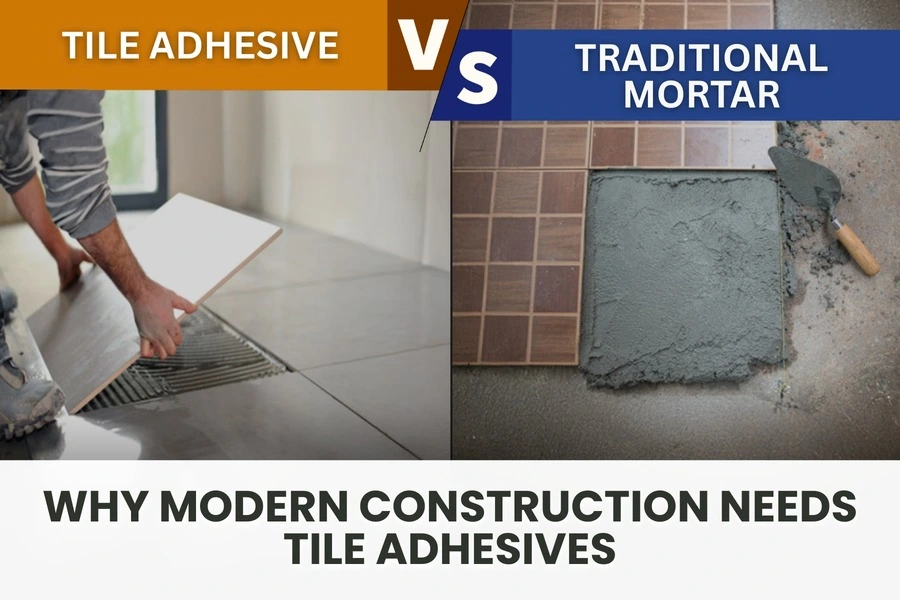
Currently, tile products represent one of the most significant elements of today’s construction projects. Tiles can help define a building’s overall aesthetic, hygiene levels and even its durability. The performance of tiles is really determined by the material you use to install them.
The Indian Construction Industry has traditionally installed tiles using cement and sand based mortars for many years. Although Cement and Sand worked very effectively to install tiles, they were only adequate to meet the minimum requirements of tile installation.
Table of Contents
Over the years, the size of tiles has increased, and the materials from which tiles are made have become increasingly heavier and denser, thus resulting in more complex installation styles. As these changes occurred, Cement and Sand-based mortars began to exhibit increased failures.
Tiles would fall off of walls because they lost their bond with the mortar, the sound of hollow tiles became prevalent, and seepage from tiles became a constant issue.
As a result of these changes, the construction industry recognised that the use of traditional mortars was not an acceptable solution for modern construction.
The construction industry began to seek out a new, higher-performance tile installation system, which ultimately resulted in the development of tile adhesives.
At Sakshi Chem Sciences, we manufacture advanced polymer-modified adhesive systems that use high-quality components like RD powder and other components to provide superior bonding strength, flexibility and long-term durability to tile installations.
To better understand how tile adhesives differ from traditional mortar systems and why modern construction cannot return to using mortars for tile installations, it is important to understand the fundamentals of tile adhesives.
What are tile adhesives?
Tile adhesives are a composite material comprised of cement and a blend of polymers and fillers that are formulated to enhance the adhesive performance and provide superior installation results.
The primary component used for manufacturing this type of tile adhesive is RD Powder. With its superior flexibility through the use of RD powder, the tiles will adhere securely to a variety of surfaces.
The benefits mentioned above can all be attributed to the properties of the RD Powder.
Tile Adhesive, which will allow for greater adhesion and waterproofness than traditional mortar, and greater flexibility through movement and heat.
In addition to the above benefits, the RD powder Tile Adhesive is specifically formulated for the larger format tiles such as porcelain, granite and marble; whereas traditional mortar is composed of only cement/sand combinations, therefore it does not provide any performance modifiers for modern tiles.
Traditional Mortar Limitations
Historically, traditional mortar has been used for many years, but it was designed for the small, lightweight, porous tile types that existed at the time. Today, modern tile formats are significantly larger in size, have a low level of porosity, and therefore do not allow moisture to be absorbed.
Because of these properties, traditional mortar cannot create chemical bond connections with these modern tile products, resulting in a high likelihood of product failure.
Key Limitations of Mortar/Tiles:
- Weak Adhesion – over time, tiles are likely to come loose.
- No flexibility, so cracks will form.
- A vast amount of shrinkage (while curing).
- No waterproofing protection.
- Will not prevent heavy/vitrified tile weight.
- Increased potential for moisture infiltration/dampness.
- Exceedingly labor intensive and creates equally as many variations in mixing.
- In bathrooms, balconies, and wet areas, mortar fails much faster, causing structural damage and costly repairs.
Tile Adhesive vs Traditional Mortar: A Clear Comparison
| Feature | Tile Adhesive | Traditional Mortar |
| Bond Strength | Very high (polymer-modified) | Medium |
| Waterproofing | Excellent | Poor |
| Flexibility | High | None |
| Shrinkage | Low | High |
| Tile Types Supported | Porcelain, vitrified, marble, granite, large tiles | Mostly small ceramic tiles |
| Application Speed | Fast and consistent | Slow and labour-dependent |
| Longevity | Decades | Frequent repairs needed |
| Cost Efficiency | Higher long-term savings | Low initial cost, high maintenance |
This comparison clearly shows why Tile Adhesive vs Traditional Mortar isn’t just a debate, it’s a transformation in construction practices.
Why Modern Construction in India Prefers Tile Adhesive?
1. Strong Bonding for Heavy and Non-Porous Tiles
Porcelain, vitrified tiles and natural stones are being used in the construction of modern homes. They require the use of chemical bonding along with mechanical grip to fasten them together. The polymer binders and RD Powder that are included in tile adhesive provide:
- High tensile adhesion.
- No hollow sounds.
- No tile movement after being installed.
This last point is crucial for wall tiles, which can move due to the use of mortar.
2. Increased Waterproofing and Resistance to Seepage
Kitchens, bathrooms, balconies and rooftops are all constantly subjected to moisture. The porous nature of mortar allows it to quickly absorb water, resulting in:
- Damp walls.
- Efflorescence.
- Mold growth.
- Decrease in the structural integrity of the wall.
The use of tile adhesive creates a water-resistant barrier, providing a significant improvement in the reduction of seepage. Therefore, tile adhesive is ideal for applying ceramic wall tiles or any type of tile in a wet or outside atmosphere.
3. Ability to Accommodate Expansion/Contraction
Because of temperature fluctuations, our buildings will naturally expand and contract. The rigidity of mortar creates stress when the building moves; therefore, cracking occurs.
The elasticity provided by RD Powder allows tile adhesive to absorb movement without breaking or popping out.


4. Perfect for the Larger Tile Sizes and Contemporary Design
Extra-large tiles require complete coverage for adhesion to support tiles, and tile adhesive provides good back-buttering and full surface coverage, and high slip resistance.
When utilising mortar to install large tiles, an uneven bond is created, therefore increasing the possibility of the tiles breaking.
5. Application is Easier and More Efficient
Unlike other adhesives that require mixing together, tile adhesive comes pre-mixed to maintain consistency. The only ingredient workers must add to the tile adhesive is water.
This provides employees with:
- Faster project completion.
- Less wastage.
- Clean and neat application.
- Uniform tile alignment.
In comparison, mortar depends entirely on manual mixing quality, leading to inconsistencies.
6. Long-Term Cost Savings
Even though tile adhesive costs more initially, the benefits outweigh the expenses:
- Fewer repairs.
- No seepage treatment.
- No tile replacement.
- Longer tile life.
Mortar saves money upfront but leads to high maintenance costs later.
Where Tile Adhesive Is Most Effective?
Sakshi Chem Sciences has developed tile adhesive products that can be used in many different situations including:
- Bathroom and kitchen tiling.
- Interior wall and exterior wall tiles.
- Residential and office floor tiling.
- Parking area and outdoor pathway tiling.
- Installation of natural stones.
- Installation of swimming pools and bodies of water.
- Installation of large format tiles.
- Application of tile over previously installed tile.
With proper product selection and proper mixing of products, Sakshi Chem Sciences provides long-lasting performance from all of its adhesive products.
The Role of RD Powder (Redispersible Polymer Powder) in Developing Quality Tile Adhesive
Redispersible Polymer Powder helps to improve tile adhesive products in various ways:
1. Improves tensile strength.
2. Improves flexibility.
3. Improves workability.
4. Reduces cracking in tile installations.
5. Increases waterproofing ability.
6. Allows for strong adhesion to difficult surfaces.
Sakshi Chem Sciences utilizes quality RD Powder in its formulations in order to provide superior performance for today’s construction industry.
Tile adhesive is the preferred future material by the tile and installation industry when comparing tile adhesive with traditional mortar products.
From tile adhesive products, contractors and installers will experience the following:
- Increased bonding strength.
- Increased waterproofing capability.
- Quicker tile installation.
- Increased longevity of tile installation.
- Cost-effective solution.
- Ability to work with modern tile products.
The tile and installation industry has advanced in many ways since the introduction of both mortar and adhesive products have become widely available.
Conclusion: Tile Adhesive Is the Future of Tiling
At Sakshi Chem Sciences, we are committed to manufacturing high-quality tile adhesives enriched with advanced polymers and RD Powder to support India’s evolving construction landscape.
If you want tiles that last for decades without popping, cracking, or causing seepage, tile adhesive is the only reliable choice.

Sagar Telrandhe is a Construction Engineer with a B.Tech in Construction Engineering & Management. Passionate about infrastructure development, project planning, and sustainable construction, he specializes in modern construction techniques, project execution, and quality management, contributing to efficient and innovative building.