
I. Introduction
Concrete has advanced drastically beyond the original definitions, as it was once developed for just basic forms of construction. Presently, concrete is expected to perform under increasing amounts of pressure – both literally and figuratively.
Modern construction structures, such as high-rise buildings and long-span bridges, have taken these expectations further by requiring the combination of all of the following factors: strength, durability, and workability simultaneously.
Table of Contents
Due to the increased demands of modern construction, advanced construction chemicals have taken over for traditional construction chemicals – particularly superplasticizers.
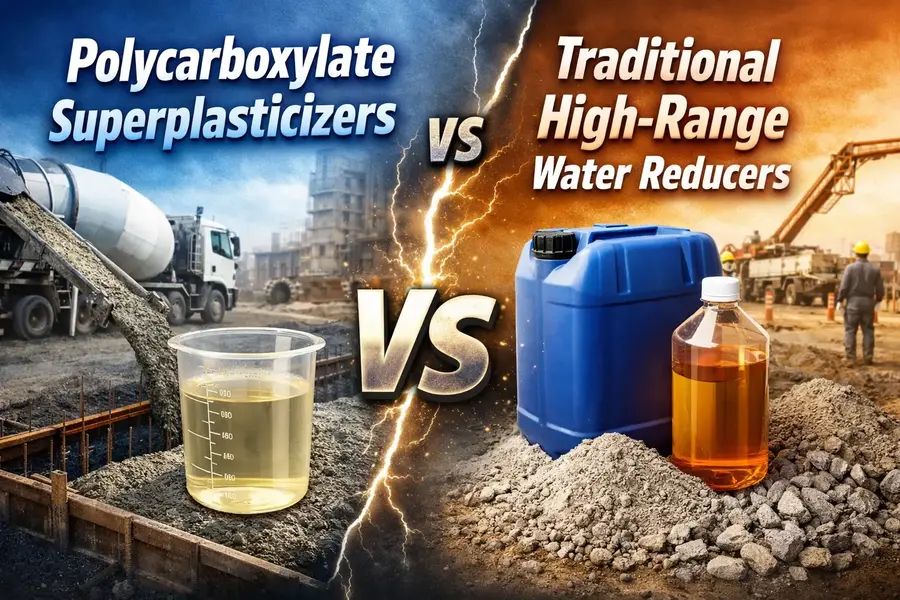
One of the more common types of advanced superplasticizers used in modern construction is the polycarboxylate superplasticizer, which, with its superior performance, flexibility, and efficiency compared to traditional high-range water reducers, such as naphthalene and melamine-based superplasticizers, has become the preferred superplasticizer for modern construction.
Sakshi Chem Sciences Pvt. Ltd. focuses on high-performance building materials that will help professionals in the building design and construction industries accommodate these demanding and ultimately growing construction industry needs.
II. How Polycarboxylate Superplasticizers Work Compared to Traditional Superplasticizers
The difference between a polycarboxylate superplasticizer and a traditional superplasticizer is found at the molecular level.
Traditional water reducer admixtures primarily utilize an electrostatic repulsion mechanism in order to create a repulsive force that pushes cement particles apart based upon the physical charge of the two types of molecules. This electrostatic repulsion only works to a certain extent.
In comparison, polycarboxylate superplasticizers use a much more advanced molecular structure composed of graphed molecules that provide for both particle repulsion due to electrostatic repulsion, as well as a physical repulsion factor through the comb-like structure that facilitates steric hindrance, as well as better dispersion, improved flowability, and greater control over the overall performance of the admixtures.
This structural innovation is the foundation of why PCE-based admixtures outperform older technologies.
III. Water Reduction and Strength Performance
One of the main roles of any superplasticizer is to reduce water while maintaining workability.
With Polycarboxylate Superplasticizers, this process becomes far more efficient.
- They can reduce water content by 25–40% or more.
- This leads to a denser concrete structure.
- Higher compressive strength is achieved.
- Long-term durability improves significantly.
Traditional high-range water reducers, in comparison, typically achieve only 15–20% water reduction, which limits their effectiveness in high-performance concrete.
In simple terms:
Less water = stronger, more durable concrete.
And PCE makes that possible without compromising workability.
IV. Workability and Slump Retention
Construction projects face delays due to the fact that concrete may need to be transported a considerable distance or used in complex assemblies.
Therefore, maintaining slump once the concrete is mixed will become extremely important.
To achieve this, polycarboxylate superplasticizers are used to keep the concrete working.
By allowing the concrete to retain flowing characteristics over time, the polycarboxylate superplasticizer disperses gradually and maintains a workable condition for extended periods based upon its molecular design.
Conversely, most traditional reduction agents lose their slump fairly rapidly and as a result:
- Require re-dosing at the job site.
- Display variable performance characteristics.
- Incur additional labor and time for the end user.
With the usage of the polycarboxylate superplasticizer, the job will run smoothly, have defined predictability, and be cost-effective.
V. Compatibility with Contemporary Concrete Mixes.
Currently, concrete mixes consist of more than just cement and sand. For example:
- fly ash.
- slag cement.
- silica fume.
All of these materials improve the performance and sustainability of the finished concrete, but they also add complexity to the concrete mix design.
Polycarboxylate superplasticizers have extremely high compatibility with these materials (modern or advanced materials) and adjust according to the mix design to ensure consistent performance.
Conversely, due to their limited flexibility, traditional reduction agents perform poorly in the more advanced applications associated with the above-mentioned materials.
VI. Flow Performance and Finish Quality
Flow is measured by more than just the ability of concrete to flow; it is also important to evaluate the performance of the concrete during placement.
With Polycarboxylate Superplasticizers, you get:
- Smooth and cohesive flow.
- Reduced segregation.
- Better pumpability.
- Cleaner surface finish.
This is especially important in:
- Self-compacting concrete.
- Architectural finishes.
- Precast elements.
Traditional reducers often result in uneven flow and higher chances of bleeding or segregation, which can affect the final quality.
VII. Sustainability and Long-Term Value
Sustainability is no longer optional in construction—it’s a necessity.
Polycarboxylate Superplasticizers contribute to greener construction by:
- Reducing cement usage.
- Lowering CO₂ emissions.
- Increasing durability (less repair and maintenance).
Traditional reducers require higher cement content to achieve similar strength, which increases environmental impact.
So while PCE may seem like a technical upgrade, it’s also a sustainable one.
VIII. Practical Cost Perspective
At first glance, Polycarboxylate Superplasticizers may appear more expensive. But looking at the bigger picture tells a different story.
They help reduce:
- Cement consumption.
- Labor costs (less rework).
- Material wastage.
And they improve:
- Efficiency.
- Consistency.
- Long-term performance.
This makes them more cost-effective over the entire lifecycle of a project.
IX. Quick Comparison Table
| Aspect | Polycarboxylate Superplasticizers | Traditional Reducers |
| Water reduction | 25–40%+ | 15–20% |
| Slump retention | Excellent | Limited |
| Compatibility | High | Moderate |
| Flow quality | Smooth & stable | Less consistent |
| Sustainability | High | Moderate |
| Overall performance | Advanced | Conventional |
X. Why Choose Sakshi Chem Sciences?
At Sakshi Chem Sciences Private Limited, we emphasize:
- Quality of the construction chemical.
- Quality of our R&D facilities and testing laboratories.
- Consistent performance of the products.
- Excellent support for our customers.
We have been in business for more than 20 years and have a global presence to assist our clients in building stronger, longer-lasting, and more efficient buildings.


XI. Summary
The differences between Polycarboxylate Superplasticizers (PCEs) and traditional high-range water reducers are apparent, both scientifically and practically.
Benefits of PCEs include the following:
i. Reduced requirement for water.
ii. Longer workability.
iii. Greater strength and durability.
iv. Sustainability improvement.
With the constant growth of the construction industry, the use of advanced construction chemicals is becoming more of a necessity, rather than an option.
This is true for your choice of admixture. Polycarboxylate Superplasticizers will not just enhance your concrete, but also your overall construction process!

Sagar Telrandhe is a Construction Engineer with a B.Tech in Construction Engineering & Management. Passionate about infrastructure development, project planning, and sustainable construction, he specializes in modern construction techniques, project execution, and quality management, contributing to efficient and innovative building.