
Introduction
Modern society relies heavily on concrete. From bridges to roadways to high-rise buildings and factories, concrete forms the basis of our infrastructure today.
While concrete continues to be used for many construction applications, the complexities of new construction projects demand more than what ordinary concrete can provide.
Today’s concrete projects need increased strength at a much earlier rate, greater durability or ability to withstand wear or damage, more desirable workability (the ability to be easily formed), and/or a higher load-carrying capacity (the ability of a structure to support weight).
Table of Contents
High Strength Admixture technology will help make this happen.
At Sakshi Chem Sciences Pvt. Ltd., we believe every strong building begins at the molecular level. With over two decades of experience in the manufacture and supply of advanced construction chemicals, we can provide admixture solutions that will enhance the properties of both fresh and hardened concrete.
All of our products go through rigorous quality control measures and meet all global requirements for safety and durability, providing you with a dependable product every time.
This guide will provide you with all of the information you need to understand high strength admixtures (what they are, how they work, types of high strength admixtures, etc.), and how they are used to modify concrete strength and workability in today’s construction projects.
What is an Admixture?
Admixture is any substance added to concrete, either before or during mixing, that modifies specific properties of the concrete mix; this definition includes all materials used to make concrete (e.g., water, cement, and aggregates). In other words, an admixture is the 5th ingredient in a concrete mix.
Concrete traditionally consists of:
- Cement.
- Fine aggregate (sand).
- Coarse aggregate.
- Water.
Nevertheless, to attain certain performance characteristics, e.g., early strength development, improved workability, decreased permeability, or a determined setting time, complementary agents are inserted into the concrete mix; these are known as admixtures.
A high strength admixture will help develop high compressive strength, reduce water to cement ratio and will aid to increase durability without reducing workability. Admixtures have heightened importance in:
- High-rise buildings.
- Pre-stressed concrete.
- Industrial flooring.
- Bridges and marine structures.
- Heavily loaded bearing structures.
Admixtures can significantly improve concrete properties when correctly matched and proportioned.
Uses of Admixtures
Admixtures are used to improve the characteristics of standard (conventional) concrete. The most common applications are found in:
1. Producing High Early Strength
Accelerated strength gain enables early removal of formwork, allowing for a faster project completion time and reducing the amount of time for construction.
2. Improving Workability
When reinforcements are congested or when the formwork is complicated and requires improved flow; therefore, properly functioning admixtures can enhance workability without increasing the amount of water.
3. Long-haul Transport
For readymix concrete, Retarders will provide for retention of workability during transportation of the product in hot weather conditions.
4. Reducing Permeability
Low permeability increases durability, particularly for:
- Marine structures.
- Basements.
- Water tanks.
- Bridges.
- Retaining walls.
5. High Performance Concrete
The need for high-strength concrete requires a low water-cement ratio. This low water-cement ratio can be achieved by using Water reducers and Super-Plasticisers.
6. Cold Weather Concreting
When water is used as an accelerator, the hydration process happens much faster in colder temperatures, so delays in setting will not occur.
At Sakshi Chem Sciences, we can create custom admixture solutions for each project based on the specific performance requirements of that project.
How Admixtures Affect Fresh Concrete Performance?
Fresh concrete is the plastic state of concrete prior to hardening. For an admixture to have a significant effect on this state, it must provide high strength and performance.
1. Increased Workability:
Admixtures like superplasticisers allow for the uniform dispersion of cement particles in the plastic (wet) state, which increases the slump at the same time as maintaining the same amount of water.
2. Reduced Water Use:
A water reducer will reduce the amount of water needed to produce concrete by approximately 5-15%. Super plasticisers can reduce water use by up to 30% or more. This greatly improves the strength of the hardened concrete.
3. Controlled Setting Time:
Retarders or delay setting of the concrete when it is placed in high temperature environments. Accelerators or fast-setting accelerants, or hydrating agents, will accelerate the setting of concrete when placed in low-temperature environments.
4. Reduced Bleed:
Admixtures improve the cohesive properties of the concrete and reduce the amount of water that separates from the other components of the concrete.
5. Improved Pumpability:
When using superplasticisers, the ability to pump flowing concrete to a higher elevation is greatly improved.
6. Reduced Segregation:
When using admixtures to better disperse the particles in concrete, there is less risk of the aggregates separating from each other.
Due to these benefits, the use of admixtures will allow contractors to utilise concrete in a much more efficient manner at the job site.
How Admixtures Affect Hardened Concrete Performance?
Once the concrete has set, the hardened characteristics of the concrete will dictate its durability and performance as a structural element.
1. Higher Compressive Strength
The compressive strength of a concrete mixture is increased directly by having a lower water-cement ratio. High Strength Admixture products allow for this increase in compressive strength to be obtained with high efficiency.
2. Increased Durability
Decreasing the permeability of a concrete mixture increases durability and protects concrete against the following:
- Chloride attack.
- Sulphate attack.
- Chemical corrosion.
3. Improved Bonding
Admixtures also help improve the bond strength between the concrete and reinforcing material.
4. Decreased Shrinkage
By controlling hydration, admixtures help to reduce the amount of cracking that occurs in a concrete mixture after it is poured.
5. Improved Resistance to Abrasion
Improved abrasion resistance is especially important for industrial floors and pavements.
6. Enhanced Resistance to Environmental Attacks
Air entrainment is an example of how an admixture can improve freeze-thaw resistance.
In today’s infrastructure, the hardened properties of a concrete mixture define the service life of the concrete, and the application of admixtures will make that significant difference for all who use or specify concrete mixtures.
Types of Admixtures
As defined by industry standards, there are two main categories of admixtures:
1. Accelerating Admixtures
Accelerating admixtures increase the rate of hydration, thus decreasing set times and increasing the strength of concrete at early ages.
Uses:
- To cure concrete in cold months.
- For performing repair work quickly.
- To perform precast work.
Effects:
- Quickly develop strength at an early age.
- Decrease bleeding in the concrete mix.
- Increase density of the concrete mixture.
- Dosage level typically ranges from 0.07%-3% of cement weight.
2. Retarding Admixtures
Retarding admixtures act to delay the setting time of a concrete mixture.
Uses:
- To cure concrete during the hot months.
- For long-haul ready-mix concrete delivery.
- To prevent the formation of cold joints.
Effects:
- Increase slump retention.
- Increase the workability of a concrete mixture.
- Reduce segregation of a concrete mixture.
The dosage level is typically between 0.05% and 1% of the total weight of the cement in a concrete mixture.
3. Plasticizers (Water Reducer)
A Water reducer improves workability while reducing water content.
Why It Is Used:
- Congested reinforcement.
- Thin structural elements.
- Cement savings.
Effects:
- 5–15% water reduction.
- Increased strength.
- Improved economy.
4. Super Plasticisers
Super Plasticisers are advanced high-range water reducers.
They provide:
- Up to 30% water reduction.
- High flowability.
- Superior strength enhancement.
Why It Is Used:
- High-strength concrete.
- Heavily reinforced sections.
- Pumped concrete.
- Industrial flooring.
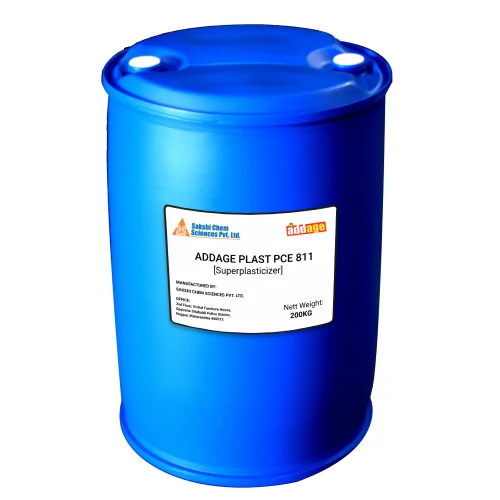
These are core components of High Strength Admixture formulations at Sakshi Chem Sciences.
5. Air Entraining Admixtures
These introduce microscopic air bubbles.
Why It Is Used:
- Freeze-thaw resistance.
- Improved workability.
- Reduced bleeding.
Requirements of Admixtures
A qualified admixture must satisfy precise performance specifications before it can be considered viable.
1. Physical Requirements
A High Strength Admixture should:
Be able to reduce the quantity of water used according to the specifications provided:
- Maintain slump limits as stated.
- Increase concrete compressive strength versus the control mix.
- Limit deviations related to the time of set.
- Reduce bleeding and shrinkage.
2. Requirements for High Workability
To achieve high-performance concrete, it is necessary to:
- Provide desirable flow values between 510-620 mm.
- Have controlled slump loss.
- Use a minimum of 90% compressive strength compared to the control mix.
3. Requirements For Uniformity
Each batch of High Strength Concrete must produce uniform Consistency in:
- The quantity of dry ingredients used in the concrete mix.
- Uniformity of relative density.
- Quantities of incorporated Chloride compounds.
- Uniformity of pH value (more acidic, lower strength, more alkaline, higher strength).
- The R & D Laboratory at Sakshi Chem Sciences uses strict testing protocols to ensure consistent quality.
- For an admixture to qualify as reliable, it must meet strict performance criteria.
Guidelines on Frequently Used Admixtures Modifying the Strength and Workability
Various types of admixtures contribute in several ways to concrete.
Water Reducers
Will provide a moderate increase in strength, will reduce the amount of water needed for mixing, and, to a small extent, increase the workability of the concrete (consistency).
Super Plasticisers
Will provide a major increase in strength (over standard) will produce a major increase in the slump (measure of consistency) of concrete, and will reduce the capability of water to penetrate through to the rebar within the concrete.

Retarders
Will extend the time required for concrete to set up, will increase the amount of time that concrete can be placed, and will delay the early strength of the concrete.
Accelerators
Will increase the early strength of the concrete, will reduce the amount of time that it requires to initially set up, and will help when pouring concrete during cold weather.
Plasticisers
These are best used in the production of high strength concrete because they give a very low water-cement ratio while still allowing a high flow of concrete.
Why choose Sakshi Chem Sciences for High Strength Admixture Solutions?
Sakshi Chem Sciences is a leading manufacturer of construction chemicals for over 20 years!
What makes us different from our competitors?
Largest Selection of Construction Chemicals – over 20 chemical solutions that can be used to modify the properties of construction materials!
- Advanced Manufacturing and Research and Development Facilities.
- Global Compliant with Health & Safety.
- Global Supplier Channels include distributors located in Mideast, African, European & South East Asia.
- Cost Effective Solutions for Customers.
- Complete Technical Support Provided by Experienced Professionals.
We manufacture High Quality, High Strength Admixtures For All Types of Construction:
“We work with our customers to create safe, strong, & long-lasting structures.”
In Conclusion
The future of Construction will not only be about building bigger. But will also be about? build smarter and stronger?
High-Performance Concrete requires a high degree of Engineering Precision at the Material Level – These are the areas that will require the use of High Strength Admixture Technology.
High Strength Admixture Technology has the ability to redefine everything that can be accomplished with concrete.
Utilizing Admixtures (such as Water Reducers, SuperPlasticisers, Reliable Retarders & Performance Driven Accelerators) correctly will allow you to achieve so much more than if you did not use Admixtures at all!
Sakshi Chem Sciences Pvt Ltd. will provide you with Construction Chemical Solutions to help create the continued evolution of modern Infrastructure through Innovative, Research & Development, and Field Experience.
We don’t just want to supply products; our aspiration is to give engineers and contractors the ability to create durable & reliable building solutions that work as intended.
Construction is built upon strength, and a construction company’s success also relies on producing high-quality concrete using the appropriate High Strength Admixture.
By using the right High Strength Admixture for your project, you will not only have a desirable outcome but will have an outcome that is functional regardless of the conditions under which it is created.

Sagar Telrandhe is a Construction Engineer with a B.Tech in Construction Engineering & Management. Passionate about infrastructure development, project planning, and sustainable construction, he specializes in modern construction techniques, project execution, and quality management, contributing to efficient and innovative building.