
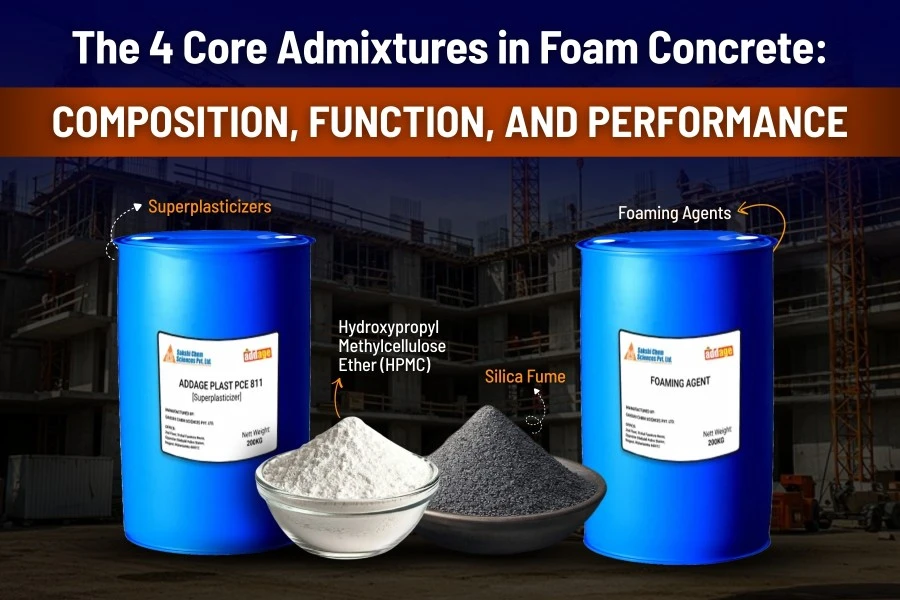
Foam Concrete is considered one of the best lightweight materials for the construction industry today due to its amazing properties. This material has good thermal insulation properties, is lightweight, and environmentally friendly; therefore, it is used for many applications such as roof insulation, tunnel backfill, void fill, and lightweight structural elements.
Table of Contents
The additive type of core admixture in foam concrete determines how well the foam concrete performs regarding the following properties: foam stability, foam concrete strength development, foam concrete workability, and foam concrete long-term durability.
Sakshi Chem Sciences Pvt. Ltd. specializes in manufacturing high-performance construction chemicals to improve the quality and performance of modern building materials.
With more than 20 years of experience in the industry and state-of-the-art research and development (R&D) facilities, as well as high-tech manufacturing methods, we ensure that each of our chemical additives meets international safety standards and durability criteria.
We will be exploring through this guide the Core Admixtures that are most important to foam concrete and how these core admixtures are composed, will function in combination to enhance the overall performance of foam concrete.
What Are Foam Concrete Admixtures?
Foam Concrete Admixtures are chemicals or naturally occurring materials that are introduced into a mixture during the foam concrete mixing process.
The purpose of these various materials is to enhance certain characteristics of the mixture (i.e., foaming stability of the foam concrete mixture, control of the hydration of the foam concrete mixture, and the workability and mechanical strength of the foam concrete mixture).
While cement and fillers make up the bulk of foam concrete, admixtures account for only a small portion of the mix. Despite this, they have a significant impact on key performance factors such as:
- Density control
- Compressive strength
- Thermal insulation
- Slurry stability
- Crack resistance
The Core Admixtures in Foam Concrete are generally classified into four main categories:
- Foaming agents
- Foam stabilizers
- Strength enhancers
- Performance modifiers
Each category performs a specific function to ensure that foam concrete achieves the desired balance between lightness and strength.
1. Foaming Agents: The Foundation of Foam Concrete
The benefits of foaming agents as additives for producing foam concrete are that they allow the material to have a cell structure within the foam concrete, which is what contributes to the composition of foam concrete being lightweight.
In addition, these agents produce stable air bubbles that are evenly distributed throughout the concrete slurry, and once the mixture cures, the bubbles create small voids within the foam concrete, thus: reducing density, improving thermal insulation, and creating air pockets in the concrete to allow it to be lightweight.
There are three general classifications of foaming agents.
Protein-Based Foaming Agent
Protein-based foaming agents are derived from hydrolyzed proteins of either plant or animal origin. Protein-based foaming agents produce fine, stable bubbles that mix well with a cement slurry.
The use of protein-based foaming agents is commonly found within higher-end projects that require a building material with superior insulation properties; this includes, but is not limited to, the following:
- In-slab heating systems.
- Rooftop insulation systems.
- Thermal wall panels.
Commonly, the dosage of protein-based foaming agents is such that it ranges from 0.5% to 2% of cement weight, depending on the desired density of the mixture being produced from the foaming agent.


Synthetic Foaming Agent
Synthetic foaming agents are produced from a combination of surfactants and chemical compounds. Synthetic foaming agents create larger foam bubbles and provide the ability to adapt better to varying construction conditions.
Furthermore, these agents can produce foam expansion ratios between 40 times and 50 times, which makes synthetic foaming agents suitable for use in large-scale commercial and industrial applications.
Commonly, the dosage of synthetic foaming agents is recommended to be between 0.3% and 1.5% of cement weight.

Chemical Foaming Agents
In some cases, aluminum powder is used as a chemical foaming agent. When it reacts with calcium hydroxide in cement slurry, hydrogen gas is produced, forming pores in the concrete.
This method is commonly used in aerated concrete block manufacturing.
2. Foam Stabilizers: Maintaining Bubble Integrity
It is crucial that the foam created during the mixing process stays stable long enough for the cement slurry to set. If there is no proper, stable foam, the bubbles can collapse, and therefore the density of cement will be inconsistent, creating a poor structure.
Foam stabilizers are crucial in this process.
Hydroxypropyl Methylcellulose Ether (HPMC) is one of the most widely used foam stabilizers.
HPMC has many great qualities: Holds water well, thickens liquids; Creates a slurry with higher viscosity; Helps foam remain cohesive.
HPMC is typically used in a concentration of 0.1% – 0.3% (by weight) of the total weight of the dry material.
HPMC helps to maintain a uniform distribution of pores in the foam concrete; if the pores are distributed uniformly, the foam will have an even density, and therefore provide better insulating capabilities for the structure.
Depending on the type of structure to be erected, other types of stabilizers may be utilized in addition to HPMC (i.e. polymer compounds and proteins).


3. Strength Enhancers: Creates Improved Mechanical Strength.
The advantage of foam concrete is its light weight. However, its light weight means foam concrete will have lesser compressive strength than standard concrete. Strength enhancement additives are occasionally added to the foam concrete to improve its mechanical properties.
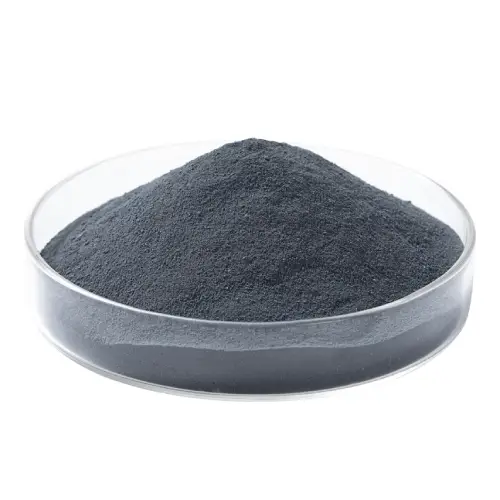
Silica Fume
Silica fume is a highly reactive pozzolanic material that reacts with calcium hydroxide to produce additional calcium silicate hydrate (C-S-H) gel.
This reaction improves the density and strength of the concrete matrix.
Typical dosage ranges from 2% to 8% of cementitious material.
Polypropylene Fibers
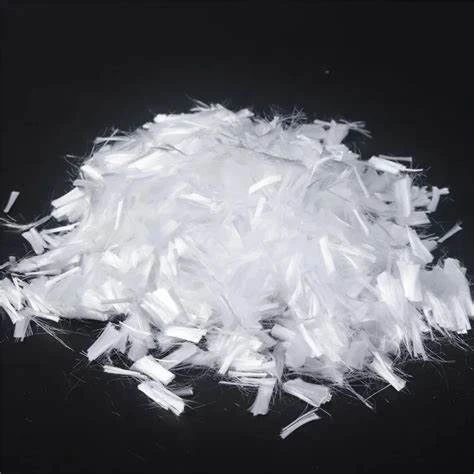
Another important strength enhancer is Polypropylene Fibers.
These synthetic fibers help improve the tensile strength and crack resistance of foam concrete.
Their benefits include:
- Reduced shrinkage cracking
- Improved tensile strength
- Better durability
- Increased impact resistance
The recommended dosage is typically 0.1% to 0.3% of the total mix weight.
By reinforcing the concrete matrix, Polypropylene Fibers help maintain structural integrity even in lightweight formulations.
4. Performance Modifiers: Enhancing Workability and Durability
Performance Modifiers
The final grouping of Core Admixtures for Foam Concrete includes performance modifiers that are designed to improve the workability of the slurry and increase long-term durability.
Below are the three most frequently used performance modifiers:
1. Water Reducers
Water reducers enable the reduction of the water-to-cement ratio while at the same time maintaining the fluidity of the foam concrete, which, in turn, improves both the strength and workability.
2. Early Strength Agents
Early strength agents will enhance the hydration of the cement, thereby enabling the concrete to achieve its strength more quickly. These admixtures may be particularly useful when concrete is placed in cold weather conditions.
3. Waterproofing Additives
Waterproofing additives improve the moisture resistance of foam concrete so that it can be used in underground applications or other applications that will be exposed to water.
Together, these performance modifiers assist in optimizing the construction processes and enhancing the durability of the completed foam concrete structures.
Considerations When Choosing Foam Concrete Core Admixtures:
The quality of foam concrete is dependent upon the performance modifiers that are used, an adequate amount of time must be taken to carefully evaluate the core admixtures before purchasing.
When evaluating performance modifiers, buyers need to evaluate several critical pieces of information.
Performance Standards
In order to ensure a uniform level of quality and safety of the product, the performance modifiers that you choose must comply with established industry standards.
Foam Stability
High-quality foaming agents should provide stable foam with minimal collapse during construction.
Compatibility
Admixtures must be compatible with the cement type and local raw materials used in the mix.
Technical Support
Suppliers that provide technical guidance can help optimize dosage and resolve on-site challenges.
Low-quality additives may reduce foam stability, increase shrinkage, or weaken the final structure. Choosing reliable suppliers helps avoid these risks.
Why Choose Sakshi Chem Sciences?
Sakshi Chem Sciences Pvt. Ltd. is one of India’s leading manufacturers and exporters of construction chemicals.
Our company offers an extensive portfolio of more than 50 products, including:
- Concrete and cement admixtures
- Waterproofing solutions
- Mold release agents
- Repair and rehabilitation products
- Grouts and additives
With a strong global presence across the Middle East, Africa, Europe, and Southeast Asia, we continue to provide high-quality construction chemical solutions that improve building performance and efficiency.
Our advanced R&D laboratory and modern manufacturing facilities allow us to develop innovative chemical formulations tailored to the evolving needs of the construction industry.
In addition, our experienced technical team offers expert guidance to ensure that customers achieve the best possible results in their projects.
Conclusion
Foam concrete has become an important material in modern construction due to its lightweight structure, insulation performance, and environmental benefits.
However, its quality and performance rely heavily on the correct use of Core Admixtures in Foam Concrete.
Foaming agents create the porous structure, stabilizers such as Hydroxypropyl Methylcellulose Ether maintain bubble stability, strength enhancers like Polypropylene Fibers improve mechanical properties, and performance modifiers optimize workability and durability.
By selecting the right additives and using them in proper proportions, contractors can achieve foam concrete that combines low density with strong structural performance.
At Sakshi Chem Sciences Pvt. Ltd., our mission is to support the construction industry with reliable, innovative, and cost-effective chemical solutions. Through advanced research, strict quality control, and global expertise, we help builders create stronger, more efficient, and sustainable structures.

Sagar Telrandhe is a Construction Engineer with a B.Tech in Construction Engineering & Management. Passionate about infrastructure development, project planning, and sustainable construction, he specializes in modern construction techniques, project execution, and quality management, contributing to efficient and innovative building.