
Concrete is one of the most useful and trusted materials for construction today. Whether it’s a mega bridge or a simple sidewalk, it provides strength, durability, and longevity.
Concrete can appear to be a dense, solid mix of aggregates, cement, sand, and water. But did you know that tiny air pockets are part of the mix?
Table of Contents
Whether naturally included or intentional, these air pockets play an important part in the way concrete behaves, especially in cold-weather climates, and this is where air content in concrete comes into play.
This document is designed to explain what air content means, why it is important, how it is measured, and how it relates to concrete admixtures so that it is easy to understand.
What Does “Air Content in Concrete” Mean?
Air content in concrete basically means the amount of air that is present in the concrete mix. It will most often be expressed as a percentage of total concrete volume.
This air can be:
Entrained: Tiny, uniform air bubbles that are intentionally added to the concrete with air-entraining agents.
Entrapped: Largely, irregular air pockets that become trapped during mixing or due to improper consolidation.
Entrained air is, in fact, desirable. It helps to provide concrete with resistance to freeze-thaw cycles. Entrapped air is generally undesirable and can lead to weakness in a concrete structure when not controlled.
Why Is Measuring Air Content in Concrete Important?
At first glance, you might be asking yourself—Why are you mixing air in a material that is supposed to be rock-solid? In fact, air helps concrete survive tough conditions, especially in freezing climates.
When water in the concrete freezes, it expands. When there is no tolerance for this expansion, the freezing water can create internal pressure that causes cracking or surface defects. The entrained air pockets function as pressure valves, allowing frozen water to expand without damaging the concrete.
This is why measuring air content is important:
Freeze-thaw protection: With the right level of air content, concrete can resist the harmful effects of repeated freezing and thawing.
Quality control: When you test for air content, you can know the concrete mix is proportioned as intended, with the proper level of air content that is consistent with the mixture, with variation in aggregates, admixtures, mixing time, etc.
Avoiding weak spots: Low air content can lead to cracks and loss of strength, or excessive air content can lead to loss of durability.
Understanding workability: Air content has an impact on the ease with which you can work with the concrete.
Whether you are pouring a residential driveway or building a huge dam, measuring air content is important.
How Does Air Get Into Concrete?
There are two ways air enters concrete.
1. Naturally During Mixing
Even without special materials added, the process of mixing cement, sand, and water includes added air, usually about 1% and 2%, called entrained air. This is a random process and can result in larger bubbles of air.
2. Deliberately By Air-Entraining Admixtures
When we are even more concentrated on durability, especially in cold environments, we add air-entraining admixtures that create uniform, tiny air bubbles.
Don’t confuse these bubbles with the previous entrapped air, as more poorly mixed air within the concrete. The sizes are consistent and stable and made throughout the beat process; they range from 0.01 mm – 1 mm.
These Entraining agents do NOT add air—they just help to keep it in the correct form and correct amount of air so the concrete will be hardened and resilient to stress.
Measuring Air Content in Concrete: What Methods Do You Need to Know?
There are many methods used to measure air content, with some advantages and disadvantages to each method. Your decision will be based on the type of concrete and materials you are using.
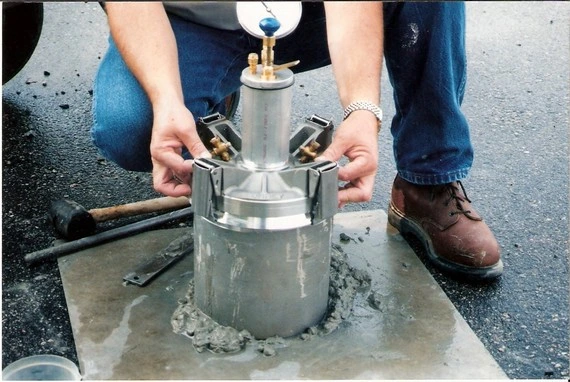
1. Pressure Method
This technique is one of the most reliable procedures, especially for normal-weight concrete. The procedure consists of applying pressure to a concrete mass and measuring the behavior of air in it.
Pressure meters can be divided into two types:
Type A – Water is used to exert pressure. The sample is capped with a container full of water, and the pressure is exerted to compress the air bubbles.
Type B – There is a separate air chamber. The air pressure is applied and discharged into the sample to measure the amount of air.
The pressure proceeds rapidly, with a good degree of reliability and ease. However. The pressure method is not suited to any lightweight or porous aggregates, such as blast furnace slag, which would yield inaccurate readings because the aggregates act like sponges.
2. Volumetric Method
The volumetric method works for all types of concrete, including lightweight and porous aggregates.
The method associated with volumetrics follows these procedures:
- A known volume of concrete sample is placed in a container.
- Water and alcohol, on occasion, would be poured into the container.
- The container is tightly sealed and shaken vigorously.
- The shaking of the sample will release bubbles of air into the body of water.
- The water level reduces, and the reduction indicates the volume of air dislodged from the concrete sample.
This technique is more complicated and slower, but it is very accurate and has advantages for unique mixes.
3. Gravimetric Methods
This is the oldest and simplest approach to measuring air content, without using special testing equipment.
It works this way:
The density of the freshly mixed concrete is measured.
This observed density is then compared to the theoretical density (the density that would occur without air).
The difference in these densities tells you how much air is in the concrete.
Although it is not as accurate as modern methods, the gravimetric technique can be useful in basic verification or research.
How Air Content Affects Performance?
Here is a quick summary of how different amounts of air in top-quality concrete can affect its nature:
| Factor | Effect of Increasing Air Content |
| Workability | Improves; concrete becomes easier to handle |
| Durability | Improves, especially in cold climates |
| Compressive Strength | Decreases by around 3-5% for every 1% increase in air |
| Resistance to Freeze-Thaw | Significantly improves |
| Slump (consistency) | Increases up to a point, then decreases |
Final Thoughts: The “Right” Amount of Air
Air is not insignificant compared to cement or aggregates, but is nonetheless one of the most critical ingredients to the durability of concrete and its longevity when exposed to the environment.
Getting the air content “right” is a careful balance as well; too little and you risk cracking when it is cold, too much and you can lose compressive strength. This is why it is crucial to test and control air content before you pour your concrete!
Now with modern technology and concrete admixtures, today’s builders can produce durable, resilient concrete and have the confidence that will assure them their structures can last for decades afterwards.
Common Questions About Air Content in Concrete
Now let’s answer some common questions to further clarify the subject.
1. Why do we test for air content?
To ensure that the concrete has an appropriate amount of entrained air, particularly in climates where it could be exposed to frost/freezing conditions (which is really the reason for it).
2. What is a good value for air content?
A good air content value for most general practices is around 6.5%. You get a solid balance of strength and durability.
3. What makes the air content go up in concrete?
Generally, air content can go up with:
1. Longer mixing times.
2. Higher concrete temperature.
3. The addition of air-entraining admixtures.
4. Higher slump (to a certain point).
4. What happens if the air content is too high?
It is good to have some air, but too much will weaken concrete strength. For every 1% increase in spacing factor, compressive strength could decrease by 3-5%.
5. How does air content relate to slump?
Air content tends to increase with a slump, usually until about 6 inches. After that, too much water may cause the amount of air the mix can hold to decrease. When slump decreases too much (below 2 inches), it can also be challenging to entrain the air.
6. How are air voids calculated?
If you’re CRUNCHING numbers:
% of Air Voids (V%) = (Vv / (Vv + Vm)) * 100
Where:
Vv = Volume of voids
Vm = Volume of solid matter = cement and aggregates (COARSE AND FINE aggregates combined)
This gives a very rough sense of how much space in the mix is occupied by air, versus solid particulate matter.

Sagar Telrandhe is a Construction Engineer with a B.Tech in Construction Engineering & Management. Passionate about infrastructure development, project planning, and sustainable construction, he specializes in modern construction techniques, project execution, and quality management, contributing to efficient and innovative building.