
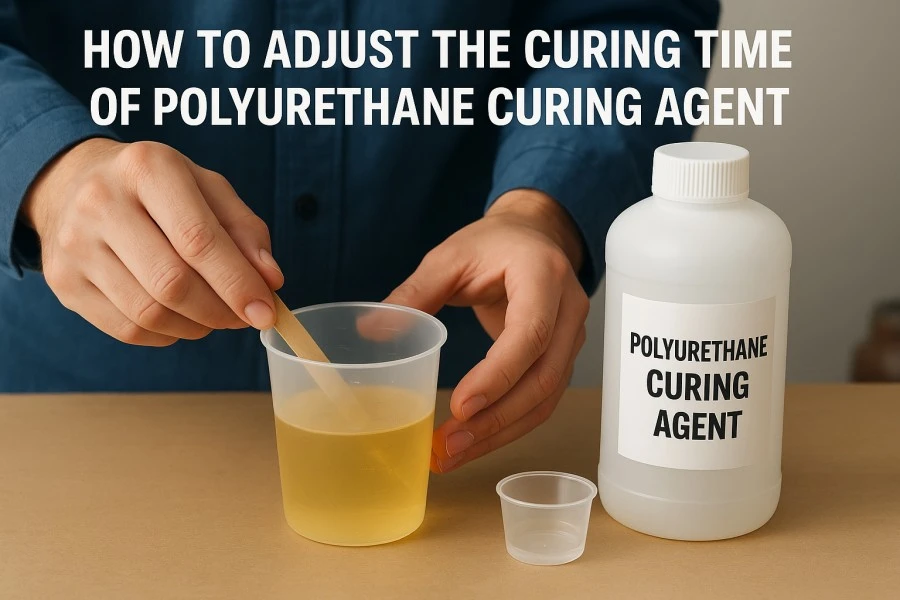
Polyurethanes are widely accepted by many different types of industries for their superior properties, such as flexibility, durability, and superb performance in applications.
However, there is one critical element that determines whether a Polyurethane System will perform according to the required specifications; that is, the curing time of the polyurethane curing agent.
Table of Contents
Obtaining proper curing times is critical. If the curing time is too short, then an applicator will have limited working time. If the curing time is too long, the project will be delayed, or the final film may sustain defects.
To achieve consistent high-quality results, it’s very important to understand how the polyurethane curing agents will react and, therefore, how their curing times can be manipulated.
As a leading manufacturer of advanced construction chemicals, Sakshi Chem Sciences provides polyurethanes with exceptionally engineered curing agents, which contain extensive experience and research and development.
This technical guide will discuss how curing times work, what will affect curing, and how an applicator may adjust curing time to meet the project requirements.
What Is a Polyurethane Curing Agent?
A Polyurethane Curing Agent is a chemical that will react with the polyurethane resin to create a cured cross linked material. After the material has been cured, a stable and durable film will be created that has excellent resistance to chemical agents, abrasion, and adherence.
In coatings, sealants, and adhesives, the curing agent controls critical performance parameters such as hardness, flexibility, drying speed, and long-term durability.
The curing time of polyurethane curing agent depends on multiple factors, many of which can be controlled or adjusted when the right knowledge and tools are used.
Key Factors That Affect the Curing Time
1. Temperature
Polyurethane curing is mainly affected by temperature. As temperature increases, molecules absorb more energy, and thus react faster (i.e., increases in temperature will accelerate the rate of the reaction).
Temperature decreases will cause a reduction in the speed at which the reaction occurs (up to 50% to 70%).
For example, at 30–35 degrees Celsius, the curing of a polyurethane coating may occur in 2 to 3 hours. At 5–10 degrees Celsius, it will take approximately twice that long to cure.
For this reason, many professionals working in colder climates will use heating elements or warm air cabinets for the purpose of controlling curing temperatures.
Sakshi Chem Sciences recommends maintaining the temperature within the range recommended by the manufacturer for your work environment to ensure a consistent finish.
2. Humidity
Humidity also has a direct effect on the curing agent (especially if the curing agent contains isocyanate).
- High humidity can cause the curing agent to take longer to cure and produce surface defects (i.e., hazed or bubbled surfaces).
- Low humidity can cause the surface of the coating to dry before the internal layers of the coating are cured.
That’s why applying polyurethane coatings while it is raining or within a damp basement typically results in poor results. By using dehumidifiers, controlling ventilation, or using other humidity-stable curing agents, you will achieve improved performance.
3. Mixing Ratio of Resin and Curing Agent
To properly cure polyurethane, there must be a specific ratio of resin to curing agent. Each manufacturer specifies a different ratio, and the following statements are a summary of the effects of not using the exact amount of curing agent.
Excessive amounts of curing agent result in a cured coating that cures faster but has reduced brittleness, while insufficient curing agent results in a coating that has not fully cured and therefore may have poor performance characteristics.
Ratios are commonly given by weight or volume, such as 1:1, 2:1, or 4:1.
Sakshi Chem Sciences emphasizes accurate measurement using digital scales rather than estimating by eye, as even a small deviation can change cure behavior drastically.

4. Type of Curing Agent
Various types of curing agents allow for distinct curing properties, such as:
- Aromatic curing agents are faster curing agents with less colour stability, often found in industrial coatings and adhesives.
- Aliphatic curing agents cure more slowly and offer strong UV protection, typically used in Automotive, Flooring, and Outdoor Finishing applications.
By choosing an appropriate curing agent, you can control a film’s flexibility, clarity, and chemical resistance.
How to Adjust the Curing Time?
1. Use Accelerators or Retarders
These additives modify the curing speed:
- Accelerators → Reduce curing time by increasing reactivity.
- Retarders → Slow the curing reaction, giving more working time.
Usage of Accelerators and Retarders should be done with caution. When used excessively, these additives may result in:
- Inadequate Leveling.
- Formation of Soft Film.
- Inadequate/Incomplete Curing.
Sakshi Chem Sciences recommends that the manufacturer’s guidelines and/or their technical team should be contacted regarding additive use.
2. Pre-Heating the Components
Pre-heating the resin and curing agent slightly (within safe limits) helps reduce viscosity and increase molecular activity.
Pre-heating is particularly helpful for:
- Cold Weather.
- Winter Applications of Polyurethane.
- Slow Curing Systems.
Warning; Excess heating of any component will destroy the chemical integrity, so it is very important that each user finds out and adheres to the temperature ranges recommended by the manufacturer.
3. Adjusting the Application Method
The method used to apply polyurethane also influences curing:
- Spraying → thin layers cure faster.
- Brushing/rolling → produces thicker films that take longer to cure.
- Pouring/self-leveling → slowest curing due to layer thickness.
Increasing airflow or using forced-drying techniques can help accelerate solvent evaporation and improve curing conditions.
4. Controlling the Work Environment
A controlled environment helps ensure predictable curing times:
- Maintain stable temperature.
- Use fans or exhaust systems for ventilation.
- Keep dust, moisture, and cold drafts away.
- Seal off large rooms to avoid fluctuating humidity.
Sakshi Chem Sciences recommends environmental monitoring for high-precision applications like industrial flooring or automotive refinishing.
Conclusion
Adjusting the curing time of polyurethane curing agent is both a science and an art. By understanding the effects of temperature, humidity, mixing ratios, and curing agent types, professionals can confidently control the curing process.
Sakshi Chem Sciences provides high-performance curing agents engineered for reliability, consistency, and superior film properties. With strong technical support and world-class manufacturing capabilities, the company continues to empower industries with dependable polyurethane solutions.
For expert guidance or to explore the full range of curing agent products, professionals can always count on Sakshi Chem Sciences.

Sagar Telrandhe is a Construction Engineer with a B.Tech in Construction Engineering & Management. Passionate about infrastructure development, project planning, and sustainable construction, he specializes in modern construction techniques, project execution, and quality management, contributing to efficient and innovative building.