
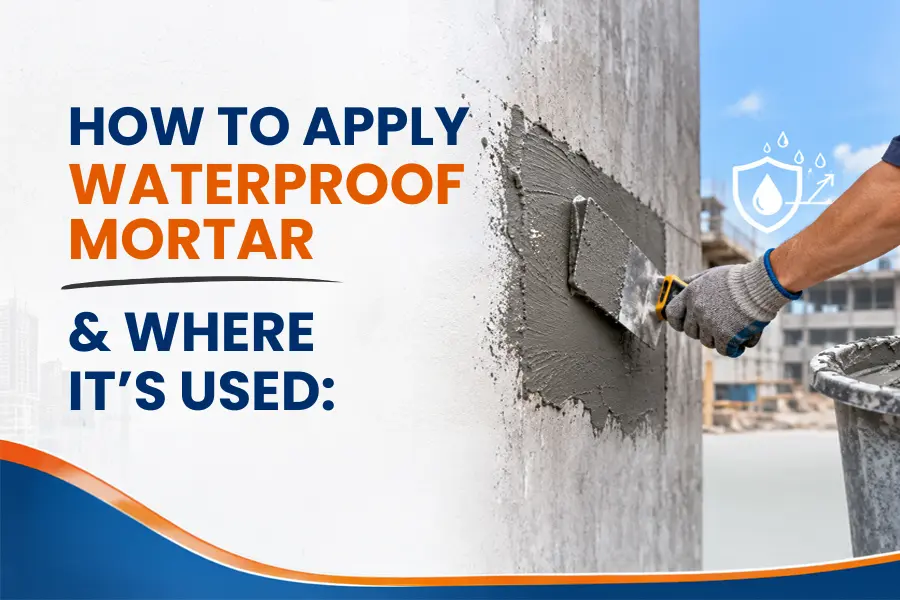
Water can penetrate through cracks, holes, seams, and poorly done joints or surfaces, which could make the construction products weak in their quality. Hence, waterproofing is important in such places as bathrooms, basements, terraces, foundations, swimming pools, and water tanks.
Table of Contents
Waterproof Mortar differs from ordinary cement mortar due to its water-resistant properties. However, just choosing the waterproof mortar does not guarantee good results.
Thus, it is important to pay attention to surface preparation, mixing, application thickness, curing, as well as the formulation.
Some modern formulations of mortars use formulas with HPMC, redispersible Polymer Powder (RDP), and PCE superplasticizers so that the water resistance qualities are improved.
In this guide, let’s talk about the application of waterproof mortar.
Step-by-Step Application Guide
Correctly applying waterproof mortar is just as crucial as choosing the right formula. Even high-quality products may not give good results if the ground is not prepared properly or if the mortar is not mixed or applied properly.
Step 1: Prepare the Base
The base must be solid and clean at the outset.
Get rid of dust, dirt, grease, oil, loose particles, laitance, old coatings, and any other factor that could lead to poor adhesion. Depending on the condition of the base, cleaning may involve wire brushing of the base, grinding, mechanical preparation, etc.
The concrete surface should have enough texture to ensure proper mechanical bonding. Any considerable cracks, damaged portions, construction joints, or pipe penetrations should be rectified based on the waterproofing system applied.
Since the surface must be wet or prepared properly as per the instructions of the manufacturer, the standing water must be removed before application.
Step 2: Mix the Mortar Correctly
Take into account the particular powder-to-water ratio that the manufacturer recommends. Do not add additional water even if the mortar seems difficult to mix. More water in the mixture may lead to the fact that the water-cement ratio being too high, and the resulting mixture could have higher porosity when it hardens.
Put mortar powder into the amount of water that is recommended and mix till you get a smooth and homogeneous consistency. A good mechanical mixer can guarantee that all of the components are well dispersed.
If the instructions indicate that the mixing period is to be followed by a resting period, do see that the mixture sits and is subjected to further mixing before its application.
The technical specifications of the product should guide you until the mixing process takes place.
Step 3: Apply the First Coat
Use a proper trowel tool to put down the first surface layer on the surface that has been prepared beforehand. Maintain contact between the cement or plaster and the surface by applying pressure. Make sure you cover necessary areas, like edges or corners, well enough. This is done to prevent such things happening as pinholes, voids, or gaps in the layer. Should you have to work with special products needing a number of layers to be applied, make sure that the first layer is roughened while it is still plastic to enhance adhesion between the layers.
Step 4: Apply the Second Coat
If a two-coat process is called for, wait for the first coat to condition before putting on the second coat.
The second coat has to cover uniformly and meet the required thickness according to the manufacturer’s recommendations and project specifications.
Thickness does not mean better waterproofing. Too much thickness can result in difficulties in application and drying; too thick a layer creates problems, while too thin a layer does not protect reliably.
Pay special attention to corners, penetrations, joints, and transitions because these are the places that are prone to weaknesses in waterproofing.
Step 5: Reinforce Vulnerable Areas
Certain applications sometimes demand extra reinforcement to provide protection, especially at the junctions of movement, corners, construction joints, or penetrations.
It is possible to use appropriate reinforcement, such as mesh resistant to alkalis, depending on the design of the waterproofing system.
This serves to support all movements, ensuring that the encountered stresses do not contribute to any cracks.
However, it is important to mention that installing reinforcement in mortar should not replace the installation of well-designed movement joints or repairs of structural cracks.
Step 6: Finish and Cure Properly
Once applied, it is essential to ensure that the mortar is protected against environmental conditions that lead to quick drying or deterioration.
The curing requirements will depend on the product, substrate, temperature, humidity, and way of application. It is necessary to follow the manufacturer’s instructions as opposed to relying on a one-size-fits-all curing time.
It is also important that no extremely dry conditions, heavy rain, standing water, or mechanical impact occur after the product has just been placed but before it acquires sufficient strength.
Correct curing makes it possible for polymer-modified products and cementitious ones to achieve their concrete characteristics.
Where Waterproof Mortar Is Used?
Waterproof mortar has a wide range of applications in areas that require moisture resistance for cement-based materials, but it is important to choose the formulation or entire waterproofing system suited for the particular project.
1. Bathrooms and Wet Areas
The elements of bathrooms, showers, and wet areas are often exposed to water and moisture.
Waterproof mortar and compatible waterproofing systems can be used to protect the product from moisture before applying tiles or other finishes.
As for vertical surfaces, the characteristics of working and sticking properties are important. HPMC can be used to improve these parameters, whereas RDP is responsible for enhancing the bonding properties.
2. Basements and Foundations
Underground constructions are in contact with underground water and hydrostatic pressure.
Waterproofing reduces moisture penetration through the foundation walls and surfaces of basements. However, waterproofing underground is not only about protecting against moisture.
3. Swimming Pools and Water Tanks
Since waterproofing construction works continuously with water, it is really important that the waterproofing of these constructions is performed properly.
In this case, mortar composition must satisfy adhesion and integrity specifications based on the level of water pressure exerted in a specific environment.
Polymer-based formulations can also be used to provide better adhesion and flexibility of the structure.
4. Terraces and Balconies
Terrace and balcony areas are directly affected by rain and temperature changes.
Water can pass through the gaps, connections, insufficient drainage, and exposed surfaces of the structure. Once it gets to the structure underneath, the substrate will get wet and damaged.
The correct type of waterproofing can stop the substrate and its layers from being affected by water.
5. Tunnels and Underground Structures
Tunnels, parking garages, and other types of structures located below ground level can be impacted by constant moisture.
Waterproofing systems used in these structures need to take into account water pressure underground, connections, movements, and drainage systems.
Waterproof mortar can be a part of the waterproofing system, providing strong protection against water damage.
6. Concrete and Masonry Restoration
Sometimes waterproof mortar can also be used for different restoration and renovation needs.
The material used for restoration has to match the old one and comply with the existing damage and performance requirements.
Why Choose Waterproof Mortar Additives from Sakshi Chem Sciences?
With two decades of experience in the manufacturing, exporting, and supplying of construction chemicals, Sakshi Chem Sciences Pvt. Ltd. has become a trustworthy name in the industry.
They offer chemical additives that contribute to modern waterproof mortar formulations with the following properties:
HPMC: enables greater water retention, increased consistency and workability, and sag resistance
RDP: enhances adhesion, cohesion, flexibility, and durability of the cement-based mortar
PCE: improves cement dispersion and reduces water needs while keeping good workability
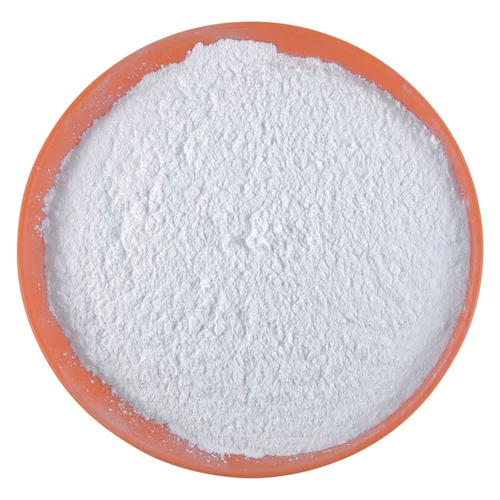

Sakshi Chem Sciences Pvt. Ltd. also gives technical assistance in choosing the correct additive, its grade, and dosage.
Conclusion
Waterproof mortar is one of the ways to protect concrete and masonry surfaces from the action of moisture; nevertheless, waterproofing will not be effective by the mere presence of the mortar.
Waterproofing quality relies heavily on factors that include proper preparation of the substrate, meticulous mixing of the mortar, its proper thickness at application, taking good care of the weak points, and adequate curing.
The formulation is also of great importance. For example, HPMC may contribute to better water retention and workability; RDP has a positive effect on adhesion, flexibility, and cohesion, while PCE facilitates control of water demand and mixing of cement particles.
Additives should be selected in compliance with the characteristics of the finished mortar and tested on the concrete mixture instead of using a “one-for-all” approach.
At Sakshi Chem Sciences, we aim to make reliable construction chemical products using top-quality manufacturing, modern R&D technologies, and professional services.
Frequently Asked Questions
What is Waterproof Mortar used for?
Waterproof mortar is used in applications where improved resistance to water penetration is required. Common applications include bathrooms, wet rooms, basements, foundations, swimming pools, water tanks, terraces, balconies, tunnels, and selected repair applications.
Can waterproof mortar be applied directly to concrete?
Yes, waterproof mortar can be applied to suitable concrete substrates, provided the surface is sound, clean, and properly prepared. Follow the manufacturer’s instructions regarding surface moisture, primers, bonding requirements, and application conditions.
Can I add extra water to waterproof mortar?
It is generally not advisable to add uncontrolled extra water. Additional water can change the designed water-cement ratio and may increase porosity after hardening. Always use the water quantity recommended for the particular product or formulation.
Does RDP make mortar waterproof?
RDP does not make mortar completely waterproof by itself. It provides polymer modification that can improve properties such as adhesion, flexibility, and cohesion, which can contribute to the performance of a properly designed waterproof mortar system.
What does HPMC do in waterproof mortar?
HPMC primarily improves water retention, workability, rheology, and sag resistance. These properties can help the mortar remain workable and achieve more consistent application.
Why is PCE used in waterproof mortar?
PCE helps disperse cement particles and can reduce water demand while maintaining suitable workability. This can contribute to a denser cementitious matrix and potentially lower permeability when the complete formulation is properly designed.
How thick should waterproof mortar be applied?
There is no single thickness suitable for every waterproofing application. The required thickness depends on the product, substrate, exposure conditions, application method, and project specification. Always follow the manufacturer’s technical data and project requirements.
Is waterproof mortar enough to stop structural water leakage?
Not always. Water may enter through structural cracks, joints, penetrations, drainage problems, or other pathways. In demanding situations, waterproof mortar should be used as part of a complete waterproofing system designed for the specific source and pressure of water.

Sagar Telrandhe is a Construction Engineer with a B.Tech in Construction Engineering & Management. Passionate about infrastructure development, project planning, and sustainable construction, he specializes in modern construction techniques, project execution, and quality management, contributing to efficient and innovative building.