
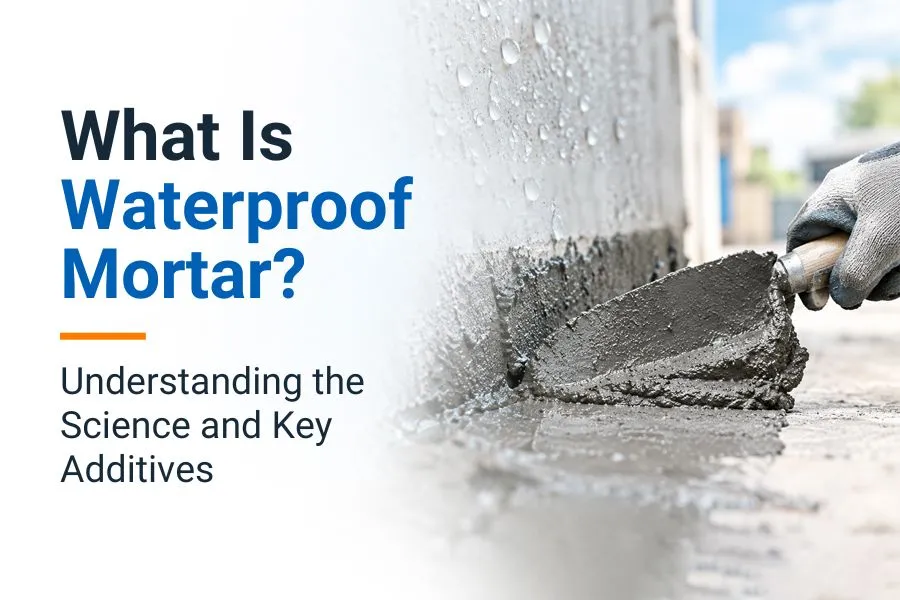
Concrete and masonry structures are highly prone to water damage. Cement-based products, despite their strength and toughness, remain vulnerable when subjected to moisture. The material has pores, micro-cracks, joints, and other weak bonding areas that allow water to get inside. Prolonged contact with water can cause moisture accumulation and further deterioration of concrete properties.
Table of Contents
This is the reason why waterproof mortar is used in particularly moisture-vulnerable areas. Basements, bathrooms, swimming pools, water tanks, terraces, foundations, tunnels, and other wet or underground installations need to be well waterproofed.
Waterproof mortar is not just a standard mortar with a waterproofing agent added. It is the technology of formulation and application that defines how effective the mortar will be. The quality of cement, grading of aggregates, amount of water, and the technological process of curing, substrate treatment, and choice of additives influence the efficacy of the mixture.
Among several components, waterproof mortar additives can be used to improve the essential characteristics of cement mortar. For example, different superplasticizers can be employed according to the specific property the additive must possess.
Let us explore the operating principle of waterproof mortar and the reasons why additives need to be used.
Is Standard Mortar Waterproof?
The simple answer is no. Conventional cement mortar is not waterproof by nature. Being a cement-based material, in its hardened form it has a porous structure. The extent of porosity depends on a number of factors such as the water-cement ratio, hydration, compressive strength, curing, selection of material, etc.
Capillary Pores
When there is more water used when making mortar than needed, excess water may cause capillary pores to appear in the material. The more water that is used, the more porous the resulting hardened mortar will be, as increased connectedness allows the water to pass through more easily.
Micro-Cracks
Micro-cracks in the mortar may occur due to various factors including drying shrinkage, temperature changes, substrate movement, improper curing, and mechanical stresses. Micro-cracks may not always be visible, but they will create pathways for water.
Poor Application
Despite being mixed perfectly, mortar may lose its effectiveness if being installed over a dirty and weak substrate surface, such as dust, grease, laitance, loose particles, and poor precursor surface treatment, which may lead to the reduction of adhesion and the formation of gaps between it and the substrate.
Excess Water
Using excess water in the mortar mix so that it can be installed better may lead to a change in the designed water-cement ratio. The mix set and hardened thus will have higher porosity and lower durability. This indicates that there is a need of controlling amount of water used for the production of durable and moisture-proof mortar.
What Makes Waterproof Mortar Different?
A waterproof mortar is specifically designed to resist water penetration more effectively than an ordinary cement mortar.
Waterproofing requires several qualities to be enhanced at once, not just a single one.
A good waterproof mortar can have such qualities as:
- Low permeability.
- Good particle packing.
- Good adhesion to substrate.
- Good cohesion.
- Resistance to cracking.
- Controlled water demand.
- Good workability.
- Good durability when exposed to moisture.
This is when the use of waterproof mortar additives comes in handy. Different waterproof mortar additives improve different parameters of the mortar mix. HPMC ensures that mortar retains water and is workable. RDP provides polymer modification and improves adhesion.

PCE means better cement-particle dispersion and lower moisture demand. The aim is to make a waterproof mortar with the best structure capable of resisting moisture. Bear in mind that waterproof mortars are not always applicable.
Core Components of Waterproof Mortar
To begin with, waterproof mortar performance is based on its ingredients; there are additives used for better formulation; nevertheless, their usage cannot remove the effects of bad base materials or incorrect proportions.
Cement
Cement is often used in hydraulic binders and is commonly seen with waterproof mortars. Mixing with water causes hardening of the bonds, providing a good density level of the material and a firm connection.
Cement must be chosen in accordance with the usage purpose and environmental conditions. The waterproof mortar does not appear due to the presence of water but rather through the formation of a good cement matrix.
Good Aggregates
The quality and grading of well-distributed sand are necessary for the final properties achieved.
Properly graded silica sand will allow making a better particle arrangement and eliminate empty areas. The sand used has to be free of clay and contamination that can influence the gluing.
Controlled Water Content
Although water is vital for cement hydration, too much of it might lead to increased porosity.
The goal is to use an optimum amount of water which allows for hydration while ensuring the requisite workability with no excess in the water-cement ratio. In this area, water-reducing agents such as PCE have proven to be useful.
Functional Additives
Modern dry-mix mortar formulations may contain additives that perform different kinds of functions. These include cellulose ethers, polymer powders, water reducers, accelerators, retarders, anti-foam substances, etc.
For waterproof mortar production, HPMC, RDP, and PCE can be beneficial depending on the task to be tackled.
The Role of Waterproof Mortar Additives
A waterproof mortar additive does not fall into any chemical category, as different kinds of additives may be used to maximize certain properties of mortar. Understanding the effect of each additive is crucial.
HPMC
HPMC helps improve the properties of mortar concerning water retention, as well as rheology. In this way, mortar will be able to retain its moisture during application, as well as enhance the performance of mortar.
RDP
RDP is a polymer-based additive capable of being redispersed in water. This additive enhances the adhesion, flexibility, and cohesion of the mortar.
PCE Superplasticizers
PCE is a superplasticizer that helps in decreasing the amount of water used in the formula. It allows a formulation to achieve the necessary workability with the least amount of water. This means that these additives cannot be used as alternatives to each other.
HPMC (Hydroxypropyl Methyl Cellulose)
Hydroxypropyl Methyl Cellulose, or HPMC, is one of the cellulose ethers used in dry mortar products. One of the functions that HPMC performs with regard to waterproof mortars is that it modifies the properties of the fresh mortar.
Water Retention
HPMC has the ability to enhance water retention of fresh mortar. This means that mortar can be applied either to an absorbing substrate or in situations where water loss would be excessive and detrimental.
If enough moisture is retained in the fresh mortar, this will lead to better cement hydration and fewer problems with rapid drying. HPMC does not render mortars waterproof; rather, it creates more favorable conditions for cement setting.
Improved Workability
Waterproof mortars must be easy to prepare and apply. In case mortar is too thick, one would most likely want to add more water, which can change the formulation and create higher water permeability. HPMC can provide greater workability without the need for uncontrolled water additions.
Sag Resistance
Waterproof mortar is often applied to vertical surfaces such as basement walls, bathroom walls, and foundations. Sagging can lead to uneven coverage and inconsistent thickness. HPMC can improve mortar rheology and help it remain in place after application.
RDP (Redispersible Polymer Powder)
Redispersible Polymer Powder, also referred to as RDP, is another crucial component that is used in today’s dry-mix mortar formulations.
RDP is made from a polymer emulsion, and its purpose is to redisperse in water during mixing. As the mortar dries, it is possible for the polymer to form a film or a network within the cementitious matrix. This modification with the use of polymers can significantly improve various essential properties at the same time.
Better Adhesion
Waterproof mortar must stay well adhered to the substrate. If mortar gets detached, water can be able to flow between the two materials. RDP enhances adhesion to appropriate substrates as well as cohesion within the mortar, which helps improve water resistance.
Flexibility
Regular cement-based materials are quite rigid. The modification with polymers can enhance the flexibility and capacity of materials to deform.
This is important in case the waterproofing area might be under slight thermal or substrate movements. However, one should not expect RDP to bridge a major crack in the construction.
Increased Cohesion
RDP has the potential to increase mortar’s internal cohesion, resulting in a stronger product. Additionally, when compounded correctly, it can be very beneficial for the durability of the surface.
Contribution to Moisture Resistance
Adding RDP to the mixture can limit moisture transmission and improve hardened mortar’s integrity. Some RDP types may have hydrophobic properties but can vary according to the polymer chemistry.
PCE Superplasticizers
Polycarboxylate ether (PCE) is an effective water-reducing additive that is widely used for concrete and cement mixtures.


PCE acts mainly through better dispersion of cement particles in water because cement particles naturally form flocs. The cement flocs can become too heavy, creating a layer of water and worsening the efficiency of the mix. PCE allows the separation of particles and optimization of mixing water.
Water Reduction
The biggest advantage of PCE is the ability to reduce water content while keeping the necessary consistency.
Reducing unnecessary water can help lower capillary porosity in hardened cementitious materials. This is relevant to waterproof mortar because lower permeability generally improves resistance to water penetration.
The exact water reduction depends on the PCE, dosage, cement, aggregate, and formulation. A fixed percentage should therefore not be assumed for every mortar system.
Enhanced Particle Dispersion
With improved dispersion of particles, it is possible to obtain a better-performing cementitious matrix. If the mix is properly proportioned and cured, density and strength properties can also improve.
Strength Improvement
PCE can also allow suitable workability to be achieved at a lower water dosage, which results in better strength in cementitious systems. Yet, PCE does not work as a waterproofing. Its role is primarily related to reducing the amount of water and dispersing particles.
How HPMC, RDP and PCE Work Together?
The advantage of these additives comes from their complementary functions.
| Additive | Main contribution |
| HPMC | Water retention, workability, rheology and sag resistance |
| RDP | Adhesion, flexibility, cohesion and polymer modification |
| PCE | Particle dispersion, water reduction and workability |
HPMC plays a role in controlling the behavior of fresh mortar. RDP acts as an additive, giving the mortar polymer properties that improve the mortar in terms of its adhesive properties and flexibility.
PCE controls the water required for mortar and the dispersion of cement particles. The combination of the three materials helps the formulator produce mortar with a proper balance of workability, adhesion, density, flexibility, and durability. However, waterproof mortar doesn’t have a universal formula.
More additives do not guarantee better performance. A higher dosage of additive could have a negative impact on such properties as setting time, air content, workability, and strength development, among others. Thus, the formulation experiments are required.
Performance Benefits of Waterproof Mortar
When the mix is correctly formulated and applied, waterproof mortar brings many great benefits.
Reduced Permeability
A non-permeable matrix produced from dense cement-based aerosols with the correct amount of water gives better resistance to water flow. PCE may help achieve that by lowering water demands, while the use of polymers may help achieve better integrity of the matrix.
Better Adhesion
A waterproof layer must remain bonded to the underlying surface. Proper adhesion helps avoid gaps and separation of the materials involved, so that water cannot find its way in. RDP may be beneficial specifically in polymer-based mortars, where bonding strength is important.
Better Crack Resistance
Cracks reduce the effectiveness of waterproofing materials. Using RDP improves flexibility and the mortar’s ability to withstand some minor movements. However, severe cracks in the structure need special treatment.
Improved Workability
A mortar that can be mixed and spread easily will probably be used effectively.
HPMC helps achieve the right consistency and enough water retention, as well as preventing sagging when applied vertically.
Better Durability
Waterproofing materials may be exposed to moisture, temperature changes, movements, and some other environmental challenges. A properly mixed and cured mortar may deliver better long-term results.
Where Is Waterproof Mortar Used?
Waterproof mortar is suitable for many applications in construction where water protection is necessary.
Basements and Foundations
Structures below ground level may experience hydrostatic pressure or groundwater.
In this case, waterproofing should be done carefully and account for drainage, cracks, joints, substrate condition, and moisture level.
Bathrooms and Wet Areas
Bathroom floors and shower areas are constantly subjected to water. Waterproof mortar and compatible waterproofing systems can keep the substrate safe from moisture before the installation of tiles or other covering materials.
Swimming pools and Water Tanks
It is important for water-retaining structures to have an appropriate waterproofing system, which is essential at all times of contact with water. The waterproofing system must be compatible with the surface of installation and withstand the pressure and nature of the environment.
Balconies and Terraces
Water may penetrate into the terrace and balcony through cracks or joints, a poor drainage system, or lack of protection against moisture.
Tunnels and Underground Structures
Tunnels, underground parking areas, and other below-ground structures can be exposed to continuous groundwater. The waterproofing design should consider hydrostatic pressure, joints, structural movement, and drainage rather than relying on a single mortar layer.
What Should You Consider When Selecting a Waterproof Mortar Additive?
Choosing a waterproof mortar additive should be guided by the performance criteria of the end product.
Utility Requirements
Find out if the mortar is intended for a horizontal or vertical surface, as a tile adhesive and waterproofing agent, for repair, or for constructing a water-retaining object. Different purposes will require different mechanical and rheological parameters.
Surface
It can be concrete, brick, block masonry, plaster, or any other material. Their absorbency, texture, strength, moisture content, and purity shall be taken into account when making the formulation decision.
Water Exposure
Accidental splashing is very different from constant contact with water or hydrostatic pressure. That factor must have an effect on the choice of the materials and waterproofing solutions overall.
Elasticity
If the surface is expected to face thermal expansion and contraction in the future or minor deformations, the polymer modification can be necessary. In the case of large-scale movements of structures, some proper joints and crack sealing solutions are required.
Weather
Hot and dry or cold and wet conditions will affect the application process and the curing time of mortars. The mortar should be verified by tests, if possible, under the appropriate conditions.
Compatibility
Additives must work together with the cement, sand, fillers, pigments, and other ingredients in the formulation. A product that performs well in one mortar may behave differently when the formulation changes. This is why laboratory testing and trial batches are important before full-scale production.
Application and Curing Matter
Even though waterproof mortar is one of the most reliable materials, the application method impacts its lifecycle significantly.
It is essential to ensure that the underlying surface is structurally sound and fully cleaned of dust, grease, dirt, and laitance. Before starting the application process, crack filling and sealing of all penetration points, as well as other critical details, should be performed.
Also, the mixing ratio of the components should be followed strictly as suggested by the producer. Yet another important issue is that curing methods differ greatly between producing companies. The use of high-pressure curing can prevent cement hydration and lead to shrinkage of mortar.
It is important to monitor the thickness of the applied mortar layer properly, as it can negatively impact the waterproofing performance. For especially challenging applications, one should often use a complex waterproofing solution that might include other types of membranes, fillers, and protective finishes.
Why Choose Sakshi Chem Sciences?
Sakshi Chem Sciences Pvt. Ltd. is known as one of the prominent manufacturers, suppliers, and exporters of construction chemicals that provide a wide range of pre- and post-construction chemicals. With an experience of over 20 years of experience, Sakshi Chem Sciences offers more than 50 types of construction chemicals, which consist of concrete admixtures, cement admixtures, waterproofing chemicals, releasing agents, grouting products, etc. Our business is based on quality, reliability, and innovation.
Closing Thought
Waterproof mortar is a vital element for construction works in conditions where moisture control is important; however, this material is not a one-component element.
Its performance depends on a large number of properties like cement, aggregate, water amount, and additives, as well as the method of application, substrate preparation, and curing.
Using a proper Additive for Waterproof Mortar can enhance the characteristics of this product. For instance, HPMC ensures proper water retention and good rheological properties of the mortar. RDP provides polymer modification, making the product better in terms of adhesion, flexibility, and mixing ability.
Finally, PCE helps to disperse cement particles and allows decreasing the amount of water used in the working process while maintaining necessary characteristics of the mixture. The best way to use these materials is to select them in accordance with the needs of the mortar instead of treating them as universal waterproofing materials.
Frequently Asked Questions
Do standard cement mortars have the ability to resist water?
No, they cannot. Standard cement mortar contains pores and may also form micro-cracks, which allow water to penetrate through. Water-resistant mortar is specifically designed to limit permeability and improve various properties, including adhesion, cohesion, and moisture resistance.
What is meant by the term ‘Waterproof Mortar Additive’?
Waterproof Mortar Additive refers to any substance added to the mortar to enhance any of the properties that are related to its ability to resist water. The various types of additives that can be used, such as HPMC, RDP, and PCE, may have a varied impact on water retention, adhesion, flexibility, dispersal of particles, and the ability to consume little water, depending on the formulation.
Is HPMC effective in the process of waterproofing the mortar?
HPMC doesn’t make the mortar waterproof on its own; however, it facilitates water retention, workability, rheology, and sag-resistance properties. Thus, it can improve the operation of a good-quality waterproof mortar.
How does RDP help in waterproofing mortars?
RDP helps to modify the properties of the polymer and thus improve the adhesion, flexibility, cohesion, and various other performance characteristics of the mortars. It can help the mortar better tolerate certain minor movements and maintain its integrity.
What is the significance of PCE in waterproof mortar?
PCE is a superplasticizer – a highly effective admixture used for making strong mixes with less water. Water could weaken mortar and concrete, so it is important to reduce the amount of water while maintaining workability. Less water in the structure is desirable for providing strength and reducing permeability.
Does waterproof mortar guarantee that no water will leak through?
Not always. Waterproof mortar can resist water and reduce its penetration, but serious leaks can develop due to cracks in the structure, joints and penetrations, drainage issues, and hydrostatic pressure. Such problems require proper waterproofing designs and details.
How to select the right waterproof mortar?
Factors that should be taken into account include substrate, exposure to water, application method, needed flexibility, climate, curing conditions, and required mechanical properties. Cement, aggregate, HPMC, RDP, PCE, and other ingredients must be tested for the purpose of making a suitable formulation.

Sagar Telrandhe is a Construction Engineer with a B.Tech in Construction Engineering & Management. Passionate about infrastructure development, project planning, and sustainable construction, he specializes in modern construction techniques, project execution, and quality management, contributing to efficient and innovative building.