
Introduction
Ultra-High Performance Concrete (UHPC) is altering the future of what modern building materials can do. The compressive strength of UHPC should surpass that of traditional materials, while being as durable and as easy to work with as any other building material made today.
UHPC has many uses, such as for infrastructures, precast elements, and high-performance architecture, to name a few, but it doesn’t come close to achieving any of these properties through the simple act of mixing cement and water.
Table of Contents
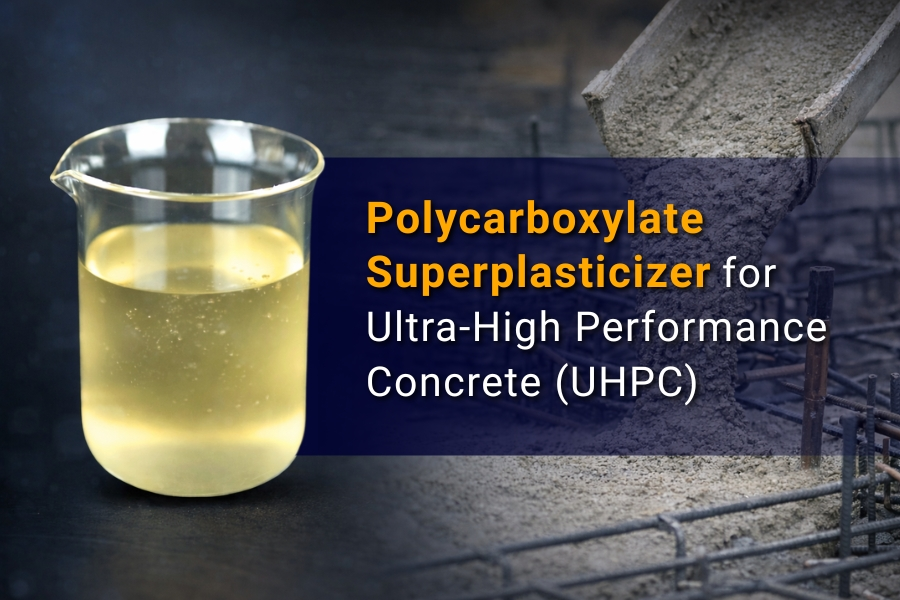
Because of this, Ultrahigh-Performance Concrete depends on advanced chemical admixtures, and the most important is Polycarboxylate Superplasticizer for Ultra High Performance Concrete!
In truth, this specialized admixture is what makes UHPC workable with such low amounts of water. If it were not present in the mix, the resulting mixture would be either too stiff, unmanageable, and/or unusable in real-world applications.
What Is Polycarboxylate Superplasticizer?
Polycarboxylate Superplasticizer (or Polycarsyl V) is considered a high-range water-reducing chemical admixture that relies on the use of advanced polymer technology. Unlike previous versions of chemical admixtures, this version operates by providing two methods of performance enhancement to the cement particles in UHPC:
1) The negatively charged polymer backbone provides an electrostatic repulsion between neighboring cement particles; and
2) The side chains of the polymer physically separate/position the cement particles.
This combination of mechanisms provides a highly efficient way of dispersing the cement particles, which results in superior UHPC performance using relatively small amounts of water.
Why UHPC Requires Polycarboxylate Superplasticizer?
UHPC is fundamentally different from conventional concrete.
A typical UHPC mix includes:
- High cement content.
- Silica fume (10–25%).
- Fine aggregates.
- Steel fibers.
- Extremely low water content.
These characteristics create several challenges:
- Very low water-binder ratio (0.14–0.20).
- High powder content.
- Poor natural flowability.
- Difficulty in fiber dispersion.
Without the Polycarboxylate Superplasticizer for Ultra-High Performance Concrete, the mix would be too stiff to handle.
PCE solves these issues by:
- Improving flow without adding water.
- Ensuring uniform particle dispersion.
- Supporting fiber distribution.
Technical Performance Characteristics
A quality Polycarboxylate Superplasticizer generally provides:
- Water reductions of 30% to 40% (typically 30% or greater).
- pH neutral (6.0~7.5).
- Low chloride content for durability.
- High solid content (more efficient).
All of these attributes are important to provide the consistencies needed to get UHPC to perform as specified.
Performance Benefits in UHPC:
1. High water reduction
PCE will provide the initial performance characteristics for Ultra-High Performance Concrete by allowing for a significant drop in total water content; therefore, providing:
- Lower porosity.
- Greater density.
- Increased compression strengths.
UHPC will achieve compressive strength of:
> 120 MPa or greater after 28 days.
> Higher than 120 MPa in optimized systems.
2. Excellent flowability and self-compacting
The low water content must allow UHPC to be workable.
PCE will provide:
- Smooth flow.
- Self-compacting characteristics.
- Reduced vibrations to achieve these characteristics.
This will be critical in complex molds, dense reinforcement areas, and precast concrete casting.
3. Outstanding slump retention
It is critical to maintain workability over time, especially during transportation and large-volume placements.
PCE will provide:
- Stable flow for extended periods of time.
- Reduced risk of segregation.
- Consistent performance for applications.
4. Enhanced strength development
PCE will provide enhanced particle dispersion, enabling better cement hydration.
This leads to:
- Higher early strength.
- Faster setting in controlled conditions.
- Improved long-term durability.
Compatibility with UHPC Components
A high-performance Polycarboxylate Superplasticizer for Ultra-High Performance Concrete must work seamlessly with various materials.
Compatible With:
- Cement types (OPC, low-alkali cement).
- Silica fume.
- Fly ash and slag.
- Steel and synthetic fibers.
Good compatibility ensures:
- Stable flow.
- No unwanted air entrainment.
- Consistent performance.
Recommended Dosage
Typical dosage ranges between:
0.15% to 0.35% of binder weight
However, the exact dosage depends on:
- Mix design.
- Material properties.
- Performance requirements.
Trial testing is essential to achieve optimal results.
Applications of UHPC with PCE
The use of Polycarboxylate Superplasticizer for Ultra-High Performance Concrete enables UHPC in a wide range of applications:
- Bridge structures
- Precast façade panels
- Marine construction
- Wind turbine components
- Railway infrastructure
Its ability to deliver high strength and durability makes it ideal for demanding environments.
Why Choose Sakshi Chem Sciences?
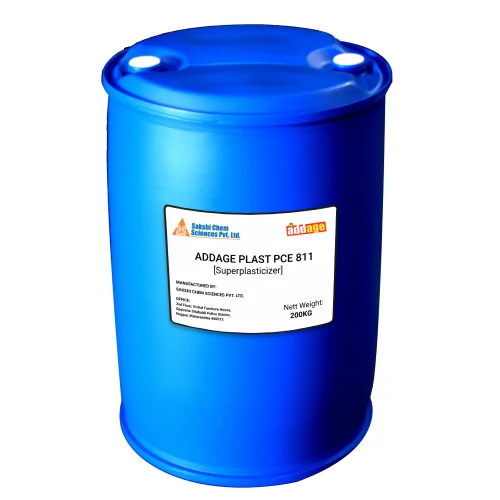
Sakshi Chem Sciences Pvt. Ltd. is a manufacturing company that specializes in high-quality and innovative construction chemicals. They have the experience, resources, staff, and network to provide reliable and effective solutions to their clients in the construction industry.
The strengths of Sakshi Chem Sciences Pvt. Ltd. include:
- 20yrs+ experience in the construction industry.
- R&D Facilities.
- Extensive range of products.
- Worldwide distribution capabilities.
Sakshi Chem Sciences Pvt. Ltd.’s solutions are designed to enhance the performance, cost, and longevity of products through the use of Polycarboxylate Superplasticizers (PCEs) in Ultra High Performance Concrete (UHPC).

Conclusion
Polycarboxylate Superplasticizers are critical components of what makes UHPC commercially viable, through providing:
- Reduced water use.
- EXCELLENT workability and form retention.
- Improved strength/durability.
- Easy to apply and compliant with the current industry standards.
Without the use of PCEs, producing a material that meets commercial expectations would not be possible.
Selecting a quality PCE and having a business relationship with a respected company like Sakshi Chem Sciences Pvt. Ltd. is very important to maintain high-performance standards and produce consistent results.
With all the advancements in construction technology, chemistry is the foundation upon which everything else works.

Sagar Telrandhe is a Construction Engineer with a B.Tech in Construction Engineering & Management. Passionate about infrastructure development, project planning, and sustainable construction, he specializes in modern construction techniques, project execution, and quality management, contributing to efficient and innovative building.