
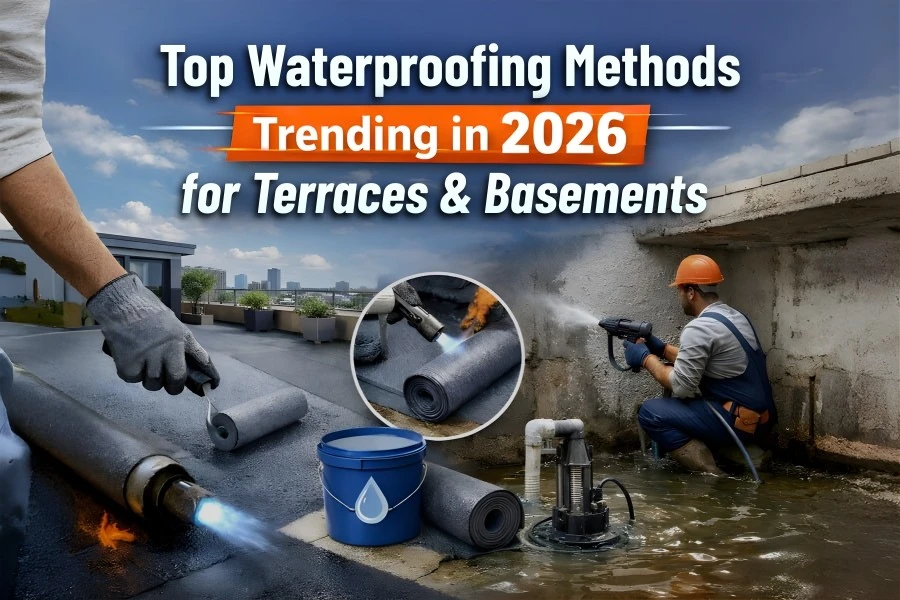
Waterproofing ceased to be an afterthought in construction at the end of an eventuality and, now in 2026, has turned into a core concept of design that materially influences the durability, security and longevity of structures.
We are experiencing increased climate change variability, increasing density in urban development and increased performance expectations all of which are dramatically impacting the rapid evolution of waterproofing systems.
Waterproofing systems have been focusing on two vulnerable areas – the terrace and the basement. Terraces are exposed to the sun, rain and thermal movement of the structure while basements are subject to moisture from soil, hydrostatic pressure from the ground and risk of long-term instances of dampness. Therefore, the first decision about the appropriate waterproofing approach is critical to avoid future failures.
This guide will introduce the Modern Waterproofing Methods that will dominate the Landscape of 2026 and highlight Modern Systems using a combination of tested methodologies and innovative technologies to create long-term waterproofing solutions. The guide will also discuss the importance of Integral Systems, Smart Materials and Hybrid Systems in the Future of Worldwide Waterproofing.
Table of Contents
Reasons waterproofing is now a design consideration in 2026:
Historically, waterproofing was a reactive approach to repair, after a problem has been identified; however, as of 2026, the approach to waterproofing is completely proactive, as follows:
- Repair costs are exponentially greater than preventative waterproofing.
- As the years progress, damage caused by water ingress will cause concrete and Rebar to become structurally compromised.
- Air quality in occupied spaces and the health and welfare of the occupants is affected by damp conditions.
- Sustainability goals demand longer-lasting structures.
- Regulatory standards increasingly emphasize durability.
Modern waterproofing methods focus not just on blocking water but on managing moisture intelligently throughout the structure’s life cycle.
Understanding Terrace & Basement Waterproofing Challenges
Terraces
- Constant exposure to UV radiation.
- Thermal expansion and contraction.
- Water ponding due to poor drainage.
- Micro-cracks caused by temperature variation.
Basements
- Continuous contact with moist soil.
- Hydrostatic water pressure.
- Capillary water movement through concrete.
- Limited access for future repairs.
Because the challenges are different, the waterproofing solution must be chosen accordingly.
1. Cementitious Waterproofing – Reinvented for 2026
Waterproofing Solutions with a Cementitious Base: The reason it’s gaining popularity in 2026
Cementitious waterproofing is one of the most widely used waterproofing systems and continues to be one of the most popular systems used for both internal and below-ground waterproofing application. However, the new formulations of cementitious waterproofing are now more technologically advanced than the traditional rigid cement coatings.
Popular Reasons for the Popularity of Cementitious Waterproofing in 2026.
Polymer modified to allow for more flexibility.
More compatibility with both concrete substrates and other integral waterproofing systems.
More Easy to apply compared to traditional cementitious waterproofing systems and materials.
The top three main applications for cementitious waterproofing would be:
- Waterproofing internal basement walls, (wet basement walls)
- Waterproofing of water tanks and sumps
- Waterproofing of lift pits
Modern-day cementitious waterproofing systems are more often utilizing integral water reducing admixtures, such as Addcrete, which substantially reduce the permeability of concrete from within, allowing the waterproofing system to last longer and be much more effective.
2. Bituminous Coating Waterproofing – Smarter & Safer
Bituminous coatings play an important role in protecting foundations and retaining walls. In 2026, there is a continued push for improved, safer, and more sustainable formulations of bituminous coatings.
The top three advancements for bituminous coatings for the market in 2026.
Adhesion to concrete and masonry surfaces has been improved as a result of improved elasticity.
Utilizing LO-VOC and eco-friendly formulations of bituminous coatings.
Understanding the locations where bituminous coatings can be used:
- 1. Exterior walls of a building
- 2. Exterior surfaces of a basement
- 3. Retaining Walls
In most of the market, bituminous coatings are often paired with multi-layered waterproofing systems, including protective cover boards and membranes.
Waterproofing Solutions with A Bitumen Based Membrane: The reason it’s gaining popularity in 2026
3. Bituminous Membrane Systems – Still a Terrace Favorite
Among the terrace waterproofing solutions, bituminous membranes continue to hold strong as being a trusted terrace waterproofing solution. Due to the durability of the products and their water resistance, they are ideal materials for installing flat roofs and podium slabs.
Why They’re Still Relevant?
- Excellent resistance to standing water
- High tensile strength
- Long service life
2026 Trend
Self-adhesive membranes are replacing torch-applied systems. They:
- Reduce fire hazards
- Speed up installation
- Improve consistency
These membranes are often paired with screeds containing waterproofing additives to create a double-protection system.
4. Liquid-Applied Waterproofing Membranes
Liquid membranes have gained massive popularity due to their seamless nature and adaptability.
What Makes Them Stand Out
- No joints or overlaps
- Excellent crack-bridging ability
- Easy application on complex geometries
Common Materials
- Acrylic-based
- Polyurethane-based
- Hybrid polymer systems
In 2026, liquid membranes enhanced with nano-additives and UV stabilizers are becoming standard for exposed terraces.
5. Polyurethane Waterproofing – High Performance for Exposed Areas
Polyurethane systems are among the most flexible waterproofing solutions available today.
Advantages
- High elasticity
- Strong adhesion to concrete, tiles, and metal
- Excellent resistance to weathering
Ideal For
- Terraces and balconies
- Roof gardens
- Podium slabs
Solvent-free polyurethane systems are trending in 2026 due to their environmental and safety benefits.
6. Crystalline Waterproofing: Internal Protection That Lasts
Crystalline waterproofing is transforming basement protection by working inside the concrete, not just on the surface.
How It Works?
- Reacts with moisture and cement compounds.
- Forms insoluble crystals inside capillaries.
- Blocks water pathways permanently.
Why It’s a 2026 Favorite?
- Self-healing of micro-cracks
- Effective against positive and negative water pressure
- Becomes part of the concrete itself
Crystalline systems are often used alongside integral admixtures like Addcrete for comprehensive basement waterproofing.
7. Injection Grouting – Precision Waterproofing for Repairs
Injection grouting remains an essential method, especially for existing structures.
Applications
- Active water leaks
- Construction joints
- Expansion joints
- Basement wall cracks
2026 Innovation
Water-reactive grouts that expand on contact with moisture are becoming more common, reducing future leakage risks.
8. Integral Waterproofing Systems – Building Waterproof Concrete
When preparing to pour concrete, Integral waterproofing compounds are added directly into the concrete mix.
- Importance of Integral Waterproofing Compounds.
- It Provides a consistent level of protection across the entire concrete mass.
- It Reduces the amount of capillary action that can occur.
- Results In Reducing Long-term Maintenance Costs.
Today, most companies use modern integral systems for their waterproofing applications (including Addcrete), which include them for the following typical applications:
- Basements
- Roof Slabs
- Water-Storing Structures
In 2026, nano-engineered integral additives will also help to improve compressive strength as well as waterproofing performance.

9. Hybrid Waterproofing Systems – Multiple Layers of Protection
Not every risk associated with waterproofing can be handled with only one system. This is why hybrid waterproofing systems are gaining in popularity for 2026.
- Typical Combinations of Systems.
- Crystalline + Membrane for Basements.
- Liquid Membrane + Screed Waterproofing for Terraces.
- Integral Admixture + Surface Coating.
Hybrid systems provide redundancy in that if a hybrid system fails at one point, other protection layers are present to continue to protect the structure from damaging moisture.
10. Spray-Applied Waterproofing Systems
Spray-applied elastomeric and polyurea-based coatings are becoming increasingly popular for large-scale projects due to their many benefits.
Benefits of Spray-Applied Waterproofing Systems Include:
- Very Fast Application
- Seamless Finish
- Exceptional Abrasion and Chemical Resistance
Application of Spray-Applied Waterproofing Systems are Ideal for:
- Industrial Roofs
- Large Terraces
- Infrastructure Projects
The speed of applying these types of coatings combined with their ability to cure quickly makes them ideal for construction projects on aggressive deadlines.
11. Sheet Membrane Waterproofing – Precision & Longevity
Sheet-based waterproofing using synthetic membranes is widely adopted in 2026 for critical applications.
Key Materials:
- PVC
- EPDM
- HDPE
Advantages:
- Factory-controlled thickness.
- High puncture resistance.
- Long service life.
Heat-welded joints ensure superior water tightness compared to adhesive-based systems.
12. Green Roof Waterproofing Systems
With sustainability at the forefront, green roofs are becoming common in modern developments.
Waterproofing Requirements:
- Root-resistant membranes.
- High durability under soil load.
- Long-term moisture resistance.
Advanced waterproofing systems now support both vegetation and structural protection without compromise.
13. Smart Waterproofing Technologies
The integration of technology into construction has introduced intelligent waterproofing systems.
Emerging Features
- Moisture-sensing layers.
- Self-healing polymers.
- Reflective waterproof coatings.
These systems help detect and address issues before visible damage occurs.
Terrace vs Basement Waterproofing: Why the Approach Must Be Different
Despite the fact that both basements and terraces are located on the ground and are at risk of sustaining water and moisture damage, the way in which each area is impacted by water pressure or the amount of pressure placed upon it varies tremendously. Therefore, waterproofing methods that will be in vogue in 2026, focus on providing specific area solutions, as opposed to applying a “one size fits all” solution.
Terrace Waterproofing Challenges
Terraces experience:
- Rainfall and the possibility of Water Stagnation.
- Consistent exposure to Ultraviolet (UV) Radiation.
- Thermal Expansion and Contraction.
- Movement of the Structure creating Cracking.
Due to these four challenges, as the terrace ages, numerous things occur:
- Cracking appears on the surface of the terrace.
- The Waterproofing Layer Degrades.
- Leaks into Ceilings.
These are the reasons why a Waterproofing System, in 2026, must provide a Flexibility and Resistance to Ultraviolet Radiation.
Basement Waterproofing Challenges
Basements are exposed to:
- Constant Groundwater Pressure.
- Lateral and upward Seepage.
- Moisture through Capillaries.
- Hydrostatic Pressure Buildup.
Even small imperfections in the basement waterproofing can lead to:
- Constant Moisture.
- Weakening the Structure.
- Mold Growth and Poor Indoor Air Quality.
As a result, Internal Waterproofing Methods, such as Crystalline Systems and Integral Admixtures, are trending heavily for basements.
Single Layer Waterproofing Methods: No Longer Enough
Among the most significant changes to the Waterproofing Methods trending in 2026 is the shift away from a Single-Layer Waterproofing Method.
Why the Shift?
Because buildings are at risk of:
- Longer Monsoon Cycles.
- Dramatic Fluctuation of Temperatures.
- Increasing levels of Groundwater.
- Expectations to Last for Longer Service Lives.
The 2026 Solution: Layered Protection
Modern waterproofing now follows a multi-defense approach, such as:
- Integral waterproofing compounds inside concrete.
- Flexible membranes on exposed surfaces.
- Protective screeds or coatings on top.
This layered approach ensures:
- Redundancy in protection.
- Longer waterproofing lifespan.
- Reduced failure risk.
Admixtures like Addcrete play a key role here by improving concrete density, reducing water permeability, and supporting external waterproofing systems
Role of Concrete Quality in Waterproofing Performance
Waterproofing failure often begins inside the concrete, not on the surface.
Poor-quality concrete leads to:
- Excessive capillary pores.
- Shrinkage cracks.
- Weak bonding with membranes.
Why 2026 Waterproofing Focuses on Concrete Chemistry?
Modern waterproofing strategies start with:
- Optimized water–cement ratio.
- Proper compaction
- Performance-enhancing admixture.
Concrete-enhancing solutions such as Addcrete help:
- Improve workability without adding water.
- Reduce bleeding and segregation.
- Enhance long-term durability.
How Additives Support Waterproofing Performance?
Additives are no longer optional in modern construction.
Benefits of Performance Additives
- Reduced permeability.
- Improved cohesion.
- Better compatibility with waterproofing layers.
Products such as Addcrete help create concrete that:
- Resists water migration.
- Bonds better with membranes.
- Performs reliably under varying conditions.
This makes additives a silent but essential part of waterproofing systems trending in 2026.
How to Choose the Right Waterproofing Method in 2026?
Selecting the right waterproofing solution depends on:
- Type of structure.
- Exposure conditions.
- Expected lifespan.
- Maintenance accessibility.
- Budget vs long-term value.
For example:
- Terraces benefit from flexible membranes.
- Basements require internal and external protection.
- High-risk zones demand hybrid systems.
Expert guidance ensures the system performs as intended.
Why Sakshi Chem Sciences Leads the Waterproofing Evolution?
With decades of experience, Sakshi Chem Sciences continues to support the construction industry with advanced waterproofing chemicals and admixture solutions. Backed by strong R&D, global quality standards, and technical expertise, the company focuses on durability, innovation, and cost-effective performance.
From integral systems like Addcrete to advanced waterproofing solutions, Sakshi Chem Sciences helps builders create structures that are resilient, future-ready, and built to last.
Conclusion
The Waterproofing Methods Trending in 2026 reflect a shift toward smarter, more integrated, and more durable protection strategies. Waterproofing is no longer just about stopping leaks, it is about extending structural life, improving sustainability, and reducing long-term costs.
For terraces and basements alike, modern solutions such as crystalline systems, liquid membranes, hybrid waterproofing, and integral admixtures are setting new benchmarks. With the right materials, expert application, and forward-thinking design, waterproofing in 2026 ensures buildings remain safe, strong, and reliable for decades to come.

Sagar Telrandhe is a Construction Engineer with a B.Tech in Construction Engineering & Management. Passionate about infrastructure development, project planning, and sustainable construction, he specializes in modern construction techniques, project execution, and quality management, contributing to efficient and innovative building.