
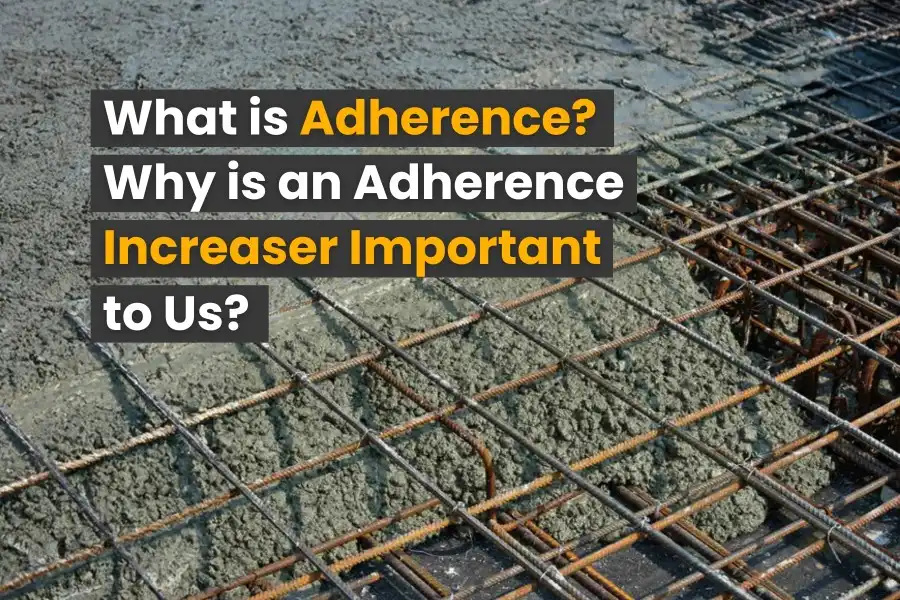
The strength derived from concrete and steel is not enough to call a structure strong; it has to do with how well these two materials work together. It is at this point (the point of bonding) that the importance of the word Adherence becomes evident.
Construction professionals frequently use the term, but a common question asked by many individuals outside of this industry is, “What is adherence, and how does it affect the success of my construction project?”
Table of Contents
Adherence is an invisible force in determining the performance of structures over time and under various types of stress. In this blog, we will define what adherence is, how it functions, and the importance of adherence increasers for modern construction methods.
What is Adherence?
To understand what is meant by adherence, one should think about it in the simplest possible way. Adherence describes the bond that forms between two dissimilar materials and allows two different types of materials to act as a single structural system.
In the case of reinforced concrete structures, adherence would refer to the bond that develops between:
- Concretes and steel reinforcements.
- Cement paste to aggregate.
- Old concrete to new repair mortar.
- Decks to finishing membranes such as plaster or screeds.
For example, concrete exhibits excellent compressive strength yet has very low tensile strength. Conversely, steel reinforcements demonstrate excellent tensile strength.
Adherence allows these two materials to grip each other firmly, transferring stress and load effectively. Without proper adherence, reinforced concrete would not function as a single structural unit.
Why Adherence Is Critical in Reinforced Concrete Structures?
Reinforced Concrete relies on maximum coordination achieved by 2 Materials:
1. Reinforcement and
2. Concrete itself.
if loads apply to the structure, the stress must be efficiently transferred from concrete to the reinforcement (or vice versa). This only occurs if the 2 materials are bonded well. Low Bonding will result in:
1. Steel slipping inside concrete.
2. Cracking before expected.
3. Load capacity is being reduced.
4. The structure will not perform as intended.
In Seismic Zones, or High-Load Structures, the importance of proper bond increases because these structures must:
- Absorb energy.
- Deform without failure.
- Distribute forces evenly throughout the structure.
Proper bonding will provide the flexibility, strength, and longevity required to perform adequately in these situations.
What are Adherence Increasers?
An Adherence Increaser may be a construction chemical or process used to increase the Bonding Strength achieved between 2 different types of Materials.
If Natural Bonding, along with proper curing, is not enough to provide the required performance, then an adherence increaser will be needed for the Material’s desired result.
Adherence Increasers are used in many ways, such as:
1. Repairs (of Concrete).
2. Plastering/Screeding.
3. Strengthening Concrete.
4. Waterproofing.
5. Bonding Old to New Concrete.
Using an Adherence Increaser increases interaction at the sub-microscopic level, which increases grip, removes slippage, and increases longevity.
Why are Adherence Increasers Important?
Adherence is critical to the longevity and safety of a structure. Poor adherence (i.e. to bad quality Materials) can cause a failure at an early age, regardless of how good the quality of the materials was.
- Improve load transfer between materials.
- Reduce the risk of delamination and cracking.
- Enhance resistance to vibration and movement.
- Increase the reliability of repairs and overlays.
- Ensure long-term performance in aggressive environments.
In modern construction, where faster execution, thinner layers, and high-performance materials are common, adherence increasers are no longer optional; they are essential.
Common Methods Used to Increase Adherence
In construction, several different techniques can be implemented to support enhanced adherence, and multiple methods may be used at the same time:
1. Use of Ribbed Reinforcement
Ribbed steel bars provide a greater mechanical bond between concrete and steel reinforcing bars. This leads to enhanced mechanical interlocking; therefore, ribbed steel reinforcing bars provide an improved mechanical bond when compared to standard smooth reinforcing bars.
2) Higher Strength Concrete
When using higher-strength (reinforced) concretes (typically with higher quality or density), the paste used in the concrete adheres better to the reinforcing bars.
3.)Transverse Reinforcement
Using stirrups and ties to confine the concrete will provide the best overall bonding characteristics of the concrete.
4) Additives That Increase Adherence
Adhesive increasing additives are by far the most effective and flexible method of increasing adhesion between two surfaces. They are most beneficial when used as part of the repair, plastering and bonding processes.
Advantages of Adhesive Increasing Additives
Modern adhesive increasing additives are formulated with added functionality that goes beyond adhesion:
1) Strong adhesion between old and new materials.
2) Greater waterproofing characteristics.
3) Reduced shrinkage and cracking of the adhesive.
4) Increased mechanical strength.
5) Increased resistance to moisture, salts, and chemicals.
6) Faster application with lower labor costs.
7) Consistent results across many different site conditions.
Proper Application of Adhesive Increasing Additives
It is not enough to just select an adhesive increasing additive; the proper application of the selected product will lead to a more successful outcome.
Preparation of Surfaces Prior to Application of Adhesive Increasing Additive
1) All dust, oils, grease, rust and loose particles must be removed.
2) All surfaces should be thoroughly cleaned.
3) Wet concrete surfaces before application with an additive. Do not leave standing water on the surface.
Application of Adhesive Increasing Additive To Concrete Surfaces
Bonding Layer Treatment- The bonding layer of most adhesive increasing additives is applied (typically as a thin bonding layer) via brush, roller or spray.
Repair mortar or plaster is applied while the bonding layer is still tacky.
Application on Steel Reinforcement
Steel surfaces must be cleaned and treated before applying adherence-enhancing coatings to improve corrosion resistance and bonding with concrete.
Proper application ensures that the bonding layer performs as intended and delivers long-term durability.
Adherence and Long-Term Structural Safety
For the duration of their existence, all structures are subjected to a variety of stressors, load changes, temperature changes, moisture, vibrations, and environmental attacks.
The higher the adherence, the more likely it is that all components will behave in concert with one another, rather than independently.
When an element has been mechanically bonded correctly:
- All loads are evenly distributed.
- Cracking can be controlled.
- Structural behaviour will be predictable.
- The cost of maintenance will be lower.
It is for these reasons that adherence is considered one of the fundamental components of durable construction.
Sakshi Chem Sciences & Advanced Construction Bonding
Sakshi Chem Sciences has more than 20 years’ experience in producing high-performance bonding and durability by creating innovative chemical solutions for the construction industry.
By combining modern manufacturing technologies with an extensive knowledge base of chemical formulas and processes, the company produces high-performance bonding and durability products that need fewer repairs and have longer life spans in many environments.
Sakshi Chem Sciences produces high-performance adhesive systems that allow for the bonding of materials and create long-term performance characteristics when used in construction.
Conclusion
The understanding of what adherence means is a prerequisite to understanding why some structures remain standing while others do not. Adherence provides a foundation of stability, flexibility, and endurance to a structure, and it is these three characteristics that create the strength of a building.
The development of products that will increase adherence is one of the most important contributions to the continuing evolution of modern construction.
Whether in new construction, repairs, or rehabilitation works, proper adherence is the foundation of long-lasting structures.
With the right materials, correct application, and advanced construction chemicals, adherence becomes a powerful tool that transforms individual components into resilient, high-performance structures built to last.

Sagar Telrandhe is a Construction Engineer with a B.Tech in Construction Engineering & Management. Passionate about infrastructure development, project planning, and sustainable construction, he specializes in modern construction techniques, project execution, and quality management, contributing to efficient and innovative building.