
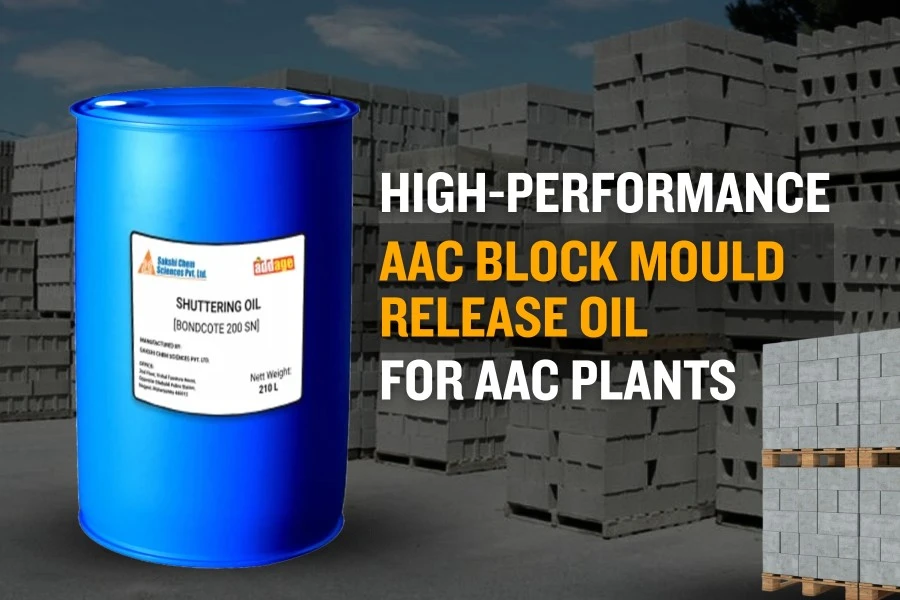
Introduction: The Importance of High-Performance AAC Mould Oils
Advanced, lightweight products made from AAC (Autoclaved Aerated Concrete) have revolutionised the way we build, offering thermal insulation as well as quick installation times.
Therefore, the production of AAC blocks requires a complete manufacturing process that includes all aspects designed to create a successful shuttering system.
One important aspect that is often ignored but plays a significant role in the quality control process for making AAC blocks is a properly manufactured autoclave-based complete mould release oil, which supports the manufacturing of an AAC block.
Table of Contents
Moulds in an AAC plant go through continuous cycles of casting, cutting, and de-moulding; if the mould release oil does not work effectively, then AAC blocks will stick to the surfaces of the mould, resulting in surface defects, delays in production, damage to the mould, and higher costs for maintaining the mould.
High-performance mould release oils can facilitate the de-moulding process, protect the surfaces of the moulds, and thus provide uninterrupted production.
In addition to providing high-performance mould release oils to meet the rigours of AAC manufacturing, Sakshi Chemical Sciences develops its high-performance mould release oils to ensure quality, reliability and dependability over time for the operability of AAC facilities.
Main Types of Mould Release Oils for the Manufacture of AAC Blocks
Different AAC manufacturing plants work under different operational conditions, use different materials for the manufacture of their moulds and employ different moulding cycles; therefore, there are several different formulations of mould release oils available.
The selection of the type of mould release oil chosen for a specific application directly affects the quality of the AAC block, the life of the mould, and the efficiency of the AAC manufacturing process.
1. Water-Based Mould Release Oil
Water-based mould release oils are widely used in AAC plants where environmental safety and cleanliness are priorities.
Key Characteristics:
- Emulsified oil dispersed in water.
- Easy to apply through spraying systems.
- Lower oil consumption compared to pure oil.
Advantages:
- Reduced surface staining on AAC blocks.
- Cleaner working environment.
- Lower VOC emissions.
- Cost-effective for large-scale operations.
Water-based AAC Block Mould Release Oil is ideal for AAC plants looking to balance performance with environmental responsibility.
2. Solvent-Based Mould Release Oil
Mould release oils based on solvents are formulated with fast-evaporating solvents for quick release.
The main features include:
fast evaporation of solvents, formation of a thin, consistent film for the release of the part, and suitability for high-speed production.
The advantages:
such as rapid drying time, good release characteristics for complicated mould shapes, and reduced stickiness in moulds when cured at high temperatures, are offset by the fact that the use of solvents requires the control of their use and proper ventilation, which limits their use to manufacturing facilities that have a proper safety program in place.
3. Mineral Oil–Based Release Oil
The mineral oil mould release oils represent the early days of manufacturing AAC.
The main features of mineral oils include:
Petroleum-based, high lubricity, and good release characteristics, as well as compatibility with the use of oiled and bare steel moulds.
The advantages of mineral-based mould release oils are:
Very high release ability, long-lasting lubricity, and the ability to prolong the life of the mould.
Mineral oil-based mould release oils are typically recommended for manufacturing facilities that use a large number of moulds with long manufacturing cycles.
4. Semi-Synthetic Release Oil
Semi-synthetic mould release oils combine the performance benefits of mineral oils with additional synthetics.
Key Characteristics:
Increasing the strength of the film created during release, increasing the thermal stability of the release oil, and improving the consistency of the release characteristics (film consistency) throughout the manufacturing process.
The advantages of semi-synthetic mould release oils include:
lower use of oil, better cleanliness of moulds after processing, and a better balance of cost versus performance.
This type of mould release oil is the best option for manufacturing AAC products that desire to increase efficiency without having to rely solely on fully synthetic mould release oils.
5. Synthetic / High-Performance Release Oil
Synthetic mould release oils represent the highest performance category for AAC manufacturing.
Key Characteristics:
- Advanced synthetic base oils.
- Stable at high temperatures.
- Uniform molecular structure.
Advantages:
- Exceptional release even under extreme conditions.
- Minimal residue on blocks and moulds.
- Extended mould life.
- Consistent performance over long production runs.
For high-capacity AAC plants, synthetic AAC Block Mould Release Oil delivers superior operational reliability and long-term cost savings.
6. Bio-Degradable Release Oil
Sustainability is now a vital part of manufacturing. Biodegradable mould release oils will become more popular as they support sustainability.
What are these biodegradable releases?
Biodegradable mould release oils are made from renewable materials. The environmental impact of using them is greatly reduced when compared to traditional options, and they are safer for workers and manufacturers, etc.
Key Characteristics:
- Derived from renewable resources.
- Low environmental impact.
- Safer for operators.
Benefits of using biodegradable mould release oils:
They create a smaller environmental footprint, they are easier to dispose of because they break down faster than non-biodegradable options, and they are compliant with green manufacturing standards.
Biodegradable grain products can also be used in AAC facilities that do not want to sacrifice their release efficiency.
Sakshi Chem Sciences – Mould Release Oils for AAC Facilities
Sakshi Chem Sciences supplies a complete line of mould release oils designed for usage in AAC facilities, resulting from extensive R&D and practical industrial evaluations.
ADDAGE BONDCOTE 200S
This is a high-quality mould release oil, providing excellent lubricity for smooth demoulding and an even surface finish, producing very little sticking of the mould, and preserving the integrity of the mould throughout multiple cycles.


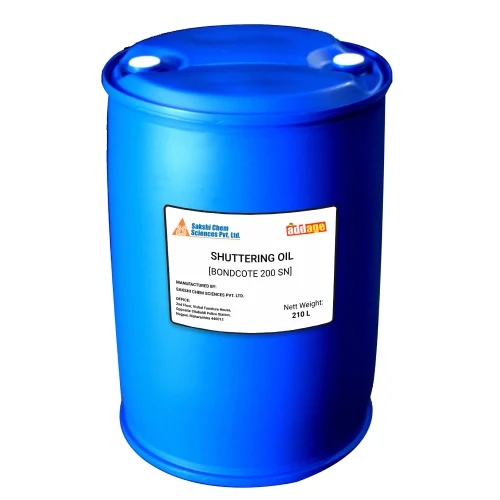
ADDAGE BONDCOTE 200SN
This is a new and improved formulation that enhances thermal stability, maintains uniform film/forming characteristics. It is designed for use in AAC facilities that operate under very high temperatures and pressures.
ADDAGE BONDCOTE 900 ASO (Pure Oil)
This product is a completely pure oil-based mould release solution. It has been formulated to hold up under the most demanding conditions of heavy-duty usage in the AAC industry. The product provides excellent lubricity and outstanding release characteristics and extends the service life of moulds.

ADDAGE SHUTTER GREASE
This product has been formulated specifically for use between the joints, edges and various components of the mould. It prevents binding, decreases wear and provides smooth movement of the mould.
ADDAGE BONDCOTE 300 W
ADDAGE BONDCOTE 300 W is an easy-to-use, water-based mould release oil that helps to improve the health and safety of workers. With ADDAGE BONDCOTE 300 W, users will have a cleaner than ever demoulding experience and significantly decrease their use of oils and chemical products for work-related purposes in all types of production environments, while providing a more eco-friendly alternative.


ADDAGE BONDCOTE 800 F (Fiber Mould)
BONDCOTE 800 F (Fibre Mould) is designed for use with fibre moulds and provides an effective solution for achieving clean release, lowering fibre adhesion, and producing uniform block surfaces.
Each of the ADDAGE BONDCOTE products has been tested to provide repeatable results. In addition, each will provide reliable performance with minimal downtime and maintenance and production losses during use.

Why Industries Trust Sakshi Chem Sciences for Oils & Release Agents?
AAC Block Manufacturers across India and the World rely on Sakshi Chem Sciences because of its performance-based on Expertise.
The Distinguishing Features of Sakshi Chem Sciences Include:
- Decades of Experience in Construction Chemicals.
- Leading Edge Research & Development And Quality Controls.
- Products Designed Conforming To Actual Plant Conditions.
- Consistent Performance From Lot-to-Lot.
- Strong Technical Support And Guidance.
- Established Export Capabilities Throughout Many Regions Of The World.
Sakshi Chem Sciences provides information to AAC block manufacturers with the development of application-specific formulations so that every AAC block mould release oil will produce measurable increases in the productivity and quality of AAC block production.
Conclusion
The importance of mould release oil in the manufacturing of AAC blocks is essential because efficiency and consistency can’t be compromised.
The use of a good quality AAC block mould release oil is vital for the ease of demoulding of now stocks, the protection of moulds, the quality of the surface finish and eliminating production delays.
Water-based, mineral oils, synthetic oils, biodegradable oils, etc., all can impact plant performance and profitability by selecting the appropriate mould release oil.
Sakshi Chem Sciences offers the best possible mould release agents to AAC facilities and is committed to the continuous development and improvement of advanced technologies to provide AAC facilities with reliable, efficient, and future-proof solutions.
The selection of a quality mould release oil represents a process decision as well as a long-term investment for all aspects of quality, efficiency, and excellence in operations.

Sagar Telrandhe is a Construction Engineer with a B.Tech in Construction Engineering & Management. Passionate about infrastructure development, project planning, and sustainable construction, he specializes in modern construction techniques, project execution, and quality management, contributing to efficient and innovative building.