
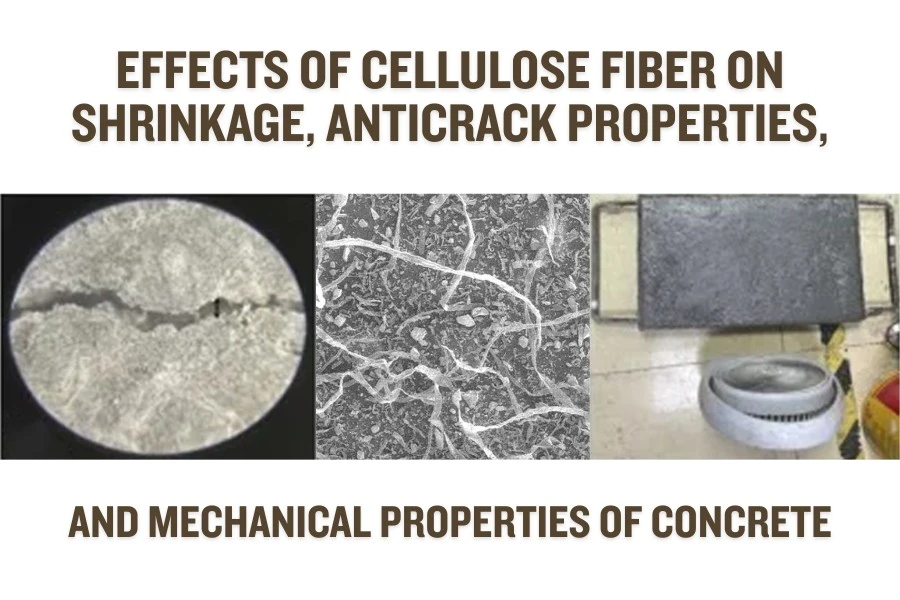
Concrete has been utilized as a major construction material due to its durability and adaptability; however, the challenge of shrinkage continues to be a significant problem for the concrete industry.
When concrete dries and hydrates, the moisture evaporates, resulting in a reduction in dimensions. This volume loss of concrete causes the formation of micro cracks that will ultimately decrease mechanical strength, durability and service life.
Table of Contents
Green building materials such as cellulose fiber will provide Architects, building material designers and manufacturers and Concrete Chemistry Companies with a tool to prevent shrinkage, aid in the control of cracking and improve structural performance.
Cellulose fiber is a superior natural material that is biodegradable, environmentally friendly, cost-effective and may be used in conjunction with cementitious building products.
In this article we provide a clear understanding of how cellulose fibers can have an impact on shrinkage, anti-cracking and mechanical properties of concrete.
Why Shrinkage Happens in Concrete?
To understand the role of cellulose fiber, it helps to know why shrinkage occurs:
1. Drying Shrinkage
Drying Shrinkage of concrete occurs as moisture evaporates from concrete surfaces causing capillary tension to create contraction of concrete.
2. Autogenous Shrinkage
Autogenous Shrinkage occurs due to the hydration of concrete and the transfer of water within the concrete to the rate of chemical reaction by low amount of liquid.
3. Thermal Shrinkage
Temperature fluctuations cause expansion and contraction, weakening the internal structure.
4. Plastic Shrinkage
Occurs within the first few hours after pouring due to rapid evaporation of surface moisture.
These shrinkage mechanisms lead to internal microcracks, which eventually join and expand, compromising the concrete’s long-term strength and durability.
Role of Cellulose Fiber in Concrete
Cellulose fibers are fibers made from plant materials and are also available in recycled products. Due to their structure, low weight, and water-absorptive properties, they work very well with cement composites.
Cellulose fiber has several properties that enhance the way concrete behaves as an additive, including:
- Water absorption and retention.
- Good dispersibility.
- Small size structure that gives it a good ability to blend with cement.
- Ability to store water as a “reservoir” for internal curing.
- Ability to act like natural crack-bridging properties.
Because of all these properties, cellulose fibers can enhance the performance and resistance to shrinkage of concrete and improve the ductility of concrete and its mechanical properties.
Influence of Cellulose Fiber on Shrinkage of Concrete
1. Decreased drying shrinkage
The major way cellulose fibers reduce drying shrinkage is by absorbing and slowly releasing water from within their structure over time.
In effect, cellulose fibers act as an internal curing system for concrete by retaining moisture within the fiber until it eventually evaporates, providing a means to slow down the drying of the concrete.
Some Benefits of this property are:
- Decreased internal stress.
- Fewer microvoids due to loss of water.
- More uniform hydration process.
- More stable form over time.
Studies show that cellulose fibers added at even low dosages significantly reduce drying shrinkage when compared to concrete without cellulose fibers.
2. Decreased autogenous shrinkage
High-performance concrete can have significant challenges associated with autogenous shrinkage due to its high-density microstructure. Adding cellulose fibers to concrete reduces the amount of autogenous shrinking in high-performance concrete, as they:
- Retaining internal moisture.
- Providing a gradual release during hydration.
- Maintaining internal humidity at early curing stages.
This results in fewer early-age microcracks and improved long-term durability.
3. Reduction in Thermal Shrinkage and Temperature Cracking
Concrete structures exposed to fluctuating temperatures experience cyclic expansion and contraction. Cellulose fibers help moderate these effects by:
- Improving ductility.
- Increasing toughness.
- Offering micro-reinforcement that accommodates expansion.
In most cases, Cellulose Fiber Modified Concrete is most suitable for use in pavements as well as Industrial Floors and Precast Elements.
Anti-Crack Properties of Cellulose Fiber
The anti-cracking properties associated with incorporating cellulose fiber into concrete are one of its main benefits.
1) Cellulose Fiber Crack Bridging Mechanism
The cellulose fiber creates a physical barrier within the cement matrix. As a result, when a crack begins to form in the concrete, cellulose fiber does three things for the concrete:
- Holds the faces of a crack together.
- Distributes the stress of the crack over a wider area.
- Prevents the crack from deepening, or expanding.
By utilising cellulose fiber within the cement matrix, the resistance of concrete to plastic, drying or thermal crack formation is greatly increased.
2) Increased Post-Peak Ductility
Traditional concrete is very brittle. Once concrete reaches its maximum strength, its failure will occur instantaneously. With the incorporation of cellulose fibre into concrete, the failure behaviour of concrete changes from instantaneous to gradual (i.e., ductile):
- Cracks develop slowly and do not occur instantaneously.
- Ductility itself increases.
- Concrete will remain intact during deformation until it yields.
The gradual failure reaction of concrete with cellulose fibre is important to consider when designing for vibration, impact, and/or structural movement.
3) Self-Healing Capability Enhancements
Because cellulose fiber retains moisture, it increases the amount of water available to rehydrate dormant cement particles. Therefore, when cracks form in the concrete, the cellulose fibre is able to provide additional moisture to unhydrated cement particles.
The effect of additional moisture allows dormant cement particles to react and eventually seal micro-cracks in the concrete.
Through the use of cellulose fibre in concrete to create self-healing capability, the overall:
- Durability.
- Water repellency and
- Performance of the structure will be improved in the long term.
Effects on Mechanical Properties of Concrete
Cellulose fibers not only reduce shrinkage and cracking—they also influence the mechanical performance of concrete in meaningful ways.
1. Compressive Strength
While cellulose fiber may slightly reduce compressive strength at very high dosages, optimized inclusion often results in:
- A denser microstructure.
- Better hydration.
- Reduced crack propagation.
This leads to improved long-term compressive strength stability.
2. Flexural Strength
Flexural strength greatly improves due to the fiber’s reinforcement effect. The fibers create a multi-directional support system within the matrix, helping the concrete resist bending stresses.
3. Tensile Strength
Cellulose fibers act as micro-reinforcement, creating a network that distributes tensile loads across the structure.
This results in:
- Higher tensile capacity.
- Improved load-bearing ability.
- Delayed crack initiation.
4. Fracture Toughness
Due to their ability to absorb and distribute the energy that would normally result in brittle failure, cellulose fibers provide a significant increase in fracture toughness.
As such, the presence of cellulose fiber in concrete makes it more efffective than other fibres for:
- Higher resistance to crack propagation
- Controlled Crack Width
- A Longer Life Span Under Load


Why Cellulose Fiber Is a Sustainable Choice?
The use of cellulose fiber represents a more environmentally friendly option in an ever-increasingly environmentally sustainable world, as it is:
• 100% Biodegradable.
• Has a low carbon footprint.
• Comes from renewable resources.
• Is safe for both the workers handling it and the end-users.
Unlike some steel and synthetic fibre materials, cellulose fibre will not rust, produce toxic chemicals, or have other disposal-related issues associated with them.
Applications of Cellulose Fiber-Modified Concrete
Because of its shrinkage control and anti-cracking benefits, cellulose fiber is now used in:
• Industrial flooring
• Precast Concrete
• Industrial Flooring
• Wall Putty and Skim Coats
• Repair Mortars
• Renders and Plasters
• High Performance Mortar Systems
• Pavement Slabs
• Shotcrete
Cellulose fibre is an increasingly important component of Dry-Mix Mortars and construction products, providing many benefits to manufacturers and consumers alike.
Conclusion
The positive effects of cellulose fibre on the shrinkage control of modern-day concrete technology will help provide stability to concrete structures through reduced drying, autogenous and thermal shrinkages; therefore, making them more durable.
Its natural ability to hold moisture, bridge microcracks, improve hydration, and enhance toughness makes it one of the most effective additives for sustainable and high-performance concrete.
At Sakshi Chem Sciences, we continue to support innovation in construction materials with additives that offer reliability, durability, and eco-friendly benefits. As construction practices evolve, cellulose fiber will play an even bigger role in shaping stronger, greener concrete solutions.

Sagar Telrandhe is a Construction Engineer with a B.Tech in Construction Engineering & Management. Passionate about infrastructure development, project planning, and sustainable construction, he specializes in modern construction techniques, project execution, and quality management, contributing to efficient and innovative building.