
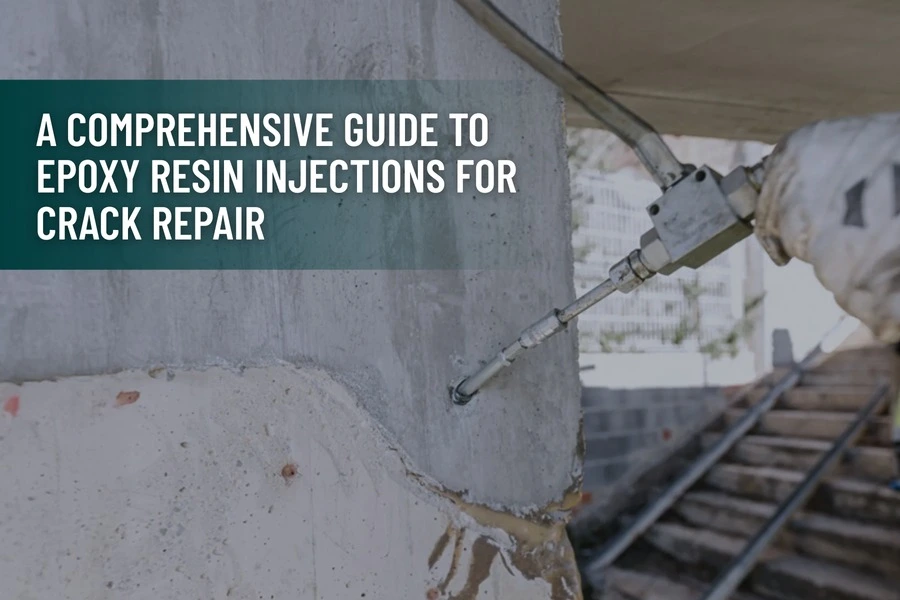
Concrete is a very sought after reliable resource in the building construction industry. The negative aspect of Concrete as it pertains to Building Construction is that although it is a resource that has rightly established itself as an established building block of many types of buildings, it does have limitations as it relates to its stress, movement and environmental impact.
Table of Contents
No matter how well Concrete is manufactured, given enough time, you will have cracks in your Concrete Floors, Beams, Columns, Slabs and Structural Walls. If left untreated, these cracks allow environmental elements, chemicals and weight to continue stressing the structure, causing weakening and ultimately disintegration.
Sakshi Chem Sciences develops and manufactures high performance epoxy resins with an emphasis on deep penetration, long bonding life and incredible bond strength that are engineered to be used for the Repair of Concrete.
This repair of concrete with epoxy resin injection guide covers all aspects of the Epoxy Resin Injection process and will provide Contractors, Engineers and Industrial Users with Basic, Practical Information regarding how the Epoxy Resin Injection process is executed and when to use it for the repair of concrete.
What is Epoxy Resin Injection?
Epoxy Resin Injection is a specialised injection method designed to restore concrete’s Structural Strength and Stability due to the existence of cracks. The injection of Epoxy Resin is performed by injecting a Low Viscosity, two-component epoxy into the cracks, voids and separations of the Concrete.
Once the injected Epoxy resin cures, it transforms into a Hard, high-bonding cohesive building material which will:
- Reconnect cracked Concrete
- Restore the original load-carrying Capacity of Concrete
- Prevent crack migration
- Forms a barrier to the infiltration of moisture and chemicals
- Increase the lifespan of Concrete.
Unlike surface repairs, which only mask the problem, epoxy injections address the issue from within.
Why Epoxy Resins? What Makes Them Ideal for Structural Repair?
The injection of epoxy is not the same as standard adhesives. Epoxies are specially formulated materials and have high tensile and compressive strength, excellent bonding properties to concrete, steel, and masonry, resistance to chemicals, oils, and moisture, minimal shrinkage, and will maintain stability over time under load and vibration.
These attributes make epoxy resin injections suitable for use in high-stress environments, including power plants, heavy machinery foundations, bridges, tunnel systems, and marine applications.
Sakshi Chem Sciences also has a strict quality control process in place to produce consistent results for its epoxy resins, regardless of the type of repair that is needed.
How is Epoxy Injection Applied?
The following outlines the procedure in lay terms:
1. Locate and Evaluate the Crack
Before any injection, the type of crack needs to be determined by answering the following questions:
Is the crack structural or superficial?
Is the crack still growing?
Is the crack caused by an external force (i.e., load, vibration, heat, or shrinkage) or from wear?
Only dormant or stable structural cracks are eligible for epoxy injection.
2. Cleaning the Crack Surface
The surfaces of each side of the crack must be thoroughly cleaned of any dirt, grease, or loose particles. Contamination prevents resins from properly bonding.
3. Placement of Injection Ports
Injection ports or small nipple-like tips will be installed at designated intervals along the crack. These serve as entry points for the epoxy resin.
4. Sealing the Surface
Using quick-setting epoxy putty, the surface of the crack is sealed off to retain injected resin within the structure instead of spilling it out onto the outside.
As the epoxy system cures and the crack becomes a single solid structure, the ports will be removed and the surface refined.
The advantages of using Epoxy Resin Injectors (also known as Structural Repair) are:
1. Restores Original Strength
When the epoxy-bonded cracks are repaired, they regain a significant amount of the original structural capacity. Often, the repaired area will actually be stronger than the surrounding areas.
2. Prevents Moisture & Chemical Penetration
For many industries, moisture, oil, and/or chemicals can weaken a structure’s integrity. By sealing the crack with epoxy, moisture, oil and/or chemicals cannot penetrate through the cracks and affect the integrity of the structure.
3. Reduces Downtime
Often, epoxy cures in less than 24 hours, which means that there will be minimal downtime.
4. Cost Savings
Compared to demolition and replacement of damaged concrete, the cost of injections is extremely low.
5. Penetration Depth
Because the epoxy resins used in Epoxy Resin Injection are low viscosity, they are able to penetrate even very small hairline cracks, thereby ensuring that the cracks are thoroughly sealed.
6. Long-Term Durability
Once cured, epoxy resins remain stable under load, temperature changes, and vibration.
Where Epoxy Resin Injections Are Most Effective?
Different types of projects make use of epoxy injection, including infrastructure, commercial and industrial projects. Typical uses include:
1. Structural Concrete Cracks – Cracks that occur in slabs, columns, shear walls, beams, and foundations
2. Foundations of Machines and Equipment – Industry that has heavy machinery experiences cracks or voids caused by vibration beneath base plates.
3. Bridges and Flyovers – When injected into cracks on these structures, injection can help prevent moisture or corrosion from entering through cracks.
4. Basement Walls and Retaining Walls – Injection helps to both restore the structural stability of the wall and prevent seepage through the wall.
5. Industrial Flooring – The types of flooring designed to handle dynamic loads caused by forklifts and exposure to chemicals will eventually develop cracks; epoxy is an excellent material for sealing cracks.
It’s important to understand when you should not be using epoxy injections, even with all its benefits.
It’s important to avoid epoxy injections if:
- A crack is an active crack and continuing to grow wider.
- Ongoing structural movement is present.
- Flexibility is needed rather than rigidness in construction.
- Heavy water flowing through a crack is present (polyurethane foaming grouts may be a better option).
Understanding how a crack behaves is a key factor in selecting the most appropriate method for repairing it.
The guidelines listed below should help to ensure that the repair will last as long as possible.
1. Select The Appropriate Viscosity Of The Resin
Hairline cracks require very low viscosity; wider cracks will have a thicker grade of viscosity.
2. Maintain Proper Mixing Proportions
If the resin is mixed improperly, the curing performance and strength of the resin will be compromised.
3. Control the Injection Pressure
Too much pressure can widen the crack or cause hidden blowouts.
4. Apply in Suitable Temperatures
Epoxy curing time varies with temperature; extreme cold or heat must be managed.
5. Follow Industry Standards
ASTM C881 or equivalent standards ensure safe and reliable application.
How Sakshi Chem Sciences Supports Reliable Crack Repair?
Having manufactured premium quality construction chemicals for decades, we have developed a series of Epoxy Resins made for:
- Highly penetrative.
- Excellent bond strength.
- Both Chemical & Moisture Resistance.
- A Long-Lasting Structural Reinforcement.
Our state-of-the-art R&D facility allows us to test each batch of epoxy resin against the highest global performance standards, thereby ensuring that Sakshi Chem Sciences is known as a partner of choice among contractors, Engineers and Developers throughout the Infrastructure Industry.
In summary:
Although concrete may crack over time, structural failure does not have to occur.
With guides to the injection of epoxy resins, engineers and contractors possess the knowledge required to accurately restore the strength, safety and durability of concrete structures.
Therefore, the injection of epoxy resins represents not just a repair solution; it signifies an investment in the long-term integrity of the structure.
With the use of Sakshi Chem Sciences high-quality epoxy resins, you can rest assured that all repairs will be performed with reliability, durability and longevity.

Sagar Telrandhe is a Construction Engineer with a B.Tech in Construction Engineering & Management. Passionate about infrastructure development, project planning, and sustainable construction, he specializes in modern construction techniques, project execution, and quality management, contributing to efficient and innovative building.