
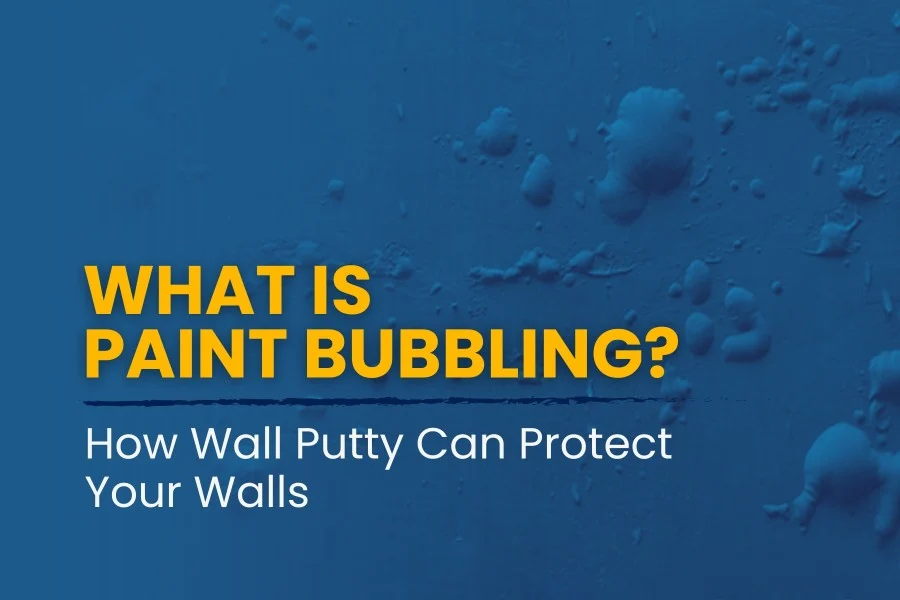
Walls are usually one of the first things that people see when they enter a home, office, or commercial building. Having clean, smooth, and newly painted walls can dramatically change the feeling of the entire space.
What about when those walls start creating ugly bubbles under the paint? For many a homeowner, that’s called beautiful paint bubbling.
Table of Contents
Paint bubbling can ruin the appearance of your interiors as well as indicate more serious issues with your wall surface or the way the painting was done. If not taken care of, bubbling can lead to potential peeling, dampness, cracks, and expensive repairs.
The correct type of construction solutions, such as high-quality wall putty and an advanced additive like Hydrophobic RD Powder, will prevent these issues from occurring, thus ensuring a durable surface finish.
Sakshi Chem Sciences Pvt. Ltd. has more than 20 years of experience in the manufacturing of innovative construction chemicals that are both affordable as well as perform excellently.
In this blog, we will discuss exactly what paint bubbling is, the causes of it, and how wall putty can help to protect your walls from it.
What is Paint Bubbling?
Otherwise known as blistering, paint bubbling occurs when air, water, or contaminants become trapped under the surface of the paint.
The trapped moisture pushes the film of paint to expand outward, creating raised blisters or bubbles on the wall. It often shows up as:
- Small or large raised locations on walls.
- Bumpy textures that ruin the paint finish.
- Soft bubbles that may peel or crack if pressed on.
If left unattended, bubbling gets worse with time and may eventually cause the paint film to peel and crack, leaving a plaster or cement substrate that was originally protected from moisture exposed.
Common Causes of Paint Bubbling
In order to resolve the issue, it’s necessary to understand the cause of the problem and what contributes to paint bubbling. Here are the major causes of paint bubbling:
1. Moisture Issues
Moisture is the number one cause of bubbling. Walls where a leak or seepage is damp, allow water to move behind the paint film when it gets behind the paint film and, allows it to dry, when evaporation occurs, and blisters form.
2. Poor Surface Preparation
Any wall or ceiling that the paint is applied to should be clean, dry, and free of grease, dirt, or dust. If not, paint cannot adhere to the substrate properly, causing a weak bond. Over time, the bond weakens enough that bubbling occurs.
3. Failing to Apply Primer
Primer acts as a bonding film between the wall surface and the paint. The paint does not have much to hold onto if the wall surface is not primed; therefore, it increases the risk of bubbling.
4. Painting over Wet Walls
Moisture gets trapped when paint is applied over wet plaster or cement that the painter didn’t allow to dry properly. Meanwhile, as the surface dries, the moisture gets trapped, and it finds an exit, which bubbles or blisters during the process of drying.
5. Extreme Temperatures
When painting during very hot or humid weather, your paint can dry too quickly on the top, leading to solvents being trapped on the bottom and causing bubbling.
6. Incompatible Layers of Paint
Placing an oil-based paint over a latex paint (or vice versa) without proper preparation can weaken adhesion, leading to bubbling when using a wall putty.
How Wall Putty Helps with Paint Bubbling?
This is where wall putty comes in as a lifesaver. Wall putty will be a base layer that you will apply underneath the finish coat of paint. It smoothes out unevenness in the surface and fills in minor cracks in the surface, and aids in better adhesion between the paint and the wall surface.
1. Provides a Smooth, Stable Base
Wall putty smoothes out imperfections, ensuring that the paint sits uniformly on the wall surface, limiting the air pockets that can become bubbles.
2. Moisture Blockage
High-quality wall putty, when coupled with additives like Hydrophobic RD Powder, will provide the walls with a water-resistant barrier to prevent moisture from penetrating it, and thus get trapped under the paint layer.
3. Improves Adhesion of the Paint
Putty will add strength to bonding the paint and minimize the chances of blistering/peeling.
4. Extends Life of the Paint
Putty provides a strong foundation between the wall and the paint, enabling it to outperform expectations for a longer length of time, while looking good.
5. Cost-Effective Protection
Although applying putty may feel like an extra step, it ultimately saves money by reducing the frequency of repainting that occurs as a result of bubbling.
The Role of Hydrophobic RD Powder in Preventing Paint Bubbling
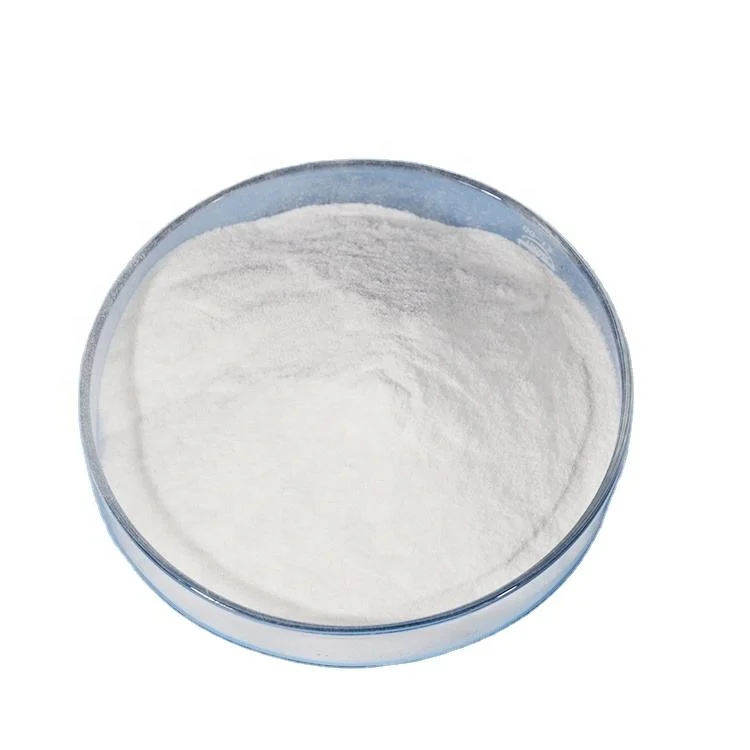
At Sakshi Chem Sciences, we are focused on higher-level solutions such as Hydrophobic RD Powder, which is more advanced (as an additive) and is used in wall putty formulations.
When mixed with wall putty, Hydrophobic RD Powder repels water molecules from even getting to the wall surface to penetrate and cause dampness.
It improves the flexibility and the bond strength of the wall putty.
It helps to make the impacts of water penetration potentially less disruptive. Cracking, peeling, and blistering are all reduced.
Reduces the physical barrier to the workability of the masons, allowing them to do the work more easily.
By adding Hydrophobic RD Powder, you can be sure (with putty applied to the walls) that they are getting that extra layer of protection to the walls, which is one of the greatest contributors to paint bubbling, moisture.

Useful Tips to Reduce the Potential of Paint Bubbling
Even with wall putty, you can take some steps to better ensure paint bubbling doesn’t occur with your result:
- Thoroughly wash the walls before applying primer and paint.
- Look for leaks or seepage before you paint and repair leaks.
- Use a primer to create a strong bond between the putty and the paint.
- Avoid painting in extreme weather, too hot or too humid.
- When stirring the paint, do it slowly to avoid creating air bubbles in the paint itself.
- Allow walls to dry completely before applying any paint coats.
Why Choose Sakshi Chem Sciences for Wall Putty & Additives?
At Sakshi Chem Sciences Pvt. Ltd., we have established the trust of the construction industry over the past twenty years. Here are the reasons why customers choose us:
Industry’s largest portfolio – Over 50 different construction chemical solutions.
Internationally export-ready – Clients in the Middle East, Africa, Europe, and Southeast Asia.
Advanced R&D lab – Ongoing research and development work, to ensure continuous innovation.
Cost-effective solutions – Highest quality for every project at the right price.
Expert help and support – A team of construction professionals that supports you at each step.
When it comes to paint bubbling with respect to protecting the walls from soaking through, we have an advanced wall putty which contains Hydrophobic RD Powder as a reliable, durable, and cost-effective solution.
Conclusion
Paint bubbling is not only unsightly, but it also signals that your walls are not protected. Regardless of whether paint bubbling is caused by moisture, lack of surface preparation, or omission of primer, it is a problem that can be proven by taking the correct action.
Applying high-quality wall putty with Hydrophobic RD Powder will prevent bubbling by providing smooth walls, strong adhesion of paint to the surface, and a long-lasting appearance.
At Sakshi Chem Sciences Pvt. Ltd., we believe it is our duty to provide builders, contractors, and homeowners with advanced construction chemicals that will make all structures more durable and visually appealing.
Choose the right foundation today, and say goodbye to bubbling walls tomorrow.
Frequently Asked Questions (FAQs)
1. What is paint bubbling?
Paint bubbling is a raised blister on painted walls, caused by trapped air or moisture or contaminants trapped under the paint film.
2. Can wall putty prevent paint bubbling?
Yes, wall putty can prevent paint bubbling by providing a smoother base, allowing the paint to dry at its lowest possible point, preventing moisture from seeping into the wall through abrasion, and providing better adhesion for the paint.
3. How does Hydrophobic RD Powder create a benefit with wall putty?
Hydrophobic RD Powder repels moisture, makes flexure better, creates stronger bonding, and protects walls from bubbling and dampness.
4. Do I need to use primer if I used wall putty?
Yes, primer is still recommended. Primer provides a stronger bond between the wall putty and paint.
5. Is it possible to fix paint bubbling without repainting?
Minor bubbling can be sanded & touched up, while larger or severe bubbling usually requires scraping, repainting the putty, and repainting the whole wall.
6. Does the weather affect paint bubbling?
Yes. Painting in an extremely hot and humid atmosphere can result in paint bubbling due to drying incorrectly.
7. How long does wall putty take to dry before I paint?
Wall putty usually takes 6 – 8 hours per coat to dry. It is recommended you wait 24 hours before painting for final drying.
8. Is wall putty waterproof?
Regular wall putty is not fully waterproof, but when enhanced with additives like Hydrophobic RD Powder, it offers excellent moisture resistance.

Sandip Agrawal, Polymer Engineer and MD of Sakshi Chem Sciences Pvt. Ltd., leads innovation in construction chemicals, shuttering oils, and industrial lubricants. With expertise in polymer science and eco-friendly solutions, he drives R&D and sustainable advancements, ensuring high-performance products for India and global markets.